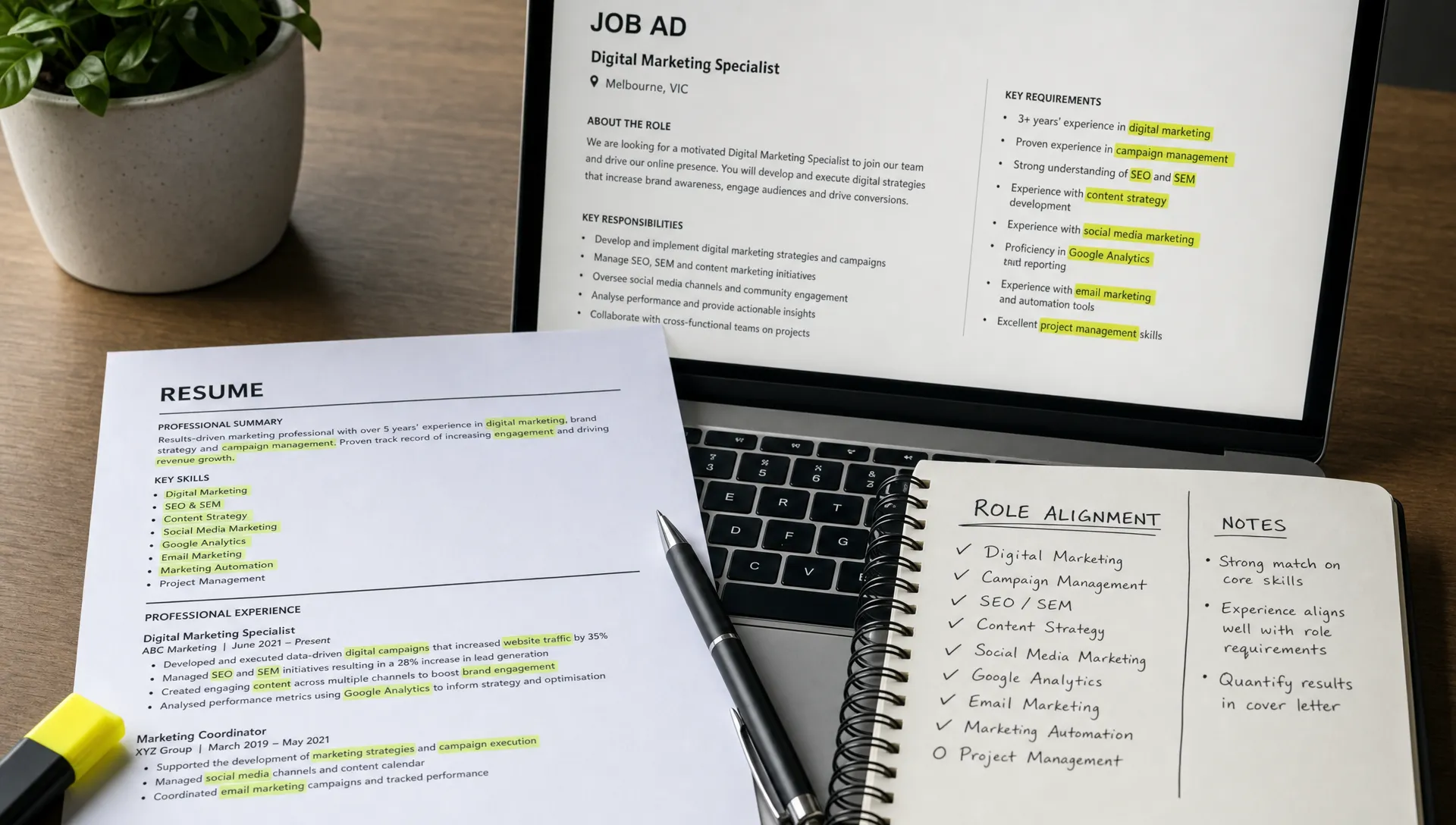
If you have ever wondered whether a cover letter is just a longer resume, you are not alone. The cover letter vs resume question comes up constantly because both documents sit in the same application, share some of the same facts, and are often submitted together.
But they do very different jobs.
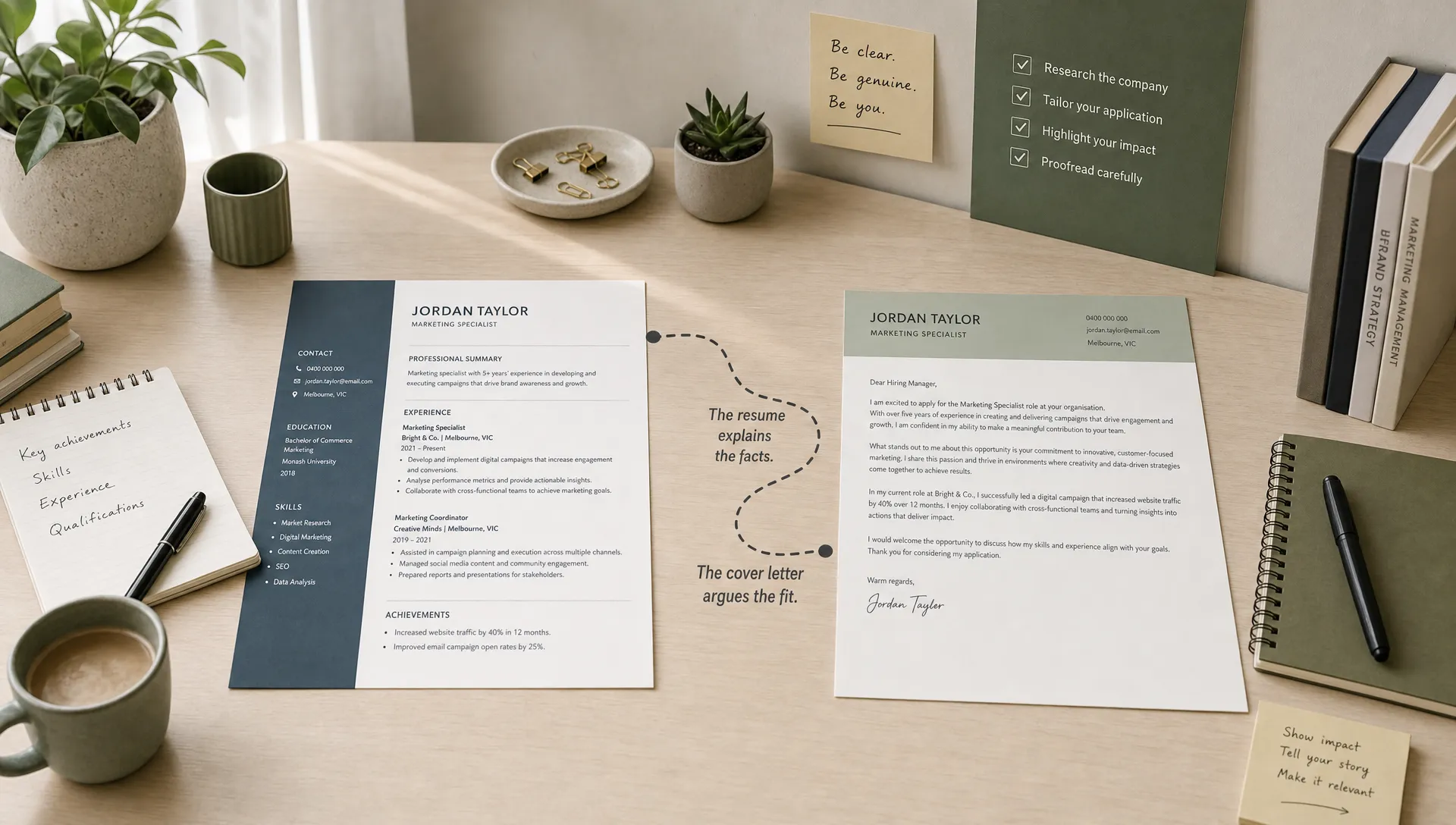
Your resume is the evidence. It shows what you have done, where you have done it, what skills you bring, and whether your background matches the role. Your cover letter is the argument. It explains why those facts matter for this employer, this role, and this moment in your career.
When you understand the difference, your application becomes sharper. You stop repeating yourself, you make it easier for employers to see your fit, and you avoid sending a generic package that sounds like it could go to any company.
Quick answer: the real difference between a cover letter and a resume
A resume is a structured summary of your qualifications. A cover letter is a tailored message that connects your qualifications to a specific role.
Think of your resume as a shortlist document. It helps a recruiter or hiring manager decide whether you meet the baseline requirements.
Think of your cover letter as a positioning document. It helps them understand how to interpret your background, especially when your fit is not immediately obvious.
What a resume really does
A resume is designed for fast evaluation. Employers are usually looking for signals, not a life story. They want to see whether your background aligns with the role, whether your skills are credible, and whether your experience is recent, relevant, and easy to understand.
In Australia, a resume is usually more detailed than a one-page snapshot, but it still needs discipline. For many students, graduates, and early-career professionals, one to two pages is enough. More experienced candidates may need more space, but length should come from relevance, not padding.
A resume turns experience into evidence
The strongest resumes do not simply say what you were responsible for. They show what changed because of your contribution.
A weak resume bullet says: Responsible for customer service.
A stronger version says: Resolved customer enquiries in a high-volume retail environment while maintaining accurate product and payment information.
An even stronger version, if true, adds a result: Resolved 40+ customer enquiries per shift in a high-volume retail environment while maintaining accurate product and payment information.
The point is not to invent impressive numbers. The point is to make your experience concrete. Employers should be able to see the skill, context, and value in each bullet.
A resume helps employers compare candidates
A resume also creates comparability. Recruiters often review many applications for the same role, so they need a consistent way to compare education, work history, technical skills, achievements, and role alignment.
This is why structure matters. Clear headings, consistent dates, readable formatting, and role-relevant language all make your resume easier to assess. If an employer uses an applicant tracking system (ATS), simple formatting and relevant wording can also help your application be parsed accurately.
ATS-ready does not mean stuffing your resume with keywords. It means using clear language that reflects the role description and presenting your information in a way that both software and humans can read.
What a cover letter really does
A cover letter gives you room to explain what a resume cannot easily show. It can highlight motivation, judgement, communication style, and the reason your experience fits the employer’s needs.
This is especially useful when your career story needs interpretation. Maybe you are moving from hospitality into administration. Maybe you are a graduate with strong project experience but limited paid experience. Maybe you have transferable skills from volunteering, sport, placements, or casual work. Your resume can list those experiences, but your cover letter can connect the dots.
A cover letter explains why this role
A good cover letter should make the employer feel that you understand the job. It should not sound like a template with the company name swapped in.
Instead of saying, I am passionate about your organisation and believe I am a great fit, explain the link between your background and the role’s priorities.
For example: Your focus on client onboarding is what drew me to this role. In my university consulting project, I worked with a local business to map customer pain points and turn them into a simple onboarding guide, which helped me build the communication and problem-solving skills this position calls for.
That sentence does more than express interest. It shows awareness, relevance, and evidence.
A cover letter gives context without overexplaining
There are moments when a resume alone may raise questions. A career change, a short role, a study-to-work transition, or a non-linear path can all make sense with the right framing.
The cover letter is where you can explain that framing briefly and confidently. You do not need to apologise for your background. You need to show the employer how your experience transfers.
For students and graduates, this might mean translating group projects, internships, volunteering, part-time work, and leadership roles into workplace skills. For career changers, it might mean showing continuity between past achievements and the new role’s requirements.
How employers read both documents
Every employer reads applications differently. Some recruiters look at the resume first and only open the cover letter for shortlisted candidates. Some hiring managers read the cover letter early to assess motivation and communication. Some roles ask for a cover letter because writing quality is part of the job.
This means your resume must stand on its own. If the cover letter is never read, the resume still needs to prove your fit.
But your cover letter should also stand on its own. If it is read first, it should quickly establish who you are, why you are applying, and what evidence makes you relevant.
The two documents should support each other without duplicating each other. Your resume provides the facts. Your cover letter selects the most important facts and explains their meaning.
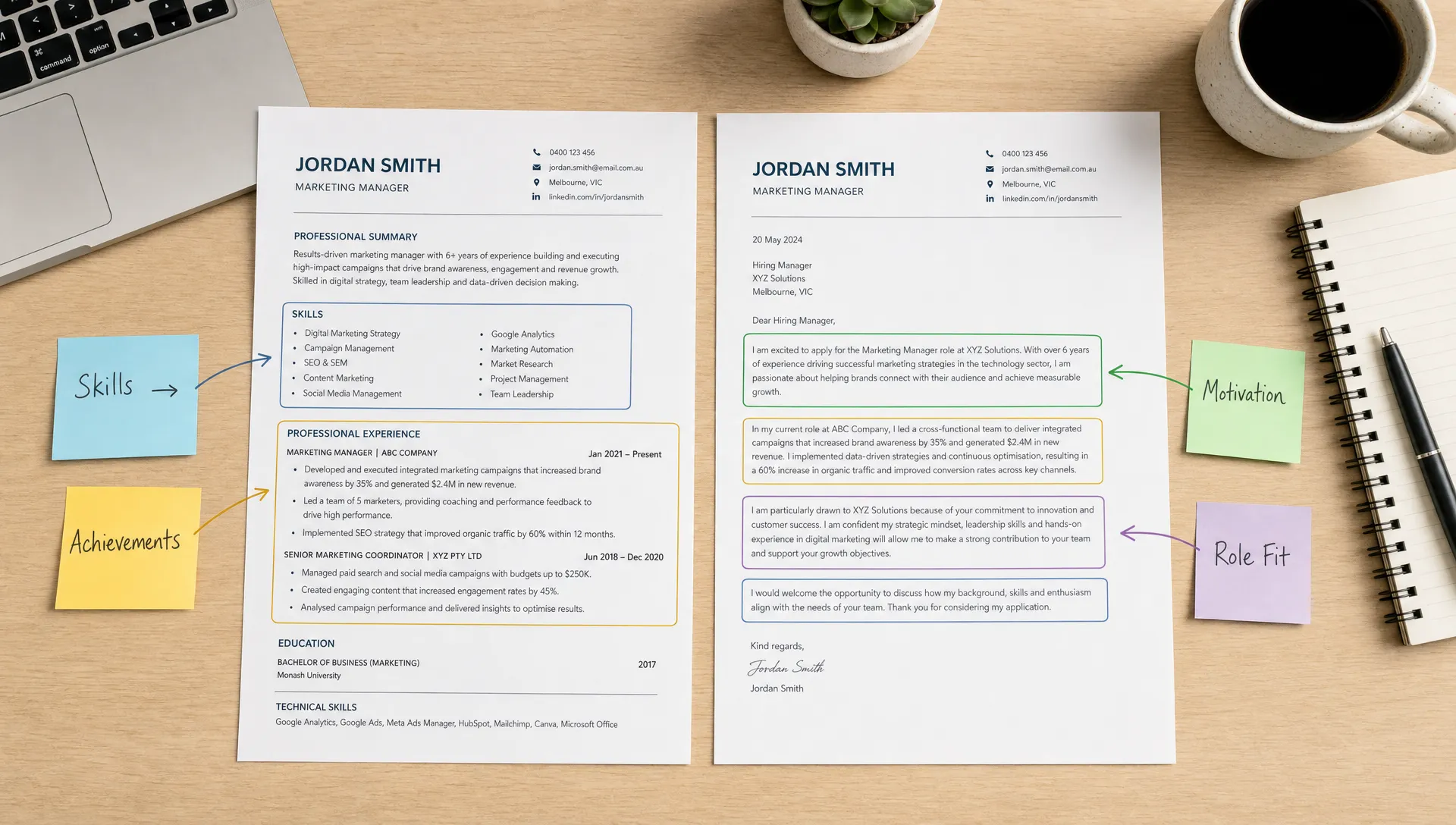
A practical example: the same experience, used differently
Imagine you are applying for a graduate marketing assistant role. The job ad mentions social media support, customer research, and teamwork.
The resume version is specific and factual. The cover letter version is interpretive and persuasive.
Neither one is better. They are doing different jobs.
When your cover letter matters most
A cover letter is especially valuable when the employer needs more than a list of credentials to understand your fit.
It matters most when you are changing careers, applying for your first professional role, moving industries, returning after a break, or applying for a role where communication is central. It also matters when the job ad specifically asks for one. If an employer requests a cover letter and you skip it, you may look careless before they even assess your experience.
A tailored cover letter can also help when your resume is close but not perfect. For example, you may not have the exact job title they requested, but you might have strong transferable experience. Your cover letter can make that case directly.
There is also a human element. Hiring is not only about credentials. Employers want to know whether you understand the work, communicate clearly, and have thought carefully about the opportunity. A cover letter can show that.
When your resume carries most of the weight
Your resume carries the most weight when the role has clear technical requirements, mandatory qualifications, licence requirements, or high-volume screening. In those situations, employers may first check whether you meet the essential criteria.
For example, a role might require a specific degree, software skill, certification, or work right. If that information is buried or missing from your resume, a strong cover letter may not save the application.
Your resume also matters most when your experience is highly relevant and easy to verify. If you have already performed a similar role, your resume should make that obvious quickly.
This is why the best applications do not treat the cover letter as a rescue document. A cover letter can strengthen your positioning, but it should not compensate for a vague or unfocused resume.
Common mistakes that blur the line
Many applications fail because the resume and cover letter try to do the same thing. The result is repetition, wasted space, and a weaker overall impression.
The cliché problem is especially common for students and early-career applicants. Instead of saying you are a team player, show where that skill came from. Group assignments, casual jobs, sport, volunteering, and community work can all provide strong evidence when framed properly. Versadox explores this idea further in its guide to how everyday socialisation can build your best resume.
How to make your resume and cover letter work together
Start with the job ad, not with your existing documents. The role description tells you what the employer cares about. Your job is to decide which parts of your background best match those priorities.
A useful approach is to build your resume first, then write the cover letter. The resume gives you the evidence base. The cover letter helps you choose the most relevant evidence and turn it into a clear message.
Before you apply, read both documents together. If the cover letter simply repeats the resume, rewrite it. If the resume lacks the evidence mentioned in the cover letter, strengthen it. If both documents feel like they could be sent to any employer, tailor them again.
Advice for students, graduates, and career changers
If you are early in your career, the cover letter vs resume distinction is even more important. You may not have years of directly relevant experience, so you need to use both documents strategically.
Your resume should organise your evidence. Include education, projects, placements, part-time work, volunteering, leadership, technical skills, and achievements where relevant. Do not minimise casual work. Retail, hospitality, tutoring, community service, and university societies can all demonstrate communication, reliability, problem-solving, and teamwork.
Your cover letter should translate that evidence. It can explain why a class project is relevant to a marketing role, why customer-facing work matters for client service, or why your previous industry gives you useful insight into a new field.
For career changers, the key is to avoid making the employer do all the translation. If you are moving from teaching to learning design, from retail to operations, or from healthcare to administration, your resume should highlight transferable skills and your cover letter should explain the logic of the move.
Your broader professional reputation also matters. Employers may form impressions through referrals, past colleagues, online presence, and informal networks. That is why your application documents should align with how you show up professionally. Versadox discusses this broader hiring reality in its article on your reputation as a second resume.
A simple quality check before you apply
Before submitting, ask yourself five questions.
If you answer no to any of these, your application probably needs more work before it is sent.
This is where a career intelligence approach can help. With Versadox, job seekers can build resumes and cover letters, compare their application against real roles, identify gaps, and use readiness scoring and guided improvements before applying. Instead of guessing whether your documents are strong enough, you can review how well they align with the role you want.
Frequently Asked Questions
Is a cover letter the same as a resume? No. A resume summarises your skills, experience, education, and achievements. A cover letter explains why those details make you a strong fit for a specific role and employer.
Do employers still read cover letters in Australia? Some do and some do not, but a tailored cover letter can still help, especially when the role asks for one, when communication matters, or when your career story needs context.
Should I include a cover letter if it is optional? Usually, yes, if you can make it specific and useful. A generic cover letter may not help, but a concise letter that adds motivation, context, and relevant examples can strengthen your application.
Can my cover letter repeat my resume? It can refer to the same experience, but it should not simply repeat it. Use the cover letter to explain why your most relevant achievements matter for the role.
Which should I write first, the resume or the cover letter? Start with the job ad, then tailor your resume, then write the cover letter. This helps you base your letter on real evidence rather than broad claims.
Apply with documents that work together
Your resume and cover letter should not compete. They should create one clear message: you understand the role, you have relevant evidence, and you can explain your fit with confidence.
If you want to strengthen both before applying, Versadox can help you build, compare, and improve your application against real roles so you know where you stand before you submit.
The Perfect Time is a Myth: The Unfiltered Truth About Career Moves
Waiting for perfect economic conditions is a complete myth. Use this data-driven, four-step strategic blueprint to confidently design and execute your next massive career pivot.





.svg)