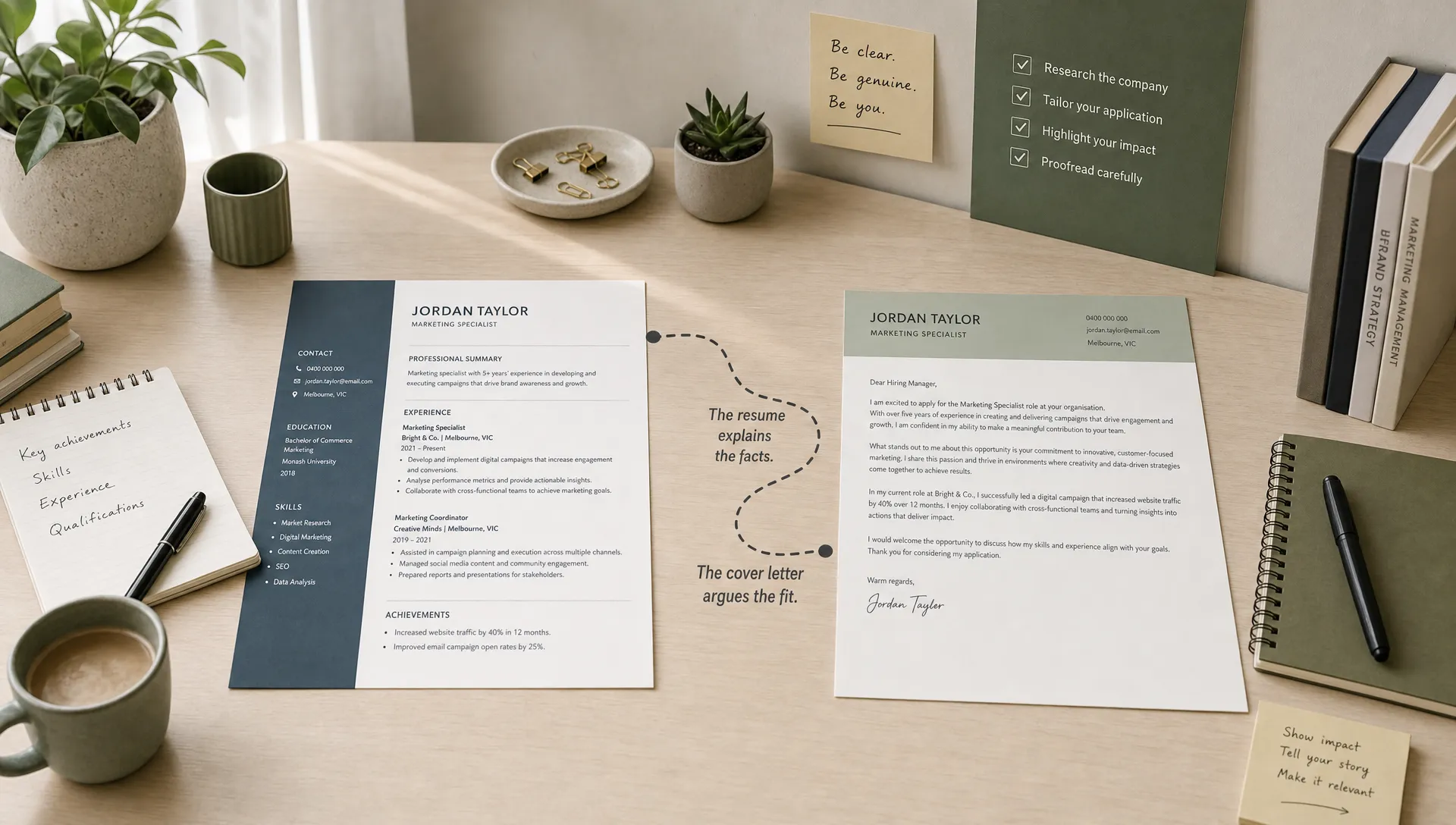
Most job seekers do not need to work harder. They need a smarter application strategy.
When you are trying to work out how to get a job faster, it is tempting to measure progress by volume: more job boards checked, more resumes sent, more late-night applications submitted. But speed does not come from sending the same resume to every role. It comes from making each application easier for a recruiter, hiring manager, or applicant tracking system to understand.
A smarter application does three things clearly. It shows why you match the role, proves that match with specific evidence, and removes doubts before the employer has time to form them. That is what helps you move from “submitted” to “shortlisted” more often.
Below is a practical framework for applying faster without becoming careless, especially if you are a student, recent graduate, early-career candidate, or career changer trying to compete in a crowded Australian job market.
Why more applications can actually slow you down
A high-volume job hunt feels productive because it creates activity. The problem is that hiring teams do not reward activity. They reward relevance.
If your resume does not quickly connect your experience to the job ad, it can be filtered out before a person spends meaningful time on it. Even when a human does read it, a generic application forces them to do the work of translating your background into their needs. Most will not do that work for you.
This is why job seekers often feel stuck after sending dozens of applications with no reply. The issue is not always that you are unqualified. It may be that your application is not making your fit obvious enough. If you want a deeper look at why silence is so common, Versadox has explored the maths behind why job seekers get ghosted.
The smarter approach is not to apply to fewer jobs for the sake of it. It is to apply to better-matched roles with stronger evidence, cleaner formatting, and clearer positioning. That is how you increase your odds without burning out.
Start with role clarity, not resume editing
Most people begin by polishing their resume. That is understandable, but it is not the best first step.
Before editing a document, decide what type of role you are trying to win. A resume for a customer service graduate role should not read the same as a resume for a junior marketing coordinator role, even if both are entry-level. Each role values different signals.
Start by choosing one to three target role families. For example, a graduate might focus on “marketing assistant”, “communications coordinator”, and “content assistant”. A career changer might target “business analyst”, “operations coordinator”, and “project support officer”.
Then collect five to ten job ads in each category and look for patterns. You are not copying the ads. You are studying the market. Pay attention to repeated requirements, tools, soft skills, industry language, and outcomes. For Australian job seekers, resources such as Jobs and Skills Australia can also help you understand occupation trends and common skill expectations.
Once you see the pattern, your application becomes easier to shape. You stop asking, “What should I include?” and start asking, “What evidence proves I can do this specific job?”
Choose roles where your evidence is already strong
A smarter application begins with better role selection. You do not need to meet every single requirement, but you do need enough credible evidence to make the employer believe you can succeed quickly.
Before applying, check the job ad against your experience. Look for alignment across areas such as:
- The core tasks of the role, not just the job title.
- The tools, systems, or platforms mentioned in the ad.
- The required communication, teamwork, and problem-solving skills.
- The industry, customer type, or working environment.
- The level of responsibility expected.
If you can prove most of the essential requirements, the role is worth serious effort. If you can only prove one or two, it may still be possible, but you need a stronger bridge, such as a project, course, volunteer experience, portfolio piece, or referral.
This is especially important for career changers. You may have valuable experience, but it may not be labelled in the same language as your target industry. A retail supervisor applying for office administration roles, for example, should not simply list “served customers” and “managed shifts”. They should show scheduling, conflict resolution, cash handling, reporting, process improvement, training, and stakeholder communication.
If your background feels ordinary, it may simply be under-translated. Versadox has also covered how to turn everyday jobs into stronger career evidence, which is often the missing piece for students and early-career applicants.
Build an evidence bank before you apply
Tailoring your resume is much faster when you are not starting from scratch every time.
Create a simple evidence bank with your strongest achievements, responsibilities, projects, tools, courses, and examples. This becomes your source material for every application. Instead of rewriting your entire resume for each role, you select the most relevant proof points and reorder them.
Good evidence is specific. “Strong communication skills” is a claim. “Handled 40+ customer enquiries per shift while resolving complaints and escalating safety issues when required” is evidence. “Team player” is a claim. “Coordinated weekly rosters for a team of 12 while covering last-minute absences” is evidence.
Your evidence bank should include:
- Achievement statements with numbers where possible.
- Examples of problems you solved.
- Tools, systems, software, or equipment you have used.
- Projects from study, work, volunteering, internships, or personal initiatives.
- Feedback, awards, promotions, or responsibilities that show trust.
Do not worry if every example is not impressive on its own. Hiring decisions are often made from patterns. A few clear examples of reliability, communication, ownership, and learning ability can create a stronger impression than a long list of vague duties.
Score the fit before spending time on the application
A fast job search needs a quality filter. Otherwise, you waste time applying to roles where your chance of being shortlisted is low.
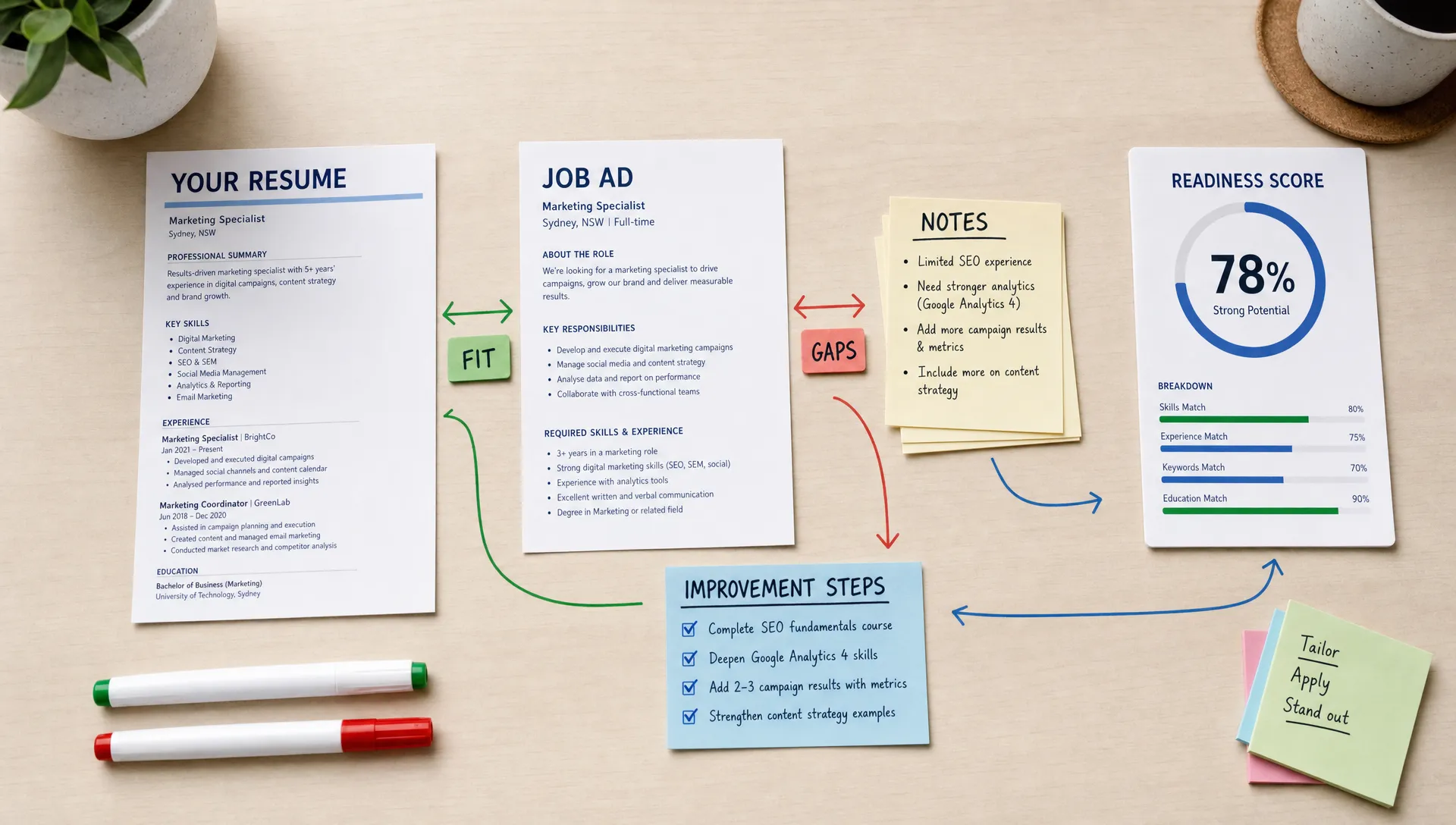
Before you commit to an application, give the role a quick fit score. You can do this manually, or use a career intelligence platform such as Versadox to compare your resume against real roles, identify gaps, and assess readiness before you apply.
Look at three areas. First, can you show that your experience matches the role’s most important responsibilities? Second, can your resume pass a quick ATS and recruiter scan because it uses relevant job language naturally? Third, can you explain any gaps without sounding defensive?
If the answer is yes, proceed. If the answer is partly, improve the application before submitting. If the answer is no, save the job ad, identify the missing skills, and decide whether it is worth building toward later.
This one step alone can make your job hunt feel calmer. You stop treating every job ad as an emergency and start treating applications as decisions.

Tailor your resume for the role, not for yourself
A resume is not a complete autobiography. It is a relevance document.
That means the best version of your resume depends on the job you are applying for. You are not changing the truth. You are changing the emphasis.
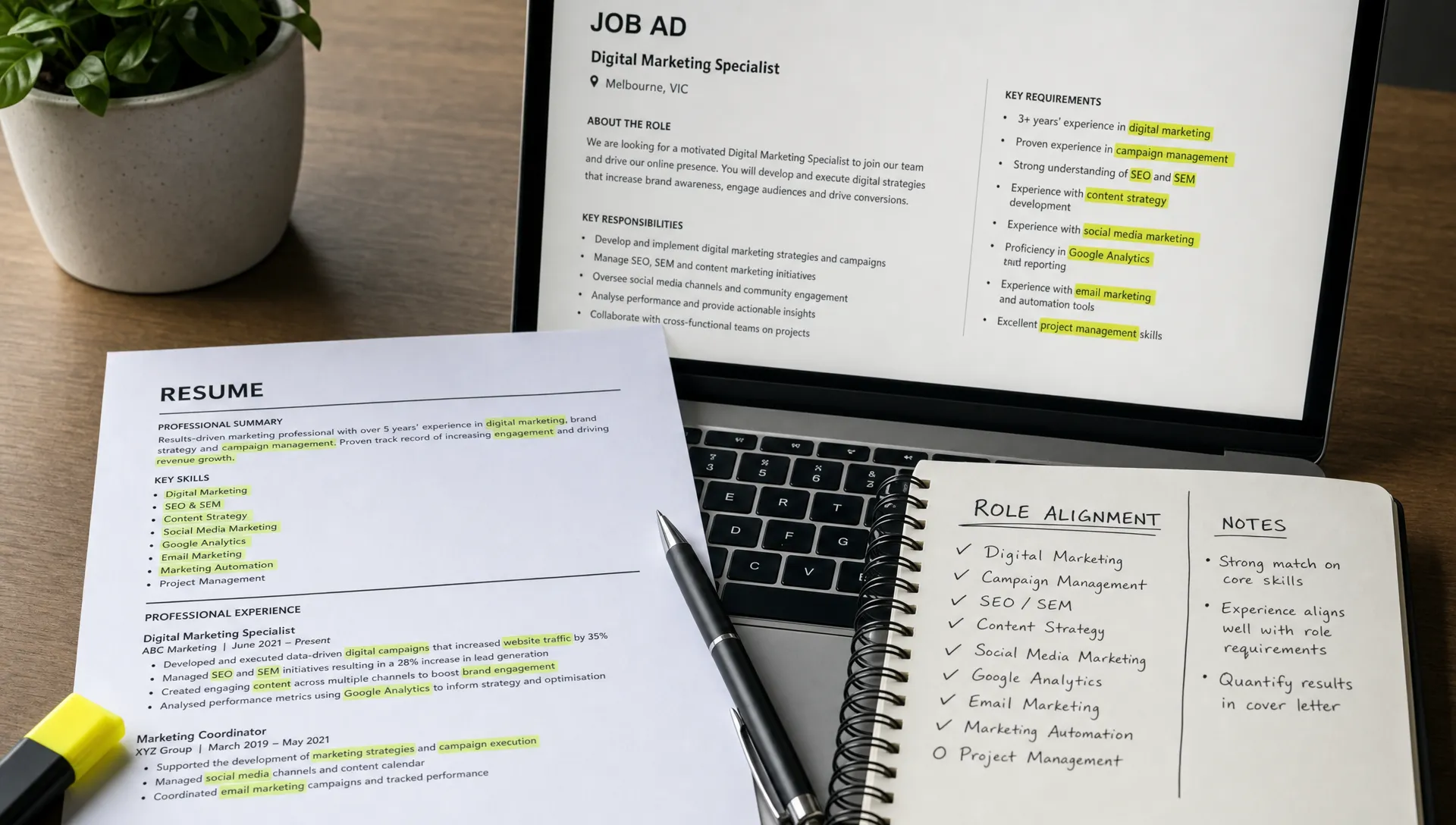
Start with the top third of the first page. This is where attention is won or lost. Your headline, summary, key skills, and most recent experience should quickly reflect the role. If the job ad is looking for a junior data analyst and your resume opens with unrelated hospitality duties, the reader may not continue long enough to find your relevant coursework or projects.
Use the job ad’s language where it genuinely matches your experience. If the ad asks for “stakeholder communication” and you have experience liaising with customers, suppliers, tutors, or team leaders, use that phrase naturally. If the ad asks for Excel, CRM, social media scheduling, rostering, reporting, or customer service, make sure those skills are visible if they are true.
But do not over-optimise. Keyword stuffing makes a resume harder to read and can damage trust. Your goal is not to trick the ATS. Your goal is to make the connection between your experience and the role easy to recognise. The strongest applications balance machine readability with human credibility, because your human edge is still what makes you memorable.
Make your cover letter answer the risk question
A weak cover letter repeats the resume. A strong cover letter reduces hiring risk.
Every employer has doubts when reviewing an applicant. Can this person do the work? Do they understand the role? Will they learn quickly? Are they genuinely interested, or applying randomly? A smart cover letter answers those questions directly.
Keep it concise. In most cases, three to five short paragraphs are enough. Open with the role and your reason for applying. Then highlight two or three pieces of evidence that align with the job. Close by reinforcing your interest and availability.
For students and graduates, the cover letter can connect study, placements, part-time work, volunteering, and projects to the role. For career changers, it can explain the transition without apologising for it. You are not asking the employer to take pity on you. You are showing that your previous experience gives you transferable value.
A useful structure is: why this role, why your background fits, and why now. If you can answer those three points clearly, your cover letter will already be stronger than most generic templates.
Close gaps before employers notice them
Not every gap is a dealbreaker. Some are easy to fix before you apply.
If multiple job ads mention a tool you do not know, spend time learning the basics and create a small project that proves it. If your resume lacks recent experience, add a volunteer project, freelance sample, uni project, portfolio task, or relevant short course. If your job history does not show leadership, identify moments where you trained someone, organised a process, handled conflict, or took responsibility.
The key is to close the most visible gaps first. You do not need to become perfect before applying. You need to remove the reasons an employer might quickly say no.
Gap identification is also where AI can help, provided you use it carefully. Instead of asking AI to “write me a resume”, use it to compare your experience against a role, find missing evidence, and suggest clearer ways to describe real work you have done. The output should still sound like you and remain accurate.
Versadox is built around this idea: score the application, identify role gaps, improve the resume or cover letter, and export a cleaner version when you are ready. That is far more useful than simply generating a polished document that may not match the job.
Apply in focused blocks and track what happens
Speed improves when you create a repeatable system.
Instead of applying randomly across the week, set aside focused application blocks. During each block, review a small number of well-matched roles, score the fit, tailor the resume, adjust the cover letter, and submit. This reduces context switching and helps you maintain quality.
Track your outcomes as you go. You do not need complicated software. A simple spreadsheet or notes app is enough. Record the job title, company, date applied, version of resume used, whether you included a cover letter, and the outcome.
After 15 to 25 applications, patterns become useful. If you are getting no responses, your targeting, resume alignment, or evidence may need work. If you are getting phone screens but no interviews, your verbal positioning may need practice. If you are getting interviews but no offers, your examples, confidence, or role fit may need improvement.
This turns rejection into information. That matters because the job search can feel emotional and personal. A tracking system helps you diagnose instead of spiral.
Use a 60-minute smarter application workflow
If you are short on time, use a fixed workflow so you do not overthink every application.
- 0 to 10 minutes: Read the job ad and highlight the essential requirements, repeated keywords, and main outcomes.
- 10 to 20 minutes: Compare the role against your resume and decide whether you have enough evidence to apply.
- 20 to 35 minutes: Tailor your resume summary, key skills, and most relevant bullet points to match the role.
- 35 to 50 minutes: Write or adjust a concise cover letter that explains fit, motivation, and transferable value.
- 50 to 60 minutes: Check formatting, file names, contact details, spelling, and any application questions before submitting.
This workflow is not about rushing. It is about preventing perfectionism from taking over. Some roles deserve more time, especially if they are highly aligned or strategically important. But many applications can be completed well within a focused hour if your evidence bank and base resume are ready.
Avoid the mistakes that make applications look weaker
Many job seekers reduce their own chances without realising it. The most common mistakes are usually simple.
A generic professional summary is one of them. If your summary could apply to any job in any industry, it is not helping. Another common mistake is listing responsibilities without outcomes. Employers want to know what you handled, improved, supported, solved, or delivered.
Formatting can also hurt you. Overly designed resumes may look good but perform poorly if they are hard to scan or export badly. ATS-ready templates are usually cleaner, more structured, and easier for both systems and people to read.
Another mistake is applying too far outside your evidence without building a bridge. Ambition is good, but the employer needs a reason to believe you can succeed. If your experience is not obvious, your resume and cover letter must do more translation work.
Finally, do not let AI flatten your voice. Hiring teams see many polished but empty applications. Your goal is not to sound like a template. It is to sound clear, relevant, and credible.
How to get a job faster without burning out
A smarter application strategy is also a burnout prevention strategy.
The job hunt can make you feel like you are constantly behind. There is always another ad, another platform, another rewrite, another rejection. But applying faster does not mean being online all day. It means building a system that improves with every application.
Set weekly targets you can actually sustain. For example, you might aim for a smaller number of high-quality applications, a few networking conversations, one skill-building action, and one review of your tracking data. That is more strategic than sending a large batch of weak applications and hoping something lands.
If you are not getting traction, do not assume you are unemployable. Assume your application system needs better data. Which roles are you targeting? What gaps appear repeatedly? Which resume version performs best? Where are employers losing confidence?
The faster path is rarely a straight line. But it becomes much clearer when every application teaches you something.
Frequently Asked Questions
How can I get a job faster if I have little experience? Focus on roles where your study, part-time work, volunteering, projects, or personal initiatives provide relevant evidence. Translate everyday responsibilities into workplace skills such as communication, reliability, organisation, customer service, problem-solving, and teamwork.
Should I tailor my resume for every job application? Yes, but tailoring does not mean rewriting everything. Keep a strong base resume and adjust the summary, key skills, and most relevant achievements so they match the specific role.
How many jobs should I apply for each week? There is no perfect number. A smaller batch of well-matched, well-tailored applications is usually better than a large batch of generic ones. Track your response rate and adjust your strategy based on results.
Can AI help me get a job faster? AI can help if you use it to improve alignment, identify gaps, and clarify your evidence. Avoid relying on AI to invent experience or produce generic language that does not sound like you.
What is the biggest mistake job seekers make? The biggest mistake is assuming the employer will work out your fit. Your application needs to make the connection obvious quickly, with clear evidence matched to the role.
Apply with more clarity and confidence
If you want to get a job faster, stop treating every application as a guess. Build a system that helps you understand where you stand, what is missing, and how to improve before you submit.
Versadox helps job seekers build stronger resumes and cover letters, compare applications against real roles, identify gaps, and improve readiness before applying. Whether you are a student, graduate, or career changer, a smarter application can help you spend less time guessing and more time moving toward interviews.





.svg)