A strong cover letter does not just say you have skills. It shows how those skills helped someone, solved something, improved a process, supported a team, or prepared you for the role you want next.
That difference matters. Hiring managers see phrases like “excellent communicator”, “hard worker”, and “team player” all the time. Those phrases are not wrong, but they are weak when they sit alone. The best skills for a cover letter are the ones you can connect to proof.
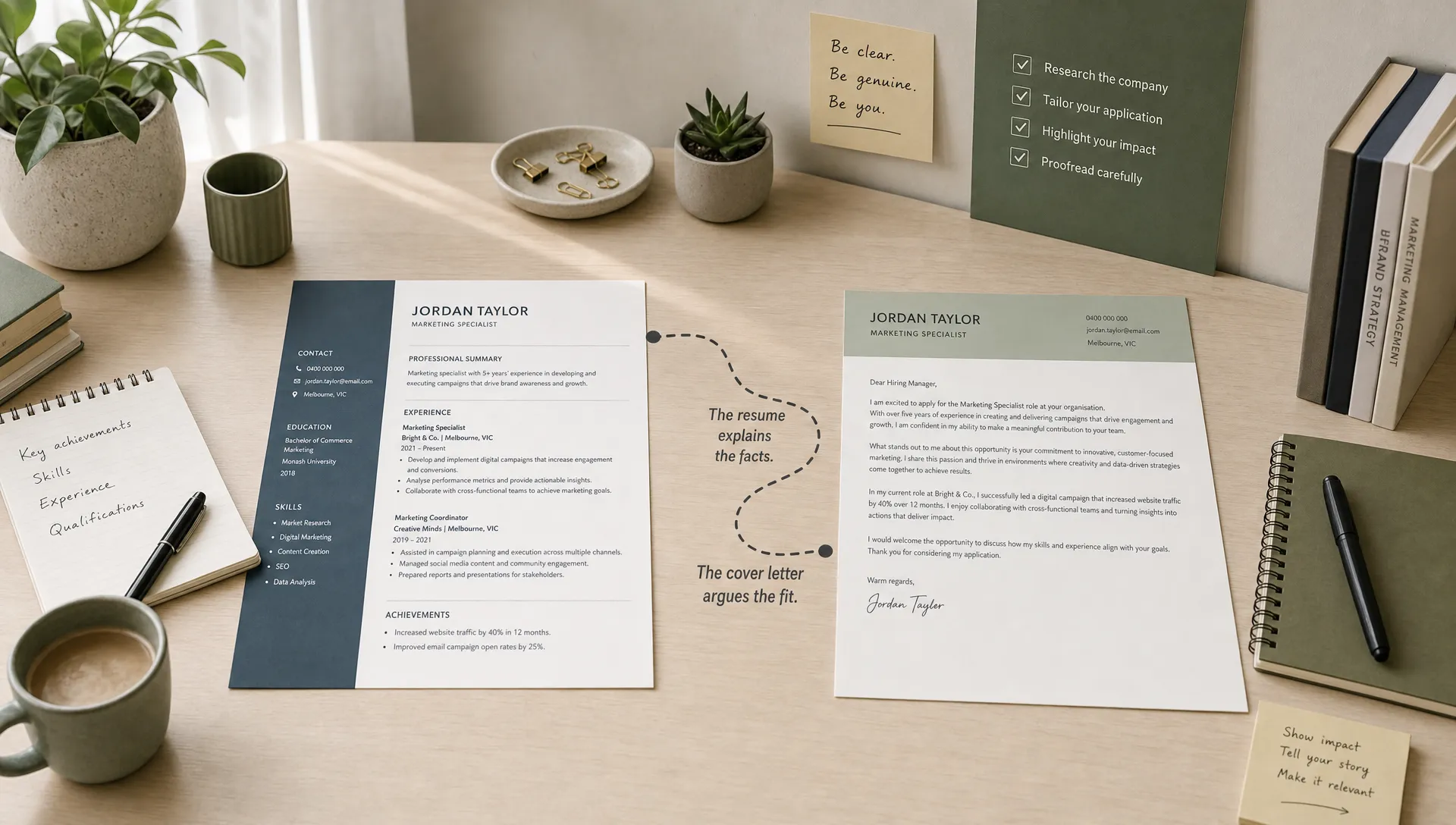
If your resume lists what you have done, your cover letter explains why that experience fits this particular job. That is especially important for students, graduates, and career changers who may not have a long list of direct experience yet. You can still make a persuasive case by choosing the right skills and backing them up with specific evidence.
What makes a skill worth including in a cover letter?
A skill belongs in your cover letter when it does three things.
It matches the role. If the job ad keeps mentioning stakeholder communication, customer support, reporting, scheduling, teamwork, or data entry, your cover letter should respond to those needs directly.
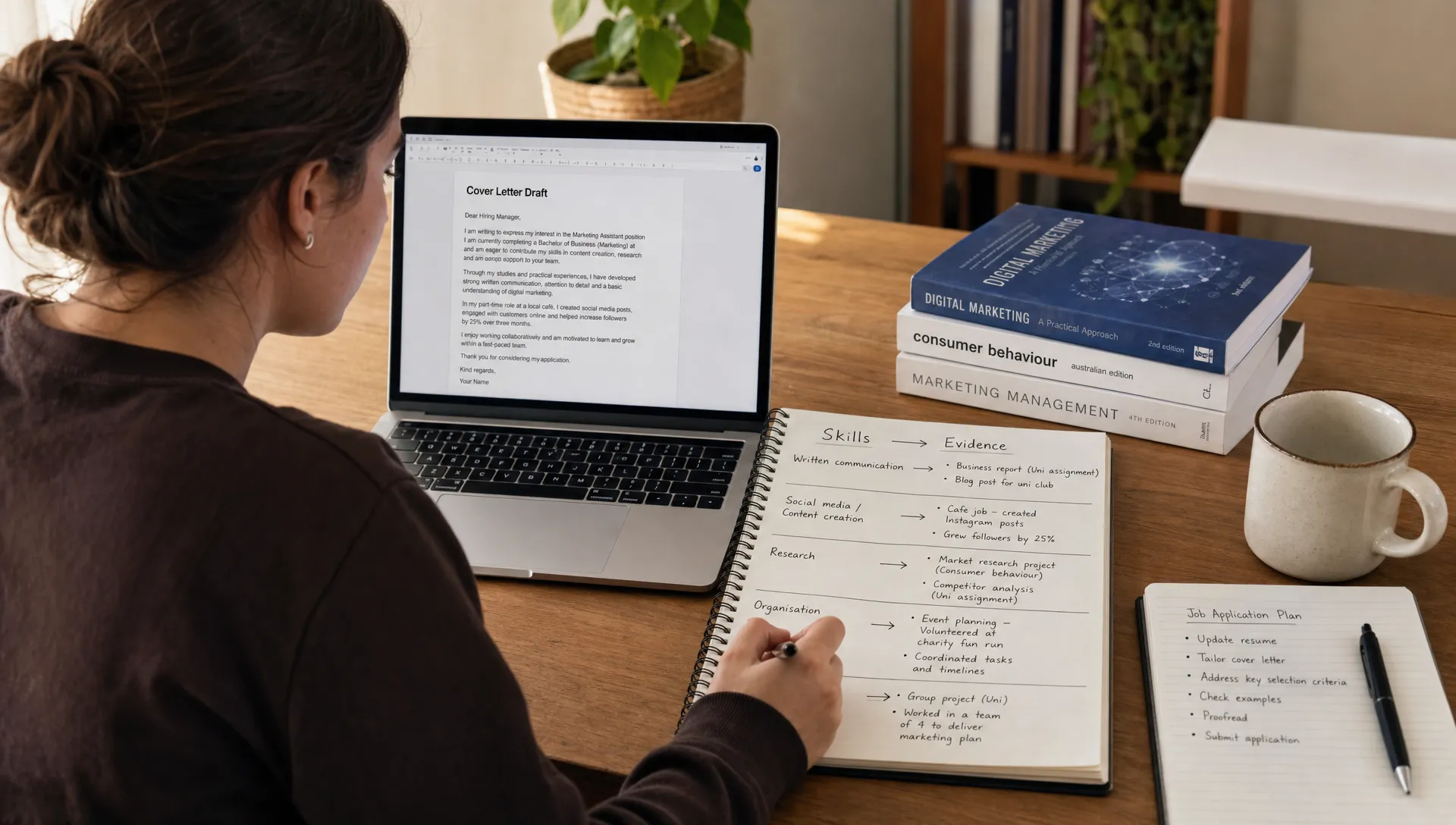
It is supported by evidence. Evidence can come from paid work, internships, university projects, volunteering, sports, community roles, personal projects, or career change experience.
It helps the employer picture you in the role. A good cover letter skill is not just a label. It gives the reader a small preview of how you would work if they hired you.
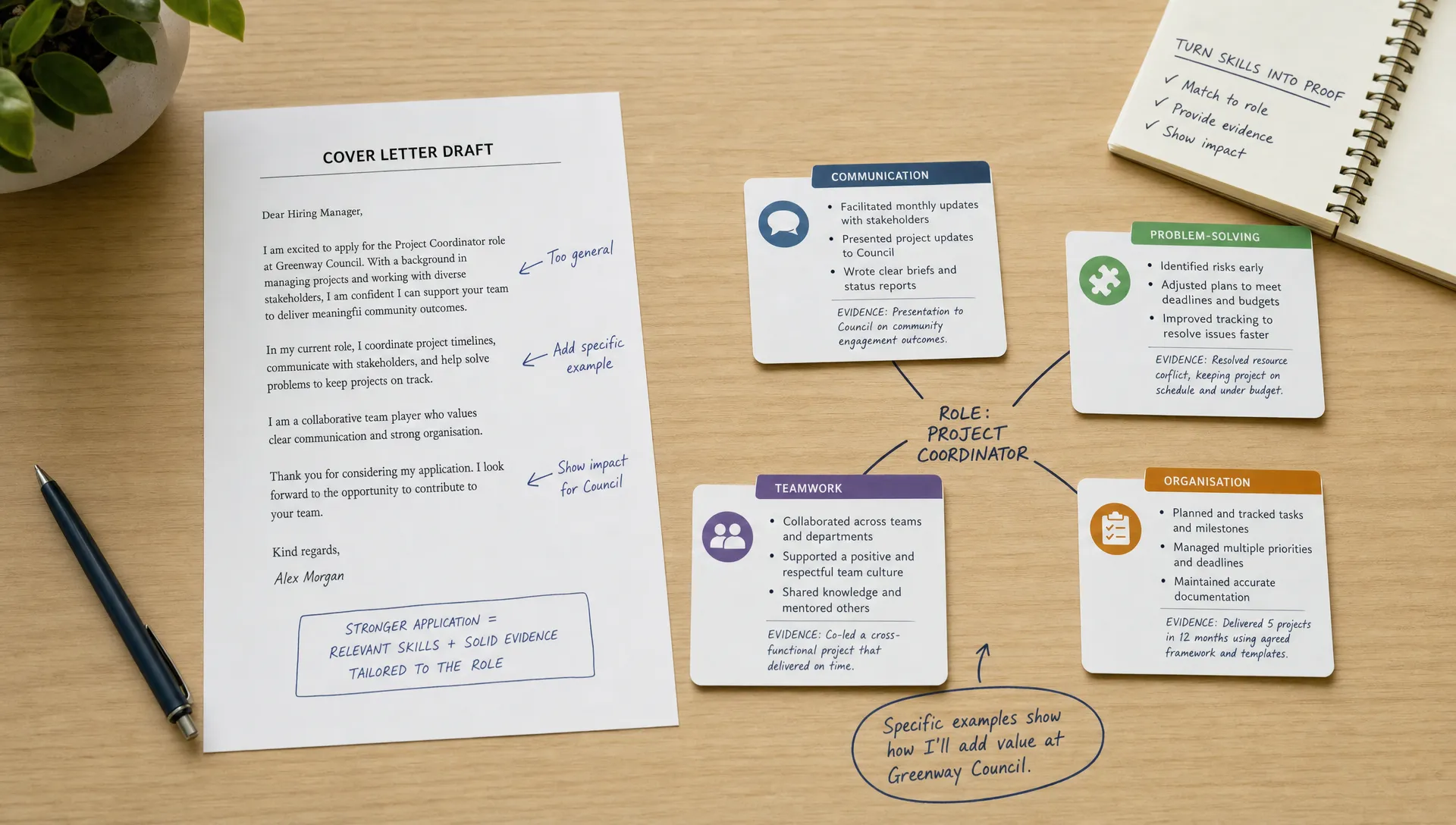
For example, “I have strong communication skills” is generic. “In my retail role, I explained product options to customers with different needs and regularly handled busy weekend enquiries while keeping service calm and clear” is much stronger.
That is the goal: choose fewer skills, then make each one believable.
Before choosing which skills to include, use a simple structure:
- Skill: Name the ability the role needs.
- Situation: Give context for where you used it.
- Action: Explain what you actually did.
- Result: Show the outcome, improvement, or value.
You do not need a dramatic achievement for every example. A result can be practical, such as helping a team meet a deadline, reducing confusion, improving customer experience, completing a project, supporting a manager, or learning a new tool quickly.
This is also where your cover letter should differ from your resume. Your resume might say “Customer service assistant, 2024”. Your cover letter can explain how that role developed patience, communication, problem-solving, and reliability. If you are unsure how the two documents should work together, Versadox has a helpful breakdown of the difference between a cover letter and resume.
Best skills for a cover letter, with proof-based examples
The best skills for a cover letter depend on the role, but the following categories are widely useful across entry-level, graduate, administrative, customer-facing, sales, marketing, operations, and early professional roles.
Communication skills
Communication is one of the safest skills to include because almost every role depends on it. The key is to show the type of communication the job needs.
For a customer-facing role, your proof might focus on explaining information clearly, handling questions, or calming tense situations. For an office role, it might focus on writing professional emails, summarising updates, or keeping stakeholders informed. For a graduate role, it might come from presentations, group projects, tutoring, or student leadership.
A proof-based sentence could be:
“Through my part-time hospitality work, I developed clear and calm communication skills by taking customer orders accurately, resolving small issues quickly, and keeping the team informed during busy service periods.”
This works because it does not just claim communication. It shows where the skill appeared and why it mattered.
Problem-solving skills
Problem-solving is valuable because employers want people who can think, not just follow instructions. This is especially useful for career changers, because problem-solving often transfers well across industries.
Good proof can come from moments where you fixed a process, handled an unexpected issue, found missing information, helped a customer, or made a project easier for others.
A strong example might be:
“In my university capstone project, I strengthened my problem-solving skills by breaking a broad research question into smaller tasks, coordinating evidence from multiple sources, and helping the group adjust our approach when early findings did not support our original idea.”
Notice that the example is not pretending to be bigger than it is. It is specific, mature, and believable.
Teamwork and collaboration
Many applicants write that they are a “team player”, but fewer explain what that actually looked like. Teamwork proof should show your role in the group, not just that you were part of one.
Useful evidence includes coordinating tasks, supporting a quieter teammate, managing disagreements, sharing information, helping during busy periods, or contributing consistently to a shared deadline.
For example:
“My teamwork skills developed through group assignments and casual work, where I learned to clarify responsibilities early, check in with others before deadlines, and step in when teammates needed support.”
If you want to avoid the usual teamwork clichés, you can also explore how everyday experiences become evidence in Versadox’s article on the team player cliché.
Organisation and time management
Organisation is a strong cover letter skill when the role involves deadlines, administration, rostering, reporting, study, customer requests, or competing priorities.
Students and graduates often underestimate this skill. Balancing study, part-time work, placements, family responsibilities, volunteering, or job applications can all provide credible proof.
A strong sentence might be:
“Balancing full-time study with part-time work has strengthened my organisation skills, particularly in planning weekly priorities, meeting assessment deadlines, and staying reliable across changing rostered shifts.”
This type of proof is useful because it shows habits, not just intention.
Attention to detail
Attention to detail is often listed in job ads, but it can sound empty if you do not explain it. This skill is especially relevant for administration, finance, healthcare support, research, data entry, legal support, operations, and technical roles.
Proof can include checking documents, entering information accurately, following procedures, reviewing reports, preparing files, testing work, or catching errors before they become problems.
For example:
“In my administration placement, I built attention to detail by updating records, checking document names against internal requirements, and asking clarifying questions before submitting completed work.”
This shows care and judgement, which is stronger than simply saying you are detail-oriented.
Technical and digital skills
Technical skills can add weight to a cover letter, but only when they are relevant to the role. Do not list every platform you have ever used. Choose the tools or digital habits that connect to the job description.
Examples might include Microsoft Excel, Google Workspace, Canva, CRM systems, point-of-sale systems, data entry platforms, content management systems, scheduling tools, analytics dashboards, coding languages, or industry-specific software.
A proof-based example could be:
“I am confident learning digital systems quickly, as shown in my retail role where I used point-of-sale software, tracked stock information, and helped new team members follow the correct transaction process.”
For a more specialised role, you might go deeper:
“My coursework in business analytics gave me practical experience cleaning data in Excel, building simple visual summaries, and explaining findings in plain language for non-technical audiences.”
If the role is technical or tool-heavy, it is worth aligning your cover letter with the way you present technology skills on your resume, so the two documents reinforce each other.
Customer awareness
Customer awareness is useful for retail, hospitality, sales, support, marketing, health services, education, community services, and client-facing roles. It shows that you understand work is not only about completing tasks. It is also about creating a good experience for the person receiving the service.
You might prove this through listening, patience, empathy, product knowledge, complaint handling, or adapting your communication style.
For example:
“My customer awareness developed through hospitality work, where I learned to read the situation quickly, adapt my tone to different customers, and keep service friendly even when the team was under pressure.”
For sales or business development roles, customer awareness can also mean understanding pipeline, outreach, and buyer needs. For instance, someone applying to a B2B sales role could reference their interest in how a B2B customer acquisition agency builds qualified conversations, then connect that interest to communication, research, and follow-up skills.
Adaptability and learning agility
Adaptability is one of the best skills for a cover letter when you are changing careers, applying for a graduate role, returning to work, or moving into a new industry. It helps address the employer’s unspoken question: “Can this person learn what they do not already know?”
Proof can include learning a new system, moving between roles, handling changing priorities, taking feedback, or stepping into unfamiliar responsibilities.
A strong example might be:
“Moving from hospitality into an office environment has strengthened my adaptability, as I have learned to translate customer service, prioritisation, and communication skills into more structured administrative tasks.”
This is particularly helpful because it frames transition as a strength, not a weakness.
Initiative
Initiative means noticing what needs to be done and taking useful action. Employers value it because it reduces the amount of supervision needed.
However, initiative should not sound like you ignore instructions or take over. The best proof shows that you acted responsibly within the situation.
For example:
“In my volunteer role, I showed initiative by creating a simple checklist for event setup, which helped new volunteers understand what needed to be completed before attendees arrived.”
This is a small example, but it is convincing because it has a clear action and outcome.
Leadership potential
You do not need a management title to show leadership. Leadership can appear through mentoring, organising, making decisions, taking responsibility, setting standards, or helping a group move forward.
This skill is useful in cover letters for graduate programs, team-based roles, community work, student leadership, project roles, and customer-facing positions where reliability matters.
A sentence could be:
“Although I have not held a formal management role, I have developed leadership potential by mentoring newer staff, modelling calm service during busy shifts, and helping the team stay focused on shared tasks.”
That phrasing is honest and confident. It does not oversell, but it still presents leadership value.
How to choose the right skills for each cover letter
You do not need to include all of these skills in one letter. In most cases, two or three well-proven skills are more persuasive than a long list.
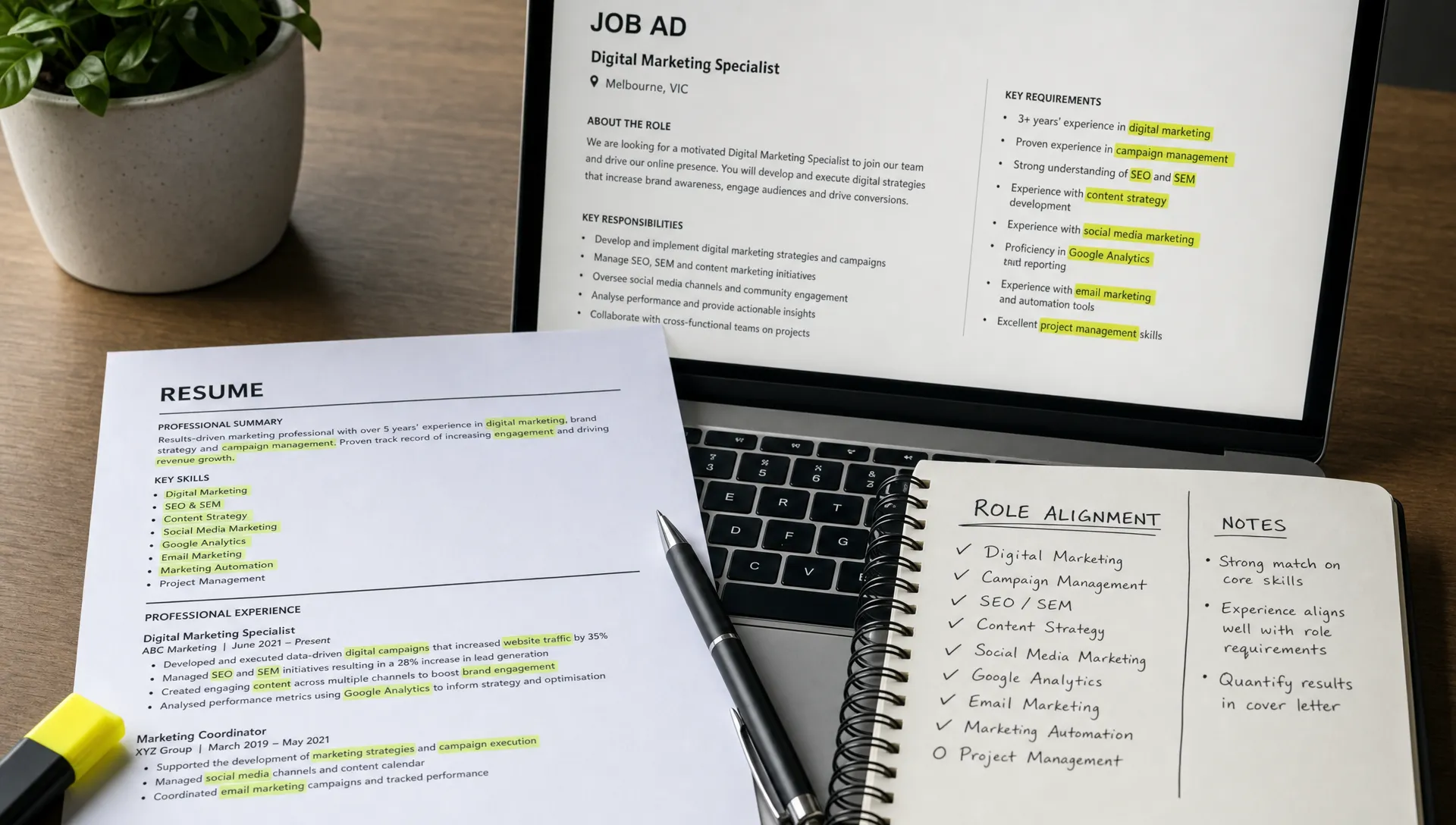
Start by reading the job ad carefully and looking for repeated clues. Employers often signal priorities through phrases such as:
- “Strong written and verbal communication”
- “Ability to manage competing priorities”
- “Customer-focused approach”
- “High attention to detail”
- “Comfortable using digital tools”
- “Works well in a team environment”
- “Willingness to learn”
Then, match each priority to a real example from your background. If you cannot prove a skill at all, do not make it the centre of your letter. Choose a related skill you can support honestly.
For example, if the ad asks for stakeholder management but you are a graduate, you might not have managed corporate stakeholders. But you may have coordinated with tutors, classmates, customers, supervisors, or community members. That still counts if you frame it accurately.
Cover letter skill examples by applicant type
Different applicants should draw proof from different places. The skill may be the same, but the evidence should fit your background.
For students, strong proof often comes from:
- Group assignments
- Part-time jobs
- Student societies
- Tutoring or mentoring
- Volunteering
- Internships or placements
- Personal projects
For graduates, strong proof often comes from:
- Capstone projects
- Internships
- Casual work
- Research tasks
- Presentations
- Industry placements
- Campus leadership
For career changers, strong proof often comes from:
- Transferable work achievements
- Customer or client experience
- Training completed for the new field
- Process improvements
- Cross-functional collaboration
- Tools learned independently
- Responsibilities that overlap with the target role
The key is to help the employer understand the bridge between where you have been and where you want to go.
Phrases that weaken your cover letter skills
Some phrases make your cover letter sound generic, even if your experience is good. Try to avoid unsupported claims like:
- “I am the perfect candidate”
- “I have excellent communication skills”
- “I work well independently and in a team”
- “I am passionate and hardworking”
- “I believe I would be a great fit”
These are not terrible ideas, but they need proof. Instead of saying “I am hardworking”, show reliability. Instead of saying “I am passionate”, explain what you have done to learn about the field. Instead of saying “I am a great fit”, connect your background to the employer’s needs.
A better approach is:
“Your role requires someone who can stay organised, communicate clearly, and learn new systems quickly. These are strengths I have developed through balancing full-time study with part-time customer service work, where reliability and clear communication were essential every week.”
That sentence feels more grounded because it connects skills to context.
A simple cover letter skills paragraph you can adapt
Here is a flexible paragraph structure you can adjust for different roles:
“Your advertisement highlighted the need for [skill one], [skill two], and [skill three]. I have developed these strengths through [experience or setting], where I [specific action]. This helped me [result or outcome], and it has prepared me to contribute to [role, team, or employer need].”
For example:
“Your advertisement highlighted the need for clear communication, strong organisation, and attention to detail. I have developed these strengths through my administration placement and part-time retail work, where I updated records, managed competing customer requests, and followed procedures accurately. These experiences have prepared me to contribute reliably in a busy team environment.”
You can make this more specific by adding the employer’s industry, the role title, or a particular responsibility from the job ad.
How Versadox helps you prove the right skills
Choosing skills is easier when you can see how your application compares to the role. Versadox helps job seekers review their resume and cover letter against real job requirements, identify gaps, and make guided improvements before applying.
That matters because many applicants either understate useful experience or include skills that do not match the role closely enough. With role alignment insights, readiness scoring, gap identification, ATS-ready templates, and guided application improvements, Versadox helps you apply with more clarity and confidence.
For students, graduates, and career changers, this can make the application process feel less like guessing and more like building a stronger case.
Frequently Asked Questions
What are the best skills for a cover letter? The best skills for a cover letter are the ones that match the job ad and can be supported with proof. Common strong choices include communication, problem-solving, teamwork, organisation, attention to detail, adaptability, technical skills, customer awareness, initiative, and leadership potential.
How many skills should I include in a cover letter? In most cases, include two or three main skills. It is better to prove a small number of relevant skills clearly than to list many skills without evidence.
Should I mention soft skills in a cover letter? Yes, but only when you can connect them to examples. Soft skills like communication, teamwork, and adaptability are valuable, but they become stronger when you show where you used them and what happened as a result.
Can I use examples from university or volunteering? Yes. University projects, placements, volunteering, sport, community involvement, and part-time work can all provide strong cover letter evidence, especially for students, graduates, and career changers.
Should my cover letter repeat the skills on my resume? It can reinforce them, but it should not simply repeat your resume. Use your cover letter to explain why those skills matter for this specific role and to add context that your resume does not have room to cover.
Final tip: skills are stronger when they sound real
The best cover letters are not the ones with the most impressive vocabulary. They are the ones that make your fit easy to understand.
Choose skills that the employer actually asked for. Connect them to real examples. Use plain, confident language. Avoid exaggeration. Show the reader how your experience, even if it is early or non-linear, has prepared you to contribute.
If you want to check whether your resume and cover letter are aligned with a role before you apply, Versadox can help you identify gaps, strengthen your application, and present your skills with more confidence.





.svg)