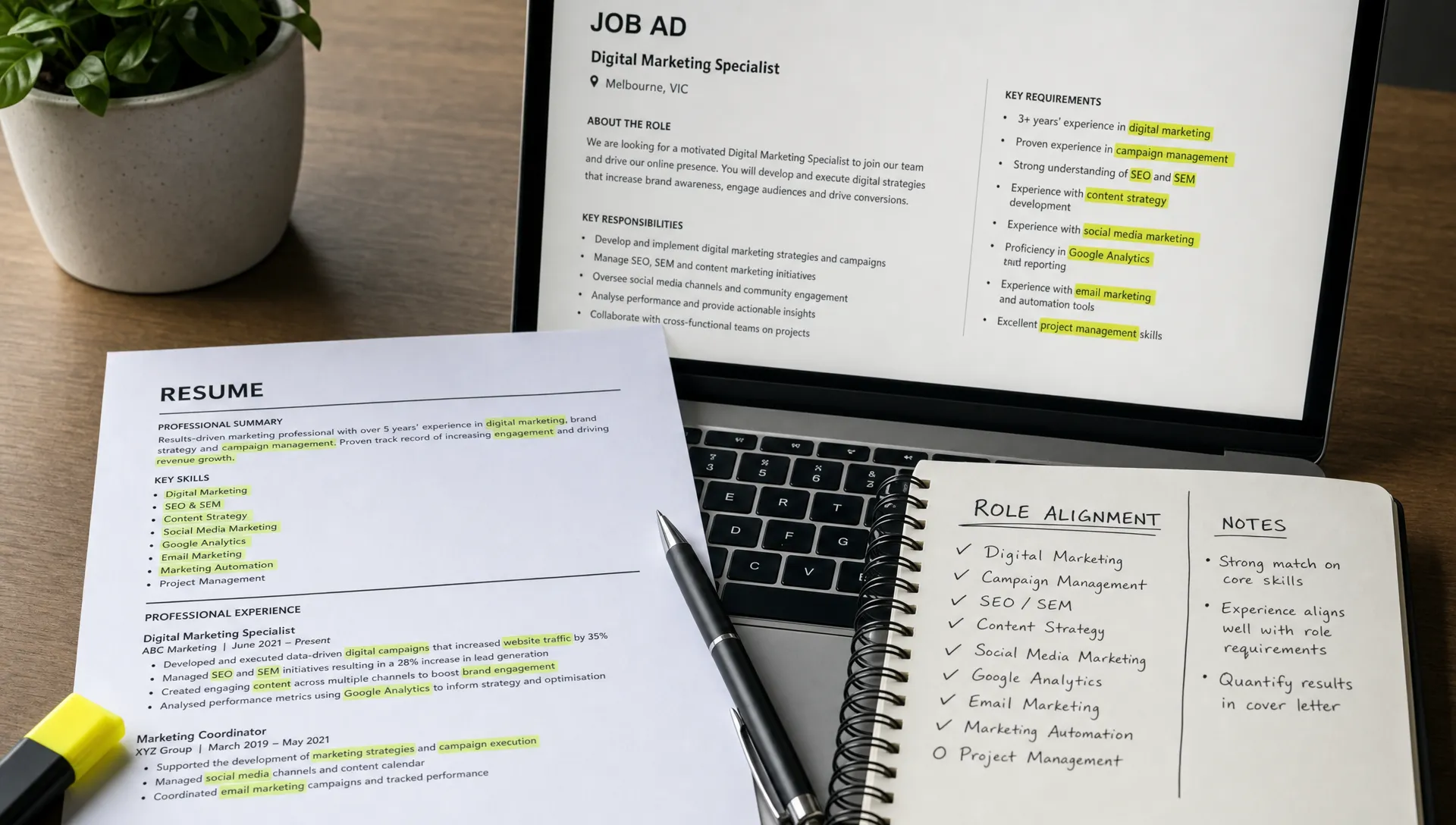
Job hunting often feels random when every application disappears into a portal and every rejection looks the same. But better application results rarely come from sending more resumes to more jobs. They come from improving the match between your experience, the role, and the evidence you choose to show.
That is the purpose of strong job hunting strategies. They help you move from hopeful volume to deliberate positioning. Instead of asking whether your resume is good in general, you start asking a more useful question: is this application convincing for this specific role?
For students, graduates, and career changers, that shift matters. You may not have a long employment history yet, but you can still present relevant skills, projects, achievements, and motivation in a way that makes hiring teams pay attention.
The best job hunting strategies start with focus
A broad job search feels productive because it creates activity. You apply for graduate programs, admin roles, marketing assistant roles, customer service jobs, internships, and anything else that looks possible. The problem is that each role expects a different story.
If your target is too wide, your resume becomes vague. Your summary tries to please everyone. Your skills section becomes a long list. Your cover letter says you are excited about the opportunity, but it does not explain why you are a strong fit for that opportunity.
Start by choosing one to three role families. A role family is a group of jobs that share similar skills, tasks, and employer expectations. For example, a commerce graduate might focus on business analyst, operations coordinator, and project support roles. A career changer from retail might target customer success, account coordinator, and sales operations roles.
A focused target gives you a clearer application strategy. It helps you decide which achievements belong at the top of your resume, which keywords are worth using, and which gaps you need to address before you apply. If you want a deeper process for making each application more targeted, Versadox has a useful guide on how to get a job faster with a smarter application.
Translate each job ad into a hiring scorecard
Most candidates read job ads like a checklist. They scan the responsibilities, look for familiar words, and decide whether they can apply. A better approach is to read the job ad like a scoring guide.
Every role description gives clues about how the employer will assess applicants. The order of responsibilities, repeated skills, required tools, and language around culture all point to what the hiring team values most.
Before you tailor your application, pull out the core requirements:
- The main outcome the role is expected to deliver
- The technical skills, tools, or systems mentioned more than once
- The soft skills that appear in context, such as stakeholder management or problem solving
- The level of independence expected, such as assisting, coordinating, managing, or leading
- The evidence the employer would trust, such as projects, results, certifications, or industry experience
This turns a job ad from a block of text into a practical brief. If the role emphasises client communication, your application should show examples of communication under pressure. If it emphasises data accuracy, your resume should include evidence of attention to detail, reporting, systems, or quality checks.
The goal is not to copy the ad word for word. The goal is to make the employer feel that your experience clearly maps to their needs.
Build an evidence bank before you tailor
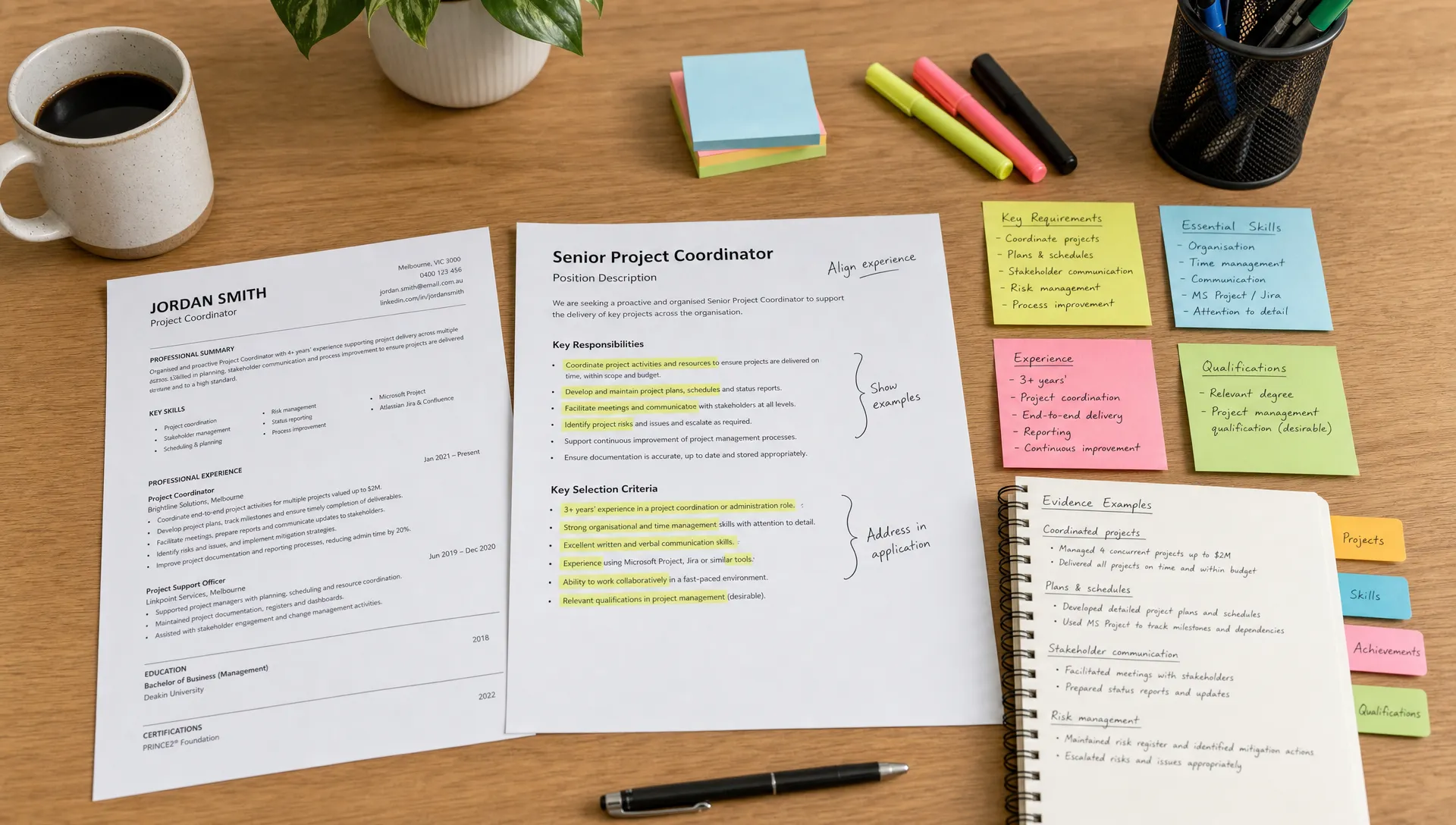
A strong resume is not just a list of tasks. It is a collection of proof. The more evidence you have ready, the easier it becomes to tailor applications quickly without starting from scratch every time.
Your evidence bank can include paid work, university projects, volunteer experience, personal projects, competitions, internships, group assignments, leadership roles, or community involvement. For early-career applicants, this is especially important because your best evidence may not come from a traditional full-time role yet.
Good evidence usually contains three parts: what you did, how you did it, and why it mattered. For example, instead of saying you worked in a busy cafe, you could say you handled peak-hour customer orders while coordinating with kitchen staff, reducing errors during high-volume service. Instead of saying you completed a university marketing project, you could say you analysed customer segments, built a campaign proposal, and presented recommendations to a panel.
Your evidence bank should capture:
- Achievements with numbers, even simple numbers such as team size, volume, frequency, or time saved
- Tools and methods you used, such as Excel, Canva, Python, customer management systems, research methods, or reporting templates
- Problems you helped solve, including customer issues, workflow delays, project confusion, or communication gaps
- Feedback or outcomes, such as improved grades, supervisor praise, repeat customers, reduced errors, or stronger engagement
- Transferable skills that connect to your target roles, such as organisation, analysis, teamwork, initiative, or adaptability
If you are unsure which skills deserve space on your resume, focus on relevance rather than quantity. Versadox explains this well in its guide to skills for your resume that employers actually notice.
Tailor for alignment, not decoration
Tailoring does not mean changing your template colour or adding a few keywords at the bottom. It means adjusting the order, emphasis, and evidence so the application answers the employer's real question: can this person do the work here?
Start with the top third of your resume. This is where alignment matters most. Your headline or summary should reflect the role family you are targeting. Your first few skills should match the job's priorities. Your most relevant achievements should appear before less relevant experience, even if the less relevant experience is more recent.
For example, a student applying for a data analyst internship should not bury a university data project under unrelated casual work duties. A retail worker moving into customer success should not describe only register tasks. They should highlight customer problem solving, product knowledge, complaint resolution, CRM exposure if applicable, and communication outcomes.
ATS-ready formatting also matters, but it should support clarity, not replace it. Use clear section headings, readable structure, and direct language. Avoid graphics that may confuse parsing. Most importantly, make sure the content itself is specific enough for a human recruiter to understand your fit.
Make your cover letter solve a different problem
Many candidates treat the cover letter as a longer version of the resume. That is a missed opportunity. A resume proves what you have done. A cover letter should explain why your experience makes sense for this specific role, employer, and next step.
This is especially valuable if your background is not linear. Career changers can use the cover letter to connect previous experience to the new field. Graduates can explain why particular projects, placements, or interests led them to the role. Students can show motivation, learning agility, and an understanding of the employer's work.
A strong cover letter usually answers three questions. Why this role? Why you? Why now? Keep it concise, but make it personal enough that it could not be sent unchanged to ten other employers.
Avoid generic enthusiasm. Instead of saying you are passionate about business, explain which part of the role interests you and how your background has prepared you for it. Instead of saying you are a quick learner, give an example of a time you learned a system, process, or subject quickly and applied it effectively.
Use networking to improve your signal
Networking is not only about asking for jobs. It is about making your name, interests, and credibility easier to recognise. In a crowded market, that recognition can help your application feel less anonymous.
For students and graduates, networking might mean speaking to alumni, attending employer events, connecting with recruiters, or asking people in target roles what their day-to-day work actually involves. For career changers, it might mean talking to people who have already made a similar transition.
The best networking messages are specific and low-pressure. Do not ask a stranger to find you a job. Ask one thoughtful question about their role, their pathway, or the skills that matter most in their field. Then use what you learn to improve your applications.
Networking also strengthens your understanding of language. Job ads can be formal and broad, but conversations reveal how people in the role actually describe their work. That language can help you write more realistic resume bullets, prepare better interview answers, and avoid applying for roles that do not match your goals.
Manage volume with a weekly application rhythm
Quality matters, but so does consistency. The aim is not to spend five hours perfecting one application and then stop for the week. The aim is to create a rhythm that gives each application enough care while keeping your pipeline active.
A practical weekly rhythm could include:
- Three to five highly aligned applications that are properly tailored
- One or two stretch applications where you meet most, but not all, of the criteria
- Two networking conversations or informational messages
- One resume or cover letter improvement based on feedback or results
- One review of your application tracker to spot patterns
Tracking matters because job hunting can distort your confidence. If you rely only on emotion, one rejection can feel like proof that nothing is working. If you track your activity, you can see whether the issue is targeting, resume alignment, interview performance, or simply not enough suitable applications yet.
Your tracker does not need to be complex. Record the role, company, date applied, resume version, key requirements, contact history, and outcome. Over time, patterns will appear. You may find that smaller companies respond more often, that one resume version performs better, or that a particular role family is not matching your current evidence.
Prepare for the next stage before it arrives
Better application results are not only about getting interviews. They are about being ready when interviews happen. If you wait until you receive an invitation, you may have only a day or two to prepare.
Build an interview bank alongside your evidence bank. Prepare examples for teamwork, conflict, problem solving, learning quickly, handling pressure, and receiving feedback. Use the same evidence from your resume, but practise explaining it in a conversational way.
Presentation also matters because it affects how composed you feel. You do not need expensive clothing to interview well, but you do need to look intentional and role-appropriate. A clean outfit, neat grooming, and understated details such as minimalist jewellery designed for everyday wear can help you present yourself with confidence without distracting from your skills.
For online interviews, test your camera, sound, lighting, and background before the day. For in-person interviews, plan travel time and bring a copy of your resume. These small steps reduce stress, which helps you communicate more clearly.
Diagnose weak points using results, not emotion
If you are not getting responses, the issue may be targeting or resume alignment. You might be applying for roles where your evidence is too thin, or your strongest proof may be hidden too low on the page. Compare your resume against the job ad and ask whether the match is obvious within the first 20 seconds.
If you are getting phone screens but not progressing, the issue may be your positioning. You may need a clearer answer to why you want the role, why you are changing direction, or how your experience connects to the employer's needs.
If you are getting final interviews but not offers, the issue may be interview depth, confidence, salary expectations, references, or competition. At this stage, the fix is often more specific preparation rather than a full resume rewrite.
Rejection is part of job hunting, but repeated patterns are useful data. The more precisely you diagnose the problem, the faster you can improve.
Frequently Asked Questions
How many jobs should I apply for each week? There is no perfect number, but most job seekers benefit from a balance of quality and consistency. Aiming for several well-targeted applications each week is usually better than sending dozens of generic ones.
Should I tailor my resume for every job? Yes, but tailoring does not always require a full rewrite. Focus on adjusting your summary, skills, achievement order, and most relevant examples so they match the role's priorities.
What if I do not meet every requirement in the job ad? You can still apply if you meet the core requirements and can show strong evidence of learning ability, transferable skills, or related experience. Be more cautious if you are missing the main technical skill or required qualification.
Do cover letters still matter? They can matter when they add context that the resume cannot show clearly. This is particularly true for graduates, career changers, applicants with gaps, or candidates applying for roles with strong motivation or communication requirements.
How do I know if my application is strong enough? A strong application makes the connection between your background and the role easy to understand. If a recruiter has to work hard to see your fit, your resume probably needs clearer alignment and stronger evidence.
Build a smarter application system with Versadox
Better job hunting strategies are not about guessing what employers want. They are about understanding the role, identifying your gaps, and improving the way you present your evidence.
Versadox helps job seekers build stronger resumes and cover letters, compare applications against real roles, review alignment, identify gaps, and improve readiness before applying. For students, graduates, and career changers, that means less guesswork and more confidence in every application you send.
If your current approach is not producing results, do not just apply harder. Apply smarter, with a clearer target, stronger evidence, and a system that helps you improve each week.






.svg)