The honest answer: there is no fixed number of job applications that guarantees a job. Some people get hired after fewer than 10 applications. Others send 100 or more before receiving an offer.
A more useful planning range is this: many job seekers should expect to send 30 to 80 targeted applications to secure a role, while graduates, career changers, and people applying in highly competitive markets may need 100 or more. If you are sending generic applications, the number can climb quickly. If your resume is strongly aligned, you have referrals, or you are applying to a narrow role family, it can be much lower.
The real question is not only “how many job applications does it take to get hired?” It is also “what is each application doing for my odds?”
If every application is similar, untailored, and sent to roles that only partly match your experience, more volume may not solve the problem. But if each application is targeted, clearly shows role fit, and helps you learn from the market, your job search becomes much more predictable.
Why there is no universal application number
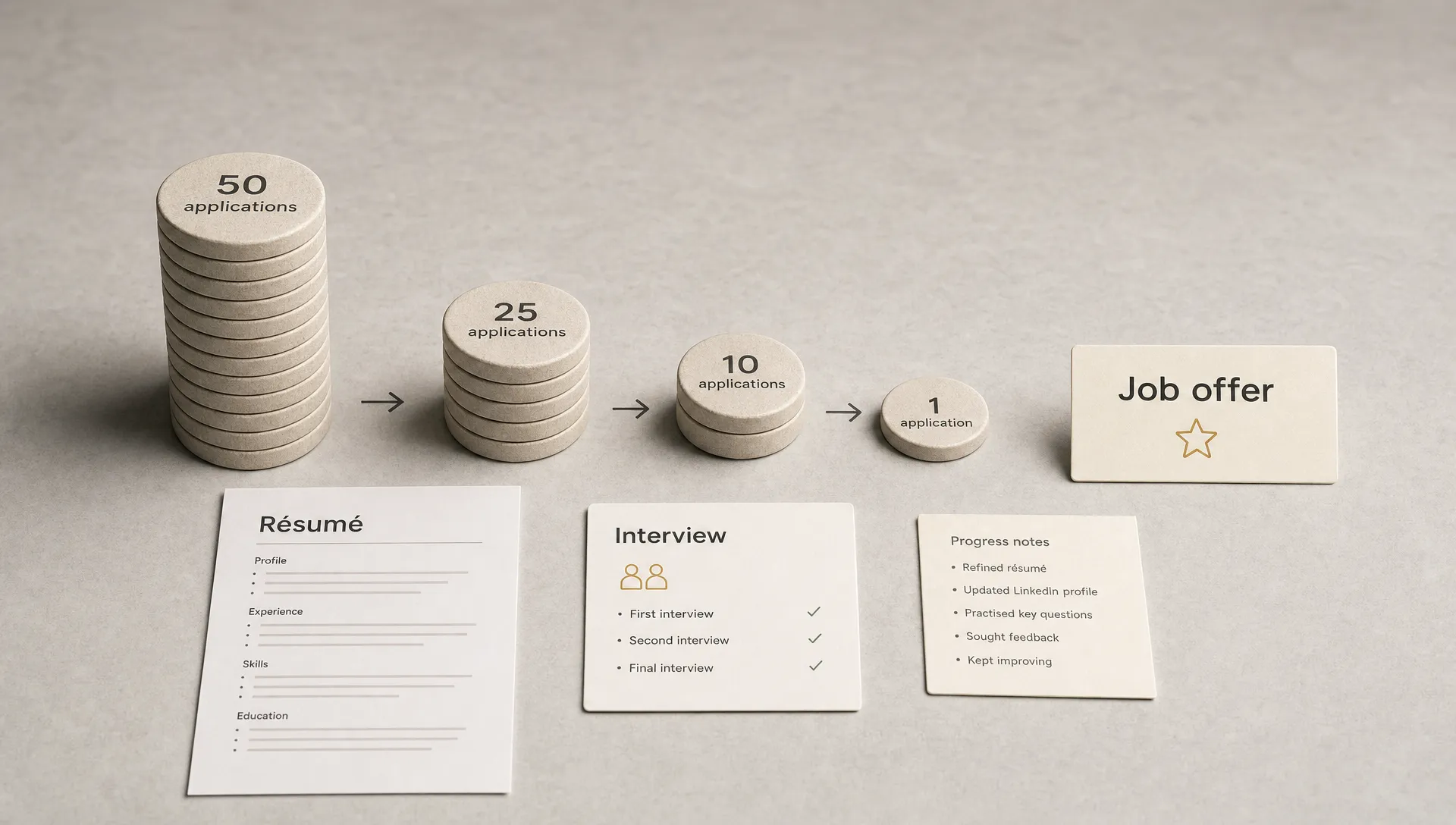
Hiring is not a lottery, even though it can feel like one. Your result depends on a funnel: applications become screenings, screenings become interviews, interviews become final stages, and final stages become offers.
A rough job search funnel might look like this:
- You apply to 20 roles and receive 2 initial interviews.
- One of those interviews progresses to a second stage.
- That process either ends in rejection, an offer, or a hold while the employer compares other candidates.
In that example, your application-to-interview rate is 10%. If you need several interview processes to land one offer, you can see why the total application count rises quickly.
For a deeper breakdown of why many applications disappear into silence, Versadox has covered the mathematics behind getting ghosted in today’s hiring process.
The important point is simple: your conversion rate matters more than your total application count.
A realistic benchmark for how many applications it may take
Use these ranges as planning guides, not guarantees.
- Strong match, targeted applications: You may need around 10 to 30 applications if your resume closely matches the role, your experience is easy to understand, and you are applying quickly to relevant openings.
- Good match, moderate competition: You may need around 30 to 80 applications if you are qualified but competing with many similar candidates.
- Graduate, career changer, or broad search: You may need 80 to 150 or more applications if you are entering a new field, applying with limited experience, or using a general resume across many job types.
- Highly generic applications: You may send 100 or more applications without much progress if your resume is not aligned to the jobs you want.
These ranges are not meant to discourage you. They are meant to help you diagnose the right problem. If you have sent 60 applications and had 8 interviews, your resume may be working and your interview strategy may need attention. If you have sent 60 applications and had no response, your targeting, resume positioning, or role alignment probably needs fixing before you keep applying.
Not all applications are equal
Counting applications can be misleading because one “application” can mean very different things.
A one-click application sent to a job with hundreds of applicants is not the same as a tailored application submitted within 24 hours, supported by a referral, and aligned to the exact requirements in the job ad.
In practice, applications usually fall into a few categories:
- Low-effort applications: Fast to send, often generic, and usually low-conversion.
- Moderately targeted applications: Adjusted to the role title, keywords, and key responsibilities.
- High-fit applications: Built around a clear match between your evidence and the employer’s priorities.
- Warm applications: Supported by networking, referrals, recruiter conversations, or direct contact.
A job seeker who sends 20 high-fit applications may outperform someone who sends 150 generic ones. Volume helps only when the baseline quality is strong enough.
What affects how many applications you will need?
Several factors influence your application count. Some are outside your control, but many can be improved.
Your role fit
The closer your experience is to the job description, the fewer applications you usually need. Employers are looking for evidence that you can do the work, not just enthusiasm.
That evidence might include:
- Relevant projects, placements, internships, or work experience.
- Tools, systems, or technical skills named in the job ad.
- Achievements that show impact, not just responsibilities.
- Industry knowledge or transferable experience from a similar environment.
If you are applying to roles where you meet only a small portion of the criteria, expect a lower response rate. That does not mean you should never stretch. It means stretch roles need stronger positioning.
Your resume clarity
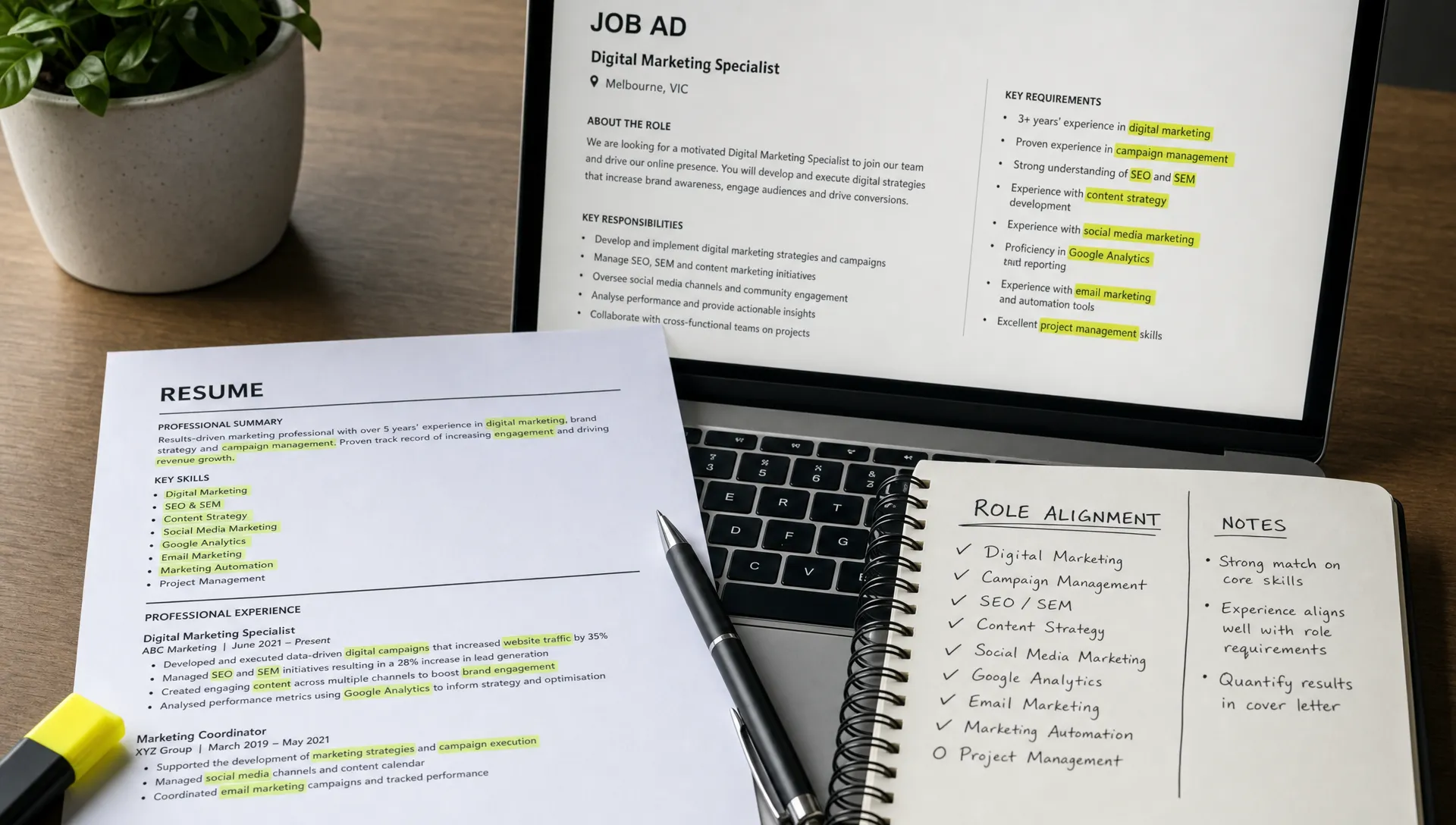
Recruiters and hiring managers often make quick decisions. If your resume does not quickly answer “why this person for this role?”, it may be passed over even if you are capable.
A strong resume should make your target role obvious, highlight the most relevant evidence near the top, and use language that matches the employer’s needs. If you are unsure whether your resume is doing that, start with the fundamentals of what a job resume is and why it matters.
The market you are applying in
Some roles receive far more applications than others. Entry-level marketing, customer service, administration, graduate programs, junior tech, and remote roles can attract large applicant pools. Niche technical roles, specialist roles, and jobs in less saturated locations may have fewer applicants.
Seniority changes the strategy too. Senior and executive roles are often filled through networks, retained search, and confidential recruitment processes rather than only public job ads. For example, candidates in leadership or business-critical functions may benefit from understanding how specialist recruiters focused on executive and strategic hiring approach the market.
Timing
Applying early can matter. Once a role has received a strong pool of applicants, employers may start screening before the closing date. If you consistently apply late, your application may be technically received but practically overlooked.
A good habit is to set alerts for your target role titles and apply within the first few days where possible. Speed should not replace quality, but it can improve your odds when combined with a tailored resume.
Referrals and networking
A referral does not guarantee an interview, but it can help your application get seen. Networking is especially useful when you are changing careers, returning to work, or trying to break into an industry where your resume does not tell the full story.
Networking does not need to feel forced. It can be as simple as asking thoughtful questions, reconnecting with former classmates or colleagues, or reaching out to people who have moved into the kind of role you want.

What your application count is telling you
Your application count is useful only when paired with outcomes. Instead of asking whether 50 applications is “too many”, look at what happened after those applications.
If you get no interviews after 15 to 20 targeted applications
This is usually a signal to pause and review your strategy. It may mean your resume is too generic, you are applying outside your realistic role fit, or your experience is not being translated well enough.
Before sending another batch, check whether your resume clearly matches the job ads you are targeting. Look at the top requirements across five roles and ask whether your resume proves those requirements in the first half of the document.
If you get screenings but no second interviews
Your resume is probably doing some of its job. The issue may be how you explain your experience, your salary expectations, your communication style, or your understanding of the role.
At this stage, practise short answers to common questions such as “tell me about yourself”, “why this role?”, and “walk me through your experience”. You should be able to connect your background to the role without sounding scripted.
If you reach final interviews but do not receive offers
This often means you are competitive, but another candidate is presenting a stronger match. Review whether you are showing enough evidence, asking strong questions, and addressing any concerns about your experience.
Final-stage rejection is frustrating, but it is also a sign that your application strategy is close. The fix may be refinement rather than a full reset.
Quality or quantity: which matters more?
You need both, but not in equal amounts.
If you apply to only two jobs per month, even excellent applications may not create enough opportunities. If you apply to 50 jobs per week with the same generic resume, you may create activity without progress.
A balanced weekly target for many job seekers is:
- Five to ten targeted applications: Focus on roles where you can clearly show fit.
- Two to five networking actions: Message alumni, former colleagues, recruiters, or people in your target field.
- One resume improvement session: Review your evidence, keywords, and achievements.
- One pipeline review: Track which roles led to responses and which did not.
This approach gives you enough volume to learn from the market while still maintaining quality.
If you want a practical system for improving each application instead of simply sending more, read Versadox’s guide on getting a job faster with a smarter application.
How to reduce the number of applications you need
The goal is not to send the most applications. The goal is to improve your application-to-interview rate.
Start by narrowing your target. Instead of applying to “anything in business”, choose a role family such as marketing coordinator, customer success associate, junior data analyst, HR assistant, or graduate project officer. A narrower target makes your resume easier to align.
Next, compare your resume against real job ads. Look for repeated requirements, tools, tasks, and soft skills. If the same requirement appears across multiple ads and your resume does not mention it, that is a gap.
Then adjust your resume for the role. You do not need to rewrite everything each time. Focus on the sections employers scan first: your summary, skills, recent experience, projects, and achievements. Your goal is to make the strongest evidence impossible to miss.
Finally, track outcomes. A simple spreadsheet or job search tracker can show which role types are producing interviews. If customer support roles respond but marketing roles do not, your market signal is telling you something useful.
When more applications are not the answer
More applications are not always the best next step. Sometimes the smarter move is to stop, diagnose, and rebuild.
Pause your application volume if:
- You are using the same resume for very different roles.
- You cannot explain why you are a strong fit for the jobs you are applying to.
- You are applying mainly because the role is easy to apply for.
- Your resume focuses on duties but not outcomes.
- You have no tracking system and cannot measure what is working.
This is especially important for students, graduates, and career changers. If your experience is still developing, positioning matters. A project, internship, casual job, volunteer role, or university assignment can become valuable evidence if it is framed around the employer’s needs.
So, how many applications should you send each week?
For most job seekers, a realistic weekly target is five to ten strong applications. That number is high enough to keep momentum and low enough to allow tailoring.
If you are unemployed and actively searching full-time, you may be able to send more. But even then, quality control matters. A productive week might include applications, networking, interview preparation, resume improvements, and follow-ups.
If you are studying, working, or managing other responsibilities, aim for consistency. Three strong applications every week for eight weeks is usually better than 30 rushed applications in one weekend followed by silence.
The best application pace is one you can sustain while still learning from feedback.
Frequently Asked Questions
How many job applications does it take to get hired on average? Many job seekers should plan for 30 to 80 targeted applications, but the number can be lower with strong alignment, referrals, or niche skills. Graduates, career changers, and applicants in competitive markets may need 100 or more.
Is 100 job applications too many? Not necessarily. It depends on the results. If 100 applications produced interviews and final rounds, you may be close. If they produced no responses, the issue is likely your targeting, resume alignment, or application quality.
How many jobs should I apply for per day? A good target is one to two strong applications per weekday. That usually produces five to ten quality applications per week without forcing you to send generic resumes.
Should I apply for jobs if I do not meet every requirement? Yes, if you meet the core requirements and can show relevant evidence. Avoid applying when you meet only a small portion of the role and cannot explain how your experience transfers.
Why am I applying to many jobs and getting no interviews? Common reasons include a generic resume, weak alignment with job descriptions, missing keywords, unclear achievements, applying too late, or targeting roles that do not match your current evidence.
Stop guessing and improve your odds before you apply
Application volume matters, but readiness matters more. If you are sending job applications without knowing how well your resume matches the role, you are relying on hope instead of strategy.
Versadox helps job seekers compare their resume and cover letter against real roles, identify gaps, understand readiness, and make guided improvements before applying. For students, graduates, and career changers, that can turn the job search from a numbers game into a clearer, more focused process.





.svg)