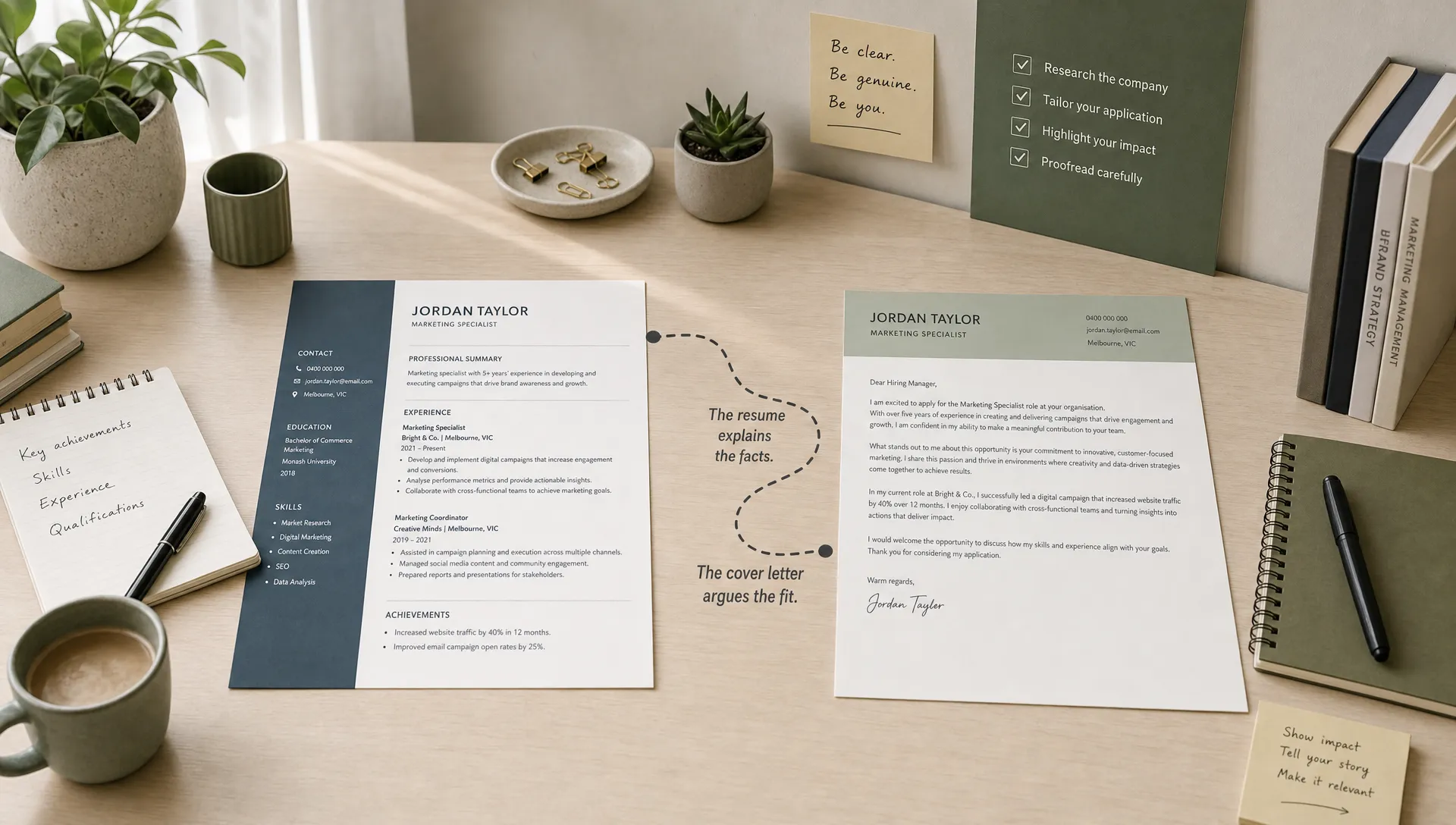
Your work experience section is usually the first place an employer looks for proof. A good resume work experience description does more than list what you were paid to do. It shows what you handled, how you worked, what changed because of your effort, and why that experience is relevant to the role you want next.
That matters whether you are applying for your first graduate role, shifting industries, or trying to move into a higher-responsibility position. Employers are not only asking, "Have you done this before?" They are also asking, "Can I trust this person to do it here?"
The good news is that improving your work experience section is not about exaggerating. It is about translating your real experience into clearer, more specific evidence.
Why your work experience description matters so much
A resume is not a career history document in the broad sense. It is a selection document. Its job is to help a recruiter, hiring manager, or applicant tracking system quickly understand whether your background matches the role.
That is why two people with similar experience can get very different results. One resume might say:
- Responsible for customer service and admin tasks.
Another might say:
- Supported 40+ customers per shift, resolved booking and payment issues, and maintained accurate records in a fast-paced retail environment.
The second version gives the employer more to work with. It includes scale, context, responsibility, and relevant skills. It also sounds more credible because it shows evidence instead of relying on generic claims.
If your resume is getting ignored, your experience may not be weak. It may simply be under-described.
What weak work experience descriptions have in common
Most weak descriptions fall into one of a few patterns. They are often too vague, too focused on duties, or too disconnected from the job being targeted.
Common issues include:
- Listing tasks without explaining their importance.
- Using generic phrases like "helped with", "worked on", or "responsible for" too often.
- Leaving out numbers, tools, systems, customers, stakeholders, or outcomes.
- Describing the job as if the reader already understands the workplace.
- Using internal jargon that means little outside the organisation.
- Repeating the same bullet structure for every role.
A hiring manager does not need every detail of your previous job. They need the details that make your fit obvious.
For example, "handled stock" is technically accurate, but it is flat. "Maintained stock accuracy across 300+ product lines and coordinated replenishment during peak trading periods" is stronger because it reveals responsibility and working conditions.
A useful resume work experience description usually combines four elements:
Action + task + context + result
You will not include all four in every bullet, but this formula helps you move beyond basic duties.
For example:
- Coordinated weekly staff rosters for a team of 12, balancing availability, labour needs, and peak service periods.
- Prepared monthly sales reports in Excel, helping managers identify product trends and adjust ordering decisions.
- Responded to customer enquiries across phone and email, resolving common issues and escalating complex cases to senior staff.
These bullets work because they answer more than "What did you do?" They also answer "How much?", "For whom?", "Using what?", and "Why did it matter?"
If your current bullet starts with "responsible for", try rewriting it with a stronger verb. Instead of "Responsible for training new team members", write "Trained 6 new team members on customer service standards, POS procedures, and shift routines."
Start with the role you want, not only the role you had
One of the biggest mistakes job seekers make is writing their work experience section in isolation. They describe their past role first, then hope it matches the job ad.
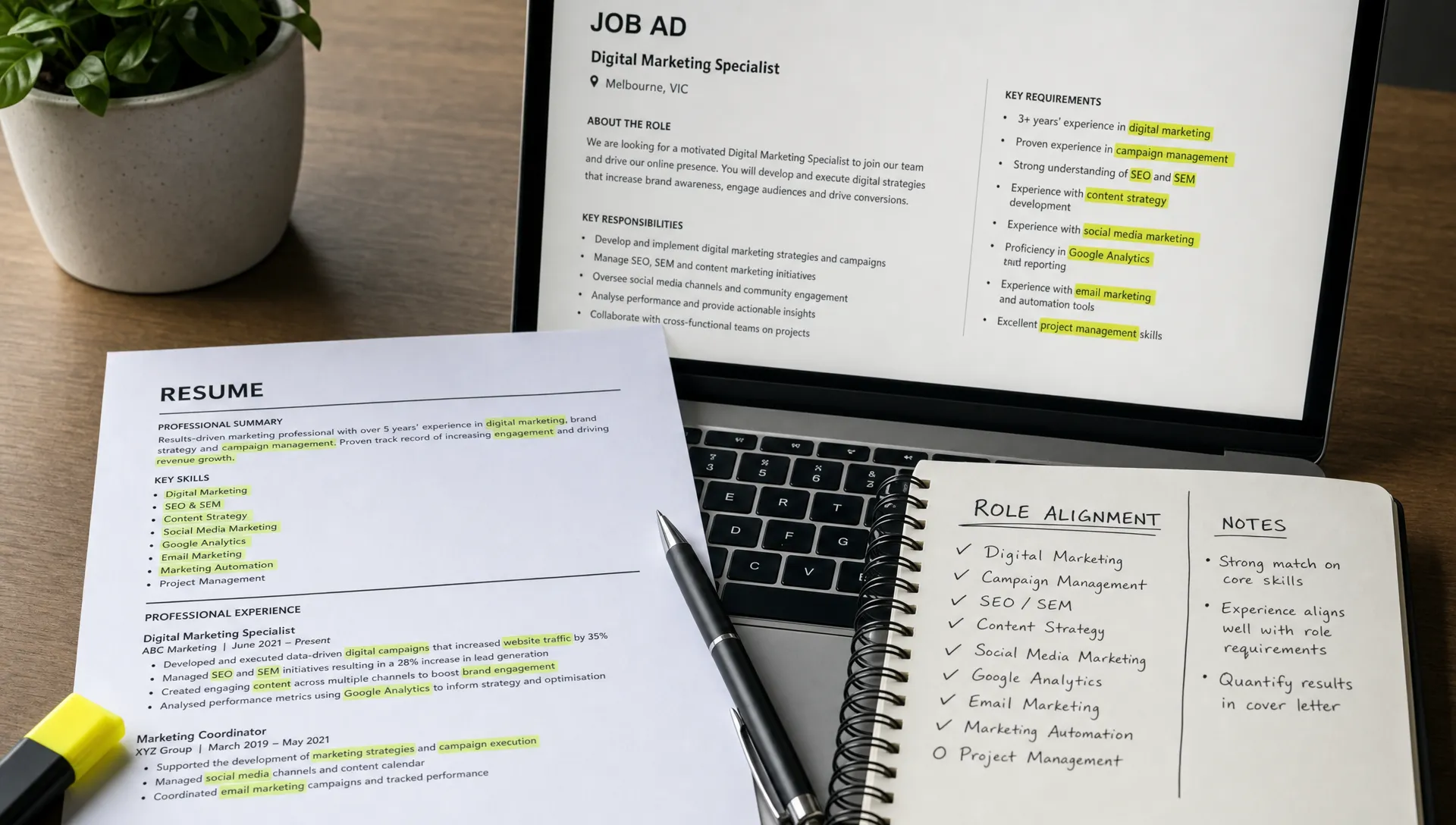
A better approach is to read the job ad before rewriting your bullets. Look for repeated themes. Are they asking for stakeholder communication, data entry, customer support, scheduling, sales targets, compliance, research, problem solving, or teamwork?
Then ask yourself where those themes appear in your experience.
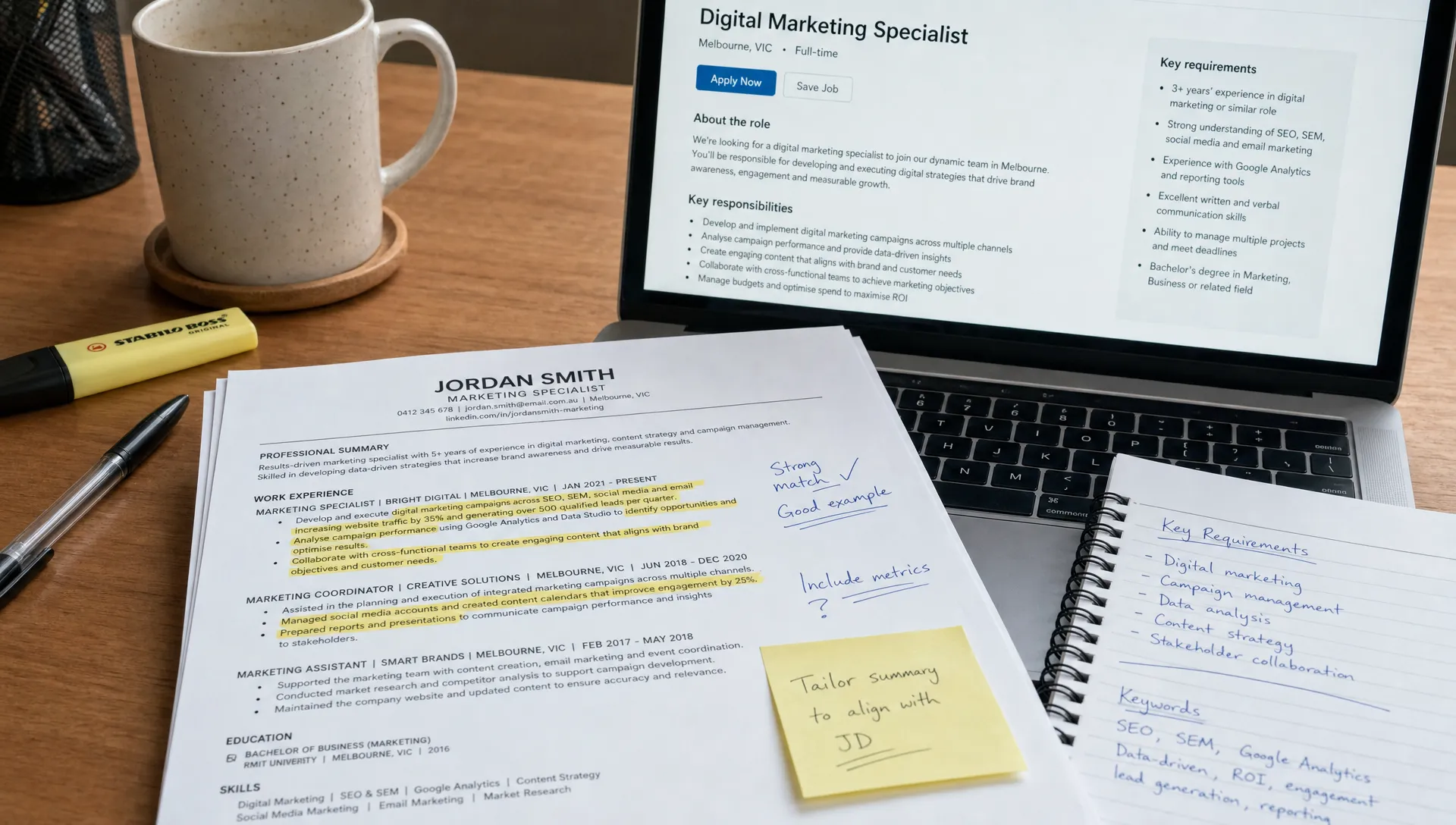
This does not mean copying the job ad or stuffing keywords into your resume. It means choosing the most relevant evidence from your background. If you are applying for an administration role, your rostering, document control, inbox management, and scheduling experience may matter more than general customer service. If you are applying for a marketing assistant role, your content, reporting, campaign support, and social media examples become more important.
This is also why a strong work experience section should connect with the rest of your resume. Your summary should introduce your positioning, while your experience proves it. If your opening section feels disconnected, revisit how to write a strong job summary for your resume so the whole document points in the same direction.
Turn duties into contributions
Many job seekers undersell themselves because they only write what was on the position description. But employers are not hiring a job description. They are hiring a person who can contribute.
To find stronger content, ask better questions about each role:
- What problems did I help solve?
- What processes did I improve, support, or keep running?
- Who relied on my work?
- What happened faster, smoother, safer, or more accurately because of my work?
- What tools, systems, or documents did I use?
- What volume of work did I handle?
- What feedback, recognition, or trust did I receive?
For example, a hospitality worker may think they only "served customers". But the contribution may include managing high-volume service, handling complaints, training casual staff, coordinating with kitchen teams, processing payments, and maintaining standards under pressure.
A retail assistant may think they only "worked at the counter". But the contribution may include product advice, stock replenishment, cash handling, visual merchandising, complaint resolution, and meeting sales targets.
A student project may seem small, but it can still show research, collaboration, presentation skills, data analysis, planning, and accountability. The key is to write it in employer language.
Add numbers where they genuinely help
Numbers make experience easier to understand. They add scale and credibility. You do not need dramatic revenue figures or perfect metrics. Simple numbers can still make a bullet stronger.
Useful numbers can include:
- Team size.
- Number of customers, calls, orders, files, or enquiries handled.
- Frequency, such as daily, weekly, or monthly.
- Timeframes and deadlines.
- Budget size, if appropriate and approved to share.
- Accuracy, turnaround time, attendance, ranking, or target achievement.
- Number of locations, products, accounts, or stakeholders supported.
A stronger bullet does not always need a final outcome like "increased sales by 20%". In many junior, casual, or entry-level roles, you may not have access to business results. That is fine. You can still show responsibility and scope.
For example:
- Processed 80+ customer transactions per shift while maintaining accuracy across cash, EFTPOS, and refund procedures.
- Managed a shared inbox of 50+ daily enquiries, prioritising urgent requests and updating internal records.
- Supported onboarding for 10 new volunteers by preparing materials, explaining procedures, and answering first-shift questions.
If you work in sales, partnerships, growth, or business development, it is also worth understanding how employers talk about pipeline, conversion, and commercial outcomes. Resources focused on revenue acceleration for founder-led B2B companies can help you recognise the kind of language commercial teams use when describing growth, diagnostics, and revenue performance.
Choose action verbs that match the level of responsibility
Action verbs help, but only if they are accurate. Do not use "led" if you did not lead. Do not use "strategised" if you were following a process. Strong writing is specific, not inflated.
Use verbs that match what you actually did:
- For service roles: resolved, supported, advised, assisted, welcomed, processed, coordinated.
- For admin roles: organised, maintained, scheduled, documented, updated, prepared, tracked.
- For technical roles: analysed, tested, configured, built, reviewed, troubleshot, implemented.
- For leadership roles: trained, supervised, delegated, coached, improved, managed, guided.
- For project roles: planned, researched, presented, collaborated, delivered, evaluated, reported.
The verb is only the start. "Managed" is not impressive by itself. "Managed weekly appointment scheduling for three practitioners, reducing double-booking issues and improving daily workflow" is much clearer.
Align your work experience with relevant skills
A strong experience section should prove the skills you claim elsewhere on your resume. If your skills section says "communication", your work experience should show communication in action. If it says "Excel", include the reports, reconciliations, trackers, or analysis you completed.
This is where many resumes feel disconnected. The skills section lists broad abilities, but the experience section does not back them up. Employers notice that gap.
For a more strategic approach, review which skills for your resume employers actually notice, then make sure your work experience gives evidence for the most relevant ones.
Think of each bullet as proof. Instead of writing "strong teamwork skills" in isolation, show it:
- Collaborated with front-of-house and kitchen teams during peak service to coordinate orders, manage customer expectations, and maintain service flow.
That bullet proves teamwork, communication, time management, and customer awareness without listing them as empty claims.
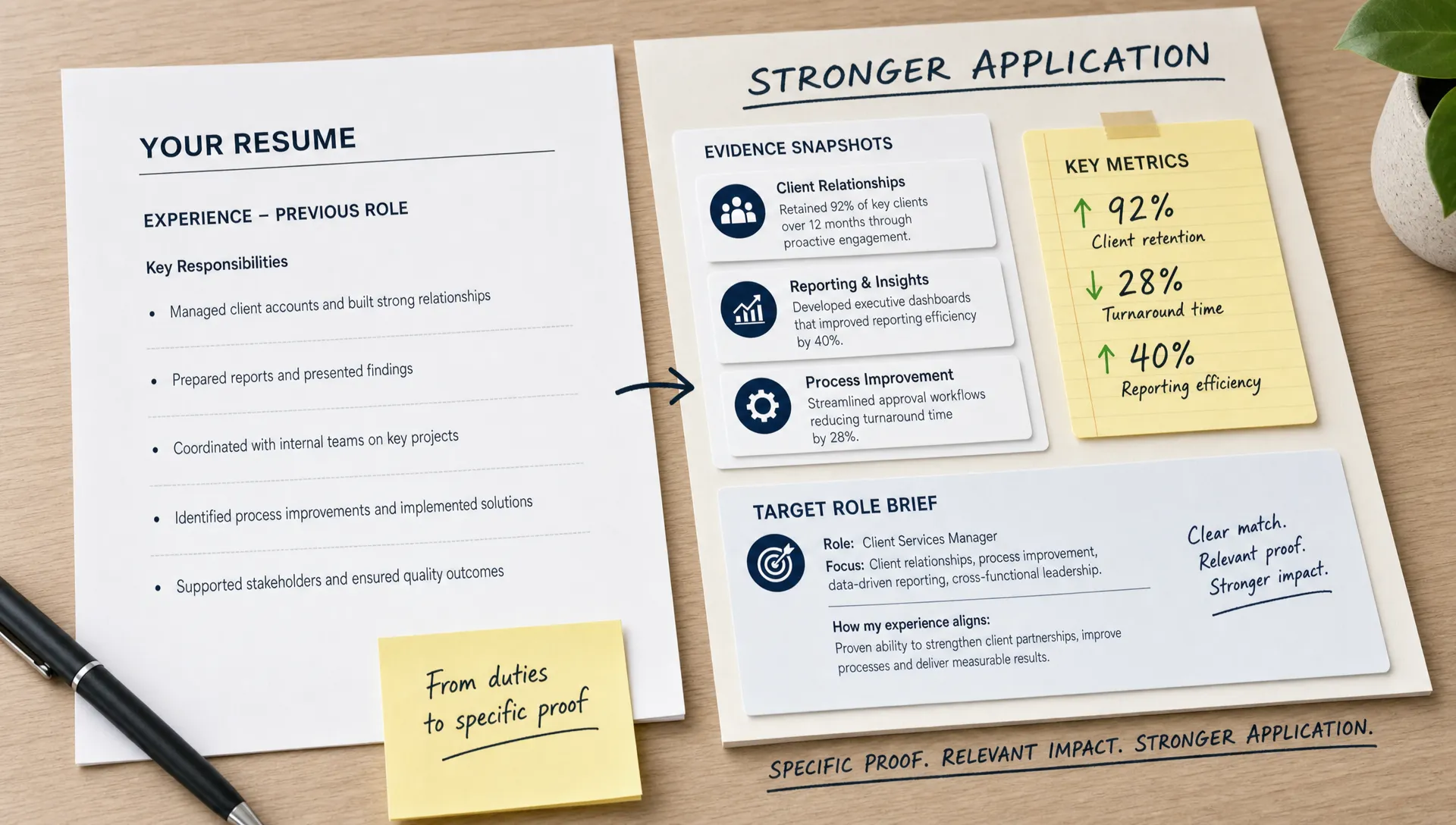
Before and after examples
Sometimes the fastest way to improve your resume is to compare weak and stronger versions of the same experience.
Customer service example
Weak version:
- Worked in customer service and answered questions.
Stronger version:
- Assisted 60+ customers per shift with product enquiries, refunds, and payment issues while maintaining a calm and professional service experience.
Why it works: The stronger version gives volume, task variety, and behaviour under pressure.
Administration example
Weak version:
- Did admin work and helped the team.
Stronger version:
- Maintained appointment records, updated client files, and prepared daily schedules to support accurate communication between staff and customers.
Why it works: It replaces vague support language with specific administrative tasks and explains why they mattered.
Graduate project example
Weak version:
- Completed a university group project on sustainability.
Stronger version:
- Researched sustainable packaging options with a team of five, analysed supplier data, and presented recommendations in a final report assessed at distinction level.
Why it works: It shows teamwork, research, analysis, communication, and achievement.
Career change example
Weak version:
Stronger version:
- Coordinated daily café operations, including staff allocation, supplier communication, cash handling, and customer issue resolution in a high-pressure service environment.
Why it works: It translates hospitality experience into transferable operational skills.
How to improve descriptions when you have limited experience
If you are a student, graduate, or early-career applicant, you may worry that you do not have enough experience to write strong bullet points. But employers know you are not applying with 10 years of experience. They are looking for signals of potential, reliability, learning ability, and fit.
You can draw from:
- Casual jobs.
- Internships.
- University projects.
- Volunteering.
- Club or society roles.
- Sports leadership.
- Family business support.
- Freelance or personal projects.
The key is to describe the experience professionally. A group assignment is not just "uni work" if it involved research, deadlines, stakeholder interviews, data analysis, or a presentation. A casual job is not "just retail" if it involved customer service, conflict resolution, stock management, sales, and teamwork.
For career changers, the same principle applies. Do not make the reader work to translate your background. If you are moving from teaching into learning design, highlight curriculum planning, student engagement, assessment, content development, and stakeholder communication. If you are moving from hospitality into office administration, highlight scheduling, records, supplier coordination, customer communication, and process discipline.
Tailor each role without rewriting everything
You do not need to rebuild your whole resume for every application. But you should adjust the emphasis.
A practical approach is to create a master version of your resume with more bullet points than you normally send. For each application, choose the most relevant bullets and reorder them so the strongest evidence appears first.
For example, if one job ad focuses on customer service, put customer-facing bullets higher. If another focuses on reporting and systems, lead with data, documentation, and process examples.
This is one of the simplest ways to build a smarter application. Instead of sending the same generic resume everywhere, you are making small, targeted decisions that help the employer connect your background to their role. If your broader job search feels scattered, this guide on how to get a job faster with a smarter application explains how targeting and evidence can improve your momentum.
Common mistakes to avoid
Improving your work experience section is not only about adding stronger content. It is also about removing what weakens your message.
Avoid these habits:
- Writing full sentences for every bullet when concise phrases would be stronger.
- Including every task you ever performed, even when it is irrelevant.
- Using the same verb repeatedly across multiple bullets.
- Overstating your responsibility or claiming outcomes you cannot explain.
- Using acronyms or internal system names without context.
- Letting older, less relevant roles take up more space than recent, relevant experience.
Also avoid making every bullet sound like a result if the result is forced. Employers can usually tell when a metric has been added just to look impressive. It is better to be clear and credible than dramatic and vague.
How many bullet points should each role have?
There is no perfect number, but relevance should guide the length.
For a recent or highly relevant role, three to six bullet points is often enough. For an older or less relevant role, one to three may be plenty. If a job was short-term, casual, or not closely related to your target role, keep it concise.
Put the strongest bullet first. Recruiters often skim, so do not hide your best evidence at the bottom. If you trained staff, handled complex customers, improved a process, supported reporting, or managed high-volume work, lead with that.
Your goal is not to make every job look equally important. Your goal is to make your most relevant experience easy to find.
A quick editing checklist
Before you send your resume, review each work experience description and ask:
- Does this bullet show what I actually did?
- Does it include useful context, scale, tools, or outcomes?
- Is it relevant to the job I am applying for?
- Could someone outside my previous workplace understand it?
- Does it prove a skill I want the employer to notice?
- Is the wording concise and professional?
If the answer is no, revise the bullet. Often, small changes make a big difference.
For example, "helped manager with reports" can become "Prepared weekly sales and attendance reports for the store manager using spreadsheet templates and POS data." The experience did not change. The clarity did.
Frequently Asked Questions
What is a resume work experience description? A resume work experience description is the set of bullet points under each job or experience entry that explains what you did, the context you worked in, and the value or skills you demonstrated.
How do I make my work experience sound better without lying? Focus on specificity. Add context, numbers, tools, stakeholders, and outcomes where accurate. You are not exaggerating your role, you are explaining it in clearer employer language.
Should I include every job duty on my resume? No. Include the duties and achievements most relevant to the role you want. A resume should be targeted, not exhaustive.
What if I do not have measurable achievements? Use scale and context instead. Mention the number of customers served, files handled, shifts completed, reports prepared, systems used, or team members supported.
Can I use AI to improve my resume work experience section? Yes, but review the output carefully. AI can help with structure and phrasing, but you should make sure every bullet is accurate, specific, and matched to your real experience.
Build a stronger resume before you apply
A better work experience section can change how employers read your whole resume. When your bullets are clear, relevant, and evidence-based, you make it easier for hiring teams to understand your value.
If you want to go beyond guesswork, Versadox helps you compare your resume against real roles, identify gaps, improve your application, and build stronger resumes and cover letters with more confidence. Before you apply, check whether your experience is telling the right story.





.svg)