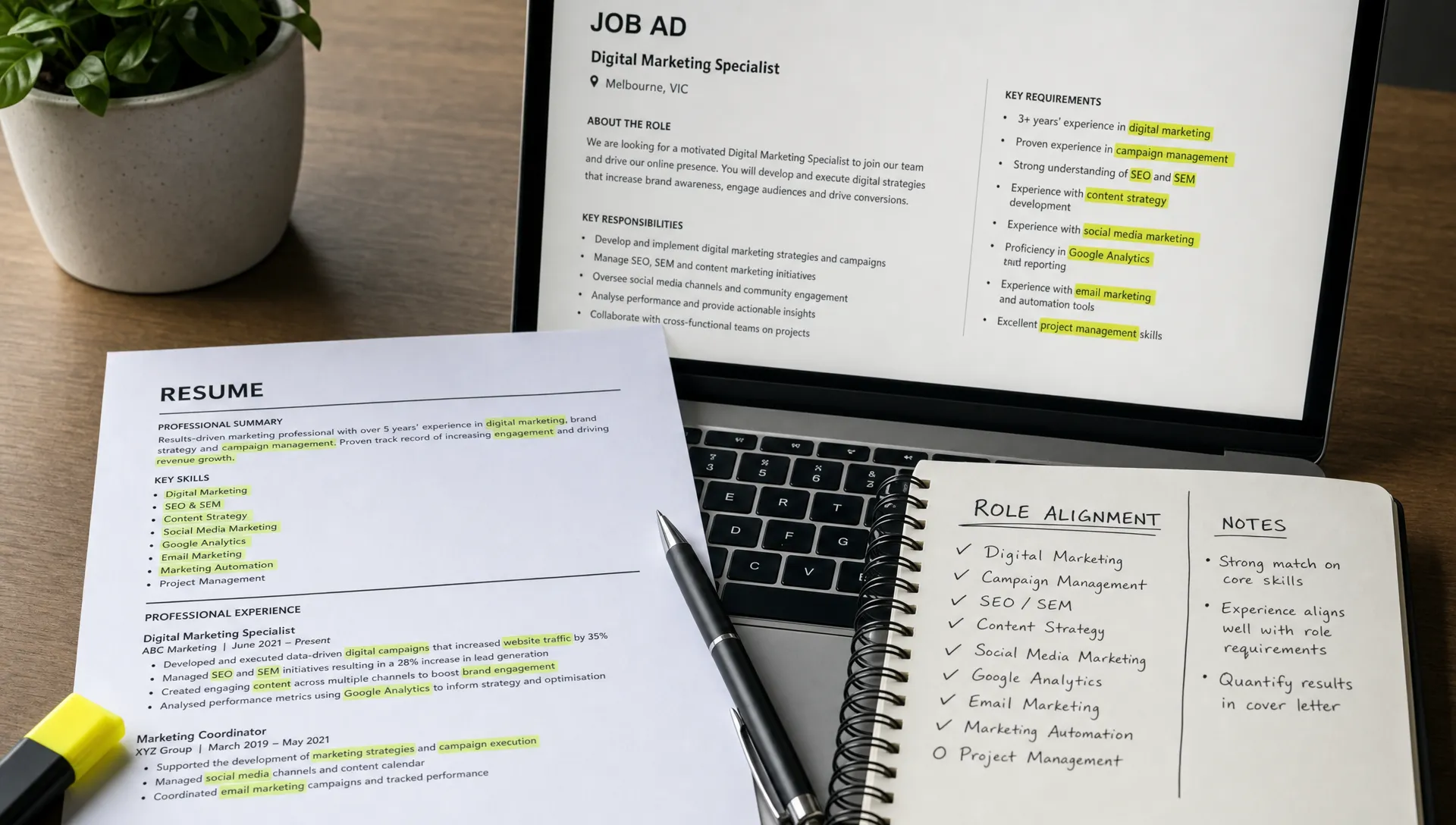
Matching your resume to a job does not mean rewriting your entire career history every time you apply. It means making the most relevant parts of your experience easier for the employer to find, understand and trust.
That distinction matters. A generic resume asks the reader to work out where you fit. A targeted resume shows them. For students, graduates and career changers, this can be the difference between looking “not experienced enough” and looking like a strong early-career candidate with the right transferable evidence.
If you are wondering how to match your resume to the job you want, the goal is simple: translate your background into the employer’s language without exaggerating, stuffing in keywords or pretending to have skills you do not have.
What resume matching really means
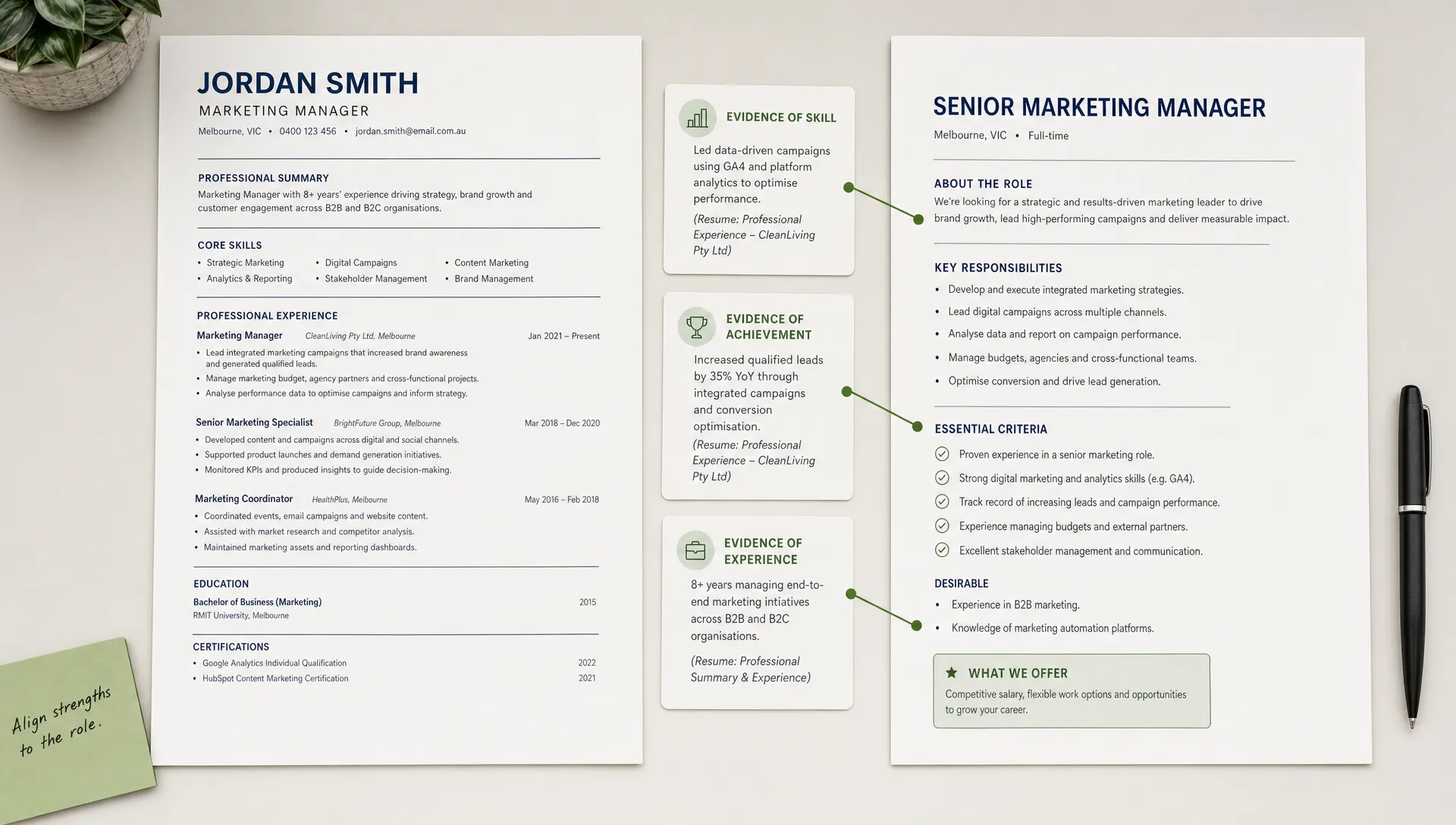
A matched resume is built around relevance. It connects three things: what the employer needs, what you have done and what you can credibly do next.
This does not mean every sentence must copy the job ad. In fact, keyword stuffing can make your resume feel unnatural and weak. Employers are not just looking for repeated words. They are looking for signals of fit, such as role-specific skills, evidence of outcomes, clear experience and sensible career direction.
A strong targeted resume usually answers these questions quickly:
- Can this person do the core tasks in the role?
- Have they worked with similar tools, people, responsibilities or environments?
- Do they understand what this job is actually for?
- Are there any obvious gaps that make the application risky?
- Is the resume clear enough to pass an initial screen?
When your resume answers those questions, it becomes easier for both applicant tracking systems and human reviewers to see why you belong in the shortlist.
Start with a clear target role, not a vague job search
Before editing your resume, define the type of role you want. Many job seekers apply across too many unrelated jobs and then wonder why their resume feels difficult to tailor. If one application is for marketing assistant, another is for customer service officer and another is for junior data analyst, your resume will keep pulling in different directions.
You do not need to target only one job title, but you do need a role family. A role family is a cluster of jobs that need similar evidence. For example, “graduate marketing and communications roles” is clearer than “anything in business”. “Entry-level IT support roles” is clearer than “tech jobs”. “Retail team leader and assistant store manager roles” is clearer than “management”.
Once you choose a role family, your resume decisions become easier. You can decide which skills to highlight, which achievements to bring forward and which older or less relevant details to shorten.
If your job search still feels too broad, it may help to step back and build a more focused application process. Versadox has a related guide on using a smarter application approach so you are not sending the same resume into every opening and hoping for the best.
Decode the job ad before touching your resume
Most job seekers read a job ad once, notice a few keywords and start editing. A better approach is to treat the ad like a brief from the employer. It tells you what problem they are hiring to solve.
Read the job ad three times, each time looking for a different layer.
- Responsibilities: What will the person actually do each week? Look for verbs such as coordinate, analyse, support, manage, prepare, communicate, process, troubleshoot or report.
- Requirements: Which skills, qualifications, tools or experiences are marked as essential or highly desirable? These usually need to appear clearly in your resume if you have them.
- Context: What kind of workplace is this? Look for clues such as fast-paced, client-facing, regulated, high-volume, remote, collaborative, startup, government, hospitality, education or healthcare.
The context layer is often where stronger applicants stand out. For example, two roles might both ask for “communication skills”, but one needs customer complaint handling and the other needs written stakeholder updates. Those are not the same evidence.
You can also research the broader occupation through sources such as Jobs and Skills Australia, especially if you are changing careers or applying for roles in an unfamiliar industry. This can help you understand common skill expectations before you tailor your resume.
Use company and industry language carefully
A job ad gives you role language. The company website gives you business language. Industry research gives you environment language. Together, they help you make your resume feel more aligned.
For example, if you are applying for operations, finance or product roles in travel technology, you might notice repeated themes around payment security, reconciliation, cash flow and compliance. Reviewing a niche platform such as Elia Pay can help you understand the kinds of problems travel businesses care about, which may influence the examples you choose to highlight if they are genuinely relevant to your background.
The key phrase is “genuinely relevant”. Do not add industry terms just because they sound impressive. Use them when they accurately describe work you have done, tools you have used, customers you have supported or problems you understand.
Build a job-fit evidence bank
Once you understand the job, gather proof before rewriting. This is especially useful if you are a student, graduate or career changer and your experience does not perfectly match the job title.
Your evidence bank can include paid work, internships, volunteering, university projects, placements, extracurricular leadership, freelance work, family business experience, community roles and personal projects. The employer does not only care where the skill came from. They care whether the skill is real and transferable.
For each target role, collect examples under a few simple headings:
- Relevant technical or practical skills
- Customer, client or stakeholder experience
- Communication examples
- Problem-solving examples
- Tools, systems or software used
- Measurable outcomes, improvements or responsibilities
- Projects that show initiative or learning ability
This gives you raw material to choose from. Instead of trying to make every past role sound relevant, you can select the evidence that best matches the opportunity.
Rewrite your summary around the role
Your resume summary is often the first section a recruiter reads, so it should not be a generic statement about being hardworking, passionate or motivated. Those qualities are fine, but they are not enough on their own.
A matched summary should quickly show your target role, your most relevant strengths and the type of value you can bring. It should feel specific to the role family without sounding like a copy of the job ad.
For example, a weak summary might say:
“I am a motivated graduate looking for an opportunity to grow my skills in a professional environment.”
A stronger version for an entry-level marketing role might say:
“Marketing graduate with experience creating social content, analysing campaign performance and coordinating university society events. Confident using Canva, Meta Business Suite and Google Analytics, with strong writing skills and a practical interest in customer engagement.”
The second version works better because it gives the reader useful evidence. It names the direction, shows relevant tools and links experience to likely job needs.
If this section is difficult to write, start with the role first, then add proof. You can also use the Versadox guide on how to write a stronger resume summary to shape the opening section without sounding vague.
Match your skills section to the job, not every skill you have
A long skills list can look impressive at first glance, but it often weakens your resume if it is unfocused. The best skills section is selective. It highlights the skills the employer is most likely to care about for this role.
Start by separating skills into two groups. First, list the must-have skills from the job ad that you genuinely have. Second, list supporting skills that strengthen your fit but are not the main screening criteria.
For example, if a job ad asks for Excel, customer service, data entry and attention to detail, those should be easy to find on your resume. If you also have photography, event planning and basic HTML, include them only if they support the role.
Where possible, make skills specific. “Microsoft Excel” is clearer than “computer skills”. “Complaint resolution” is clearer than “people skills”. “Inventory management” is clearer than “retail experience”. Specific skills are easier to match and easier to believe.
There is also a difference between claiming a skill and proving it. If a job requires stakeholder communication, do not only list “communication”. Show it in a bullet, such as preparing weekly updates, handling customer enquiries, presenting project findings or coordinating with suppliers.
For more depth on this, Versadox has a practical guide to choosing resume skills employers actually notice, which is especially helpful if your current skills section feels too broad.
Rework experience bullets so they prove fit
Your experience section should not read like a job description copied from your old role. Employers already know what a cashier, intern, tutor or admin assistant might generally do. They want to know what you did, how you did it and why it matters for this role.
A useful structure is:
- Action verb
- Task or responsibility
- Skill or method used
- Result, scale or purpose
For example, instead of writing “Responsible for customer service”, you could write:
“Resolved customer enquiries in a high-volume retail environment, using product knowledge and calm communication to support positive store experiences.”
Instead of “Worked on group assignments”, you could write:
“Coordinated a four-person university project, managed weekly task allocation and delivered a research presentation on consumer behaviour trends.”
Instead of “Used Excel”, you could write:
“Maintained Excel tracking sheets for weekly stock counts, improving visibility of low-stock items for the store supervisor.”
Notice that these examples do not exaggerate. They simply make the evidence more useful. The reader can now see communication, coordination, Excel use, organisation and responsibility.
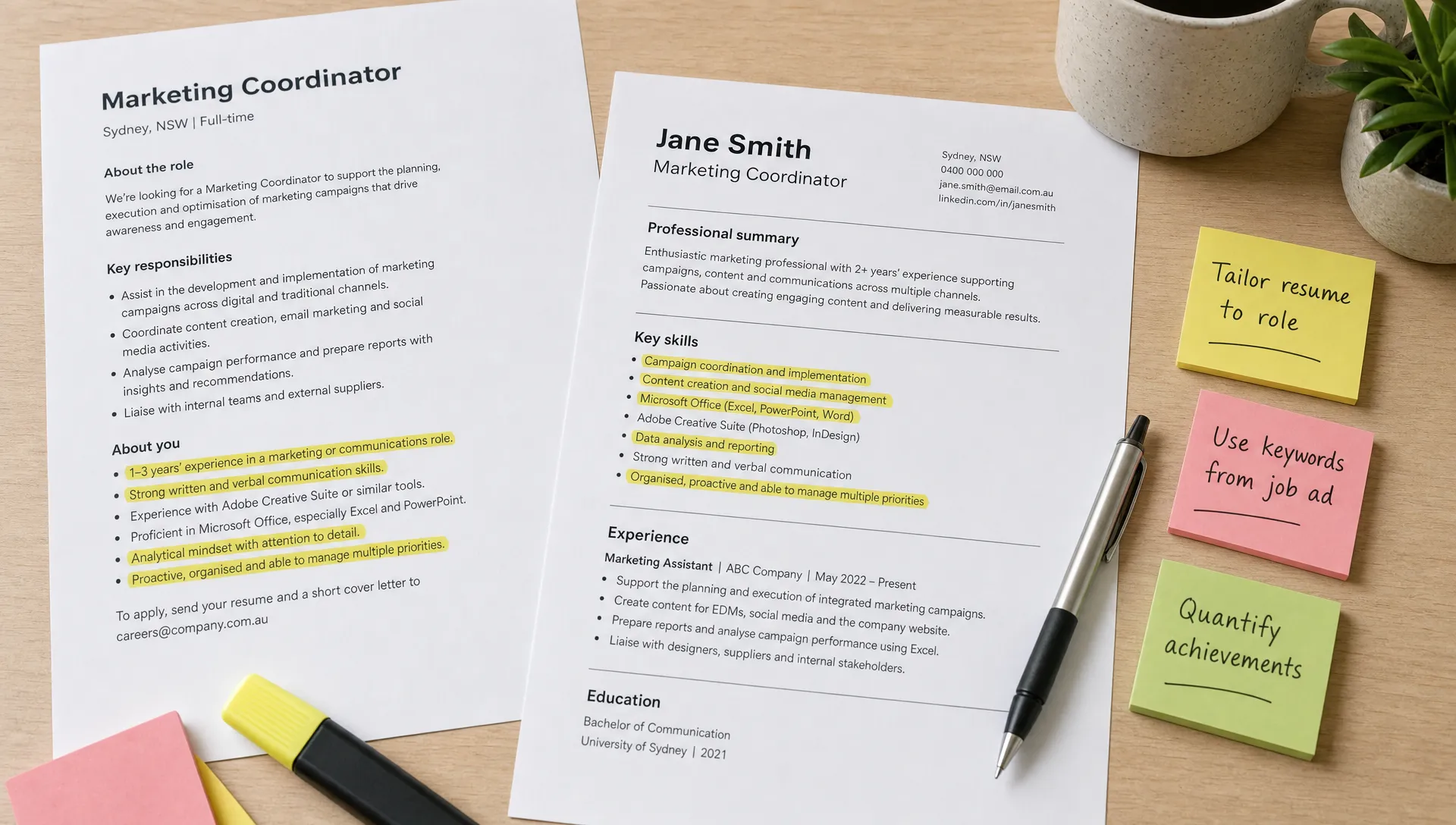
Bring the most relevant details higher
Resume matching is not only about wording. It is also about order. The most relevant information should appear where the reader is most likely to notice it.
If you are applying for a graduate accounting role and your part-time café work is listed before your accounting internship, the resume may not be helping you. If you are applying for an IT support role and your technical projects are buried under unrelated casual jobs, move them higher.
Depending on your background, you might adjust the order of sections like this:
- Put a relevant internship, placement or project above unrelated casual work.
- Move technical skills higher for technical roles.
- Add a projects section if your strongest evidence comes from study or self-directed work.
- Keep education near the top if you are a student or recent graduate.
- Keep recent professional experience near the top if it is already relevant.
This is not about hiding anything. It is about making the employer’s decision easier. If your best evidence is on page two, many readers may never get to it.
Address gaps without making them the focus
Most applicants have some gaps. You might be missing a tool, lack industry experience or be applying from a different field. A good tailored resume does not pretend the gap does not exist. It reduces concern by showing nearby evidence.
If you have not used the exact software in the job ad, show similar systems you have learned. If you do not have direct industry experience, show transferable context such as customer handling, compliance, reporting, sales support, scheduling or stakeholder coordination. If you lack paid experience, use projects, placements or volunteering to show capability.
For example, a career changer moving from hospitality to office administration might highlight:
- Rostering and shift coordination
- Supplier communication
- Cash handling and daily reconciliation
- Customer complaint resolution
- Training new staff
- Use of booking, point-of-sale or inventory systems
These examples do not claim office experience where it does not exist. They show the employer that the candidate has already practised relevant behaviours in another environment.
Keep your resume ATS-friendly
Many employers use applicant tracking systems to store, filter or search applications. Even when a human makes the final decision, your resume still needs to be easy for software to read.
An ATS-friendly resume is usually simple, clear and consistent. It uses standard headings, readable formatting and relevant language from the job ad where accurate. It avoids unnecessary graphics, confusing layouts and vague section names.
Practical ATS-friendly habits include:
- Use headings such as Summary, Skills, Experience, Education and Projects.
- Save and export in the format requested by the employer, often PDF or Word.
- Use standard job titles where possible, even if your internal title was unusual.
- Include important tools and qualifications in plain text.
- Avoid relying on images, icons or columns to communicate key information.
Versadox includes ATS-ready templates and PDF export, which can help you present your information cleanly while focusing your energy on alignment and evidence.
Do a final role-alignment check
Before applying, review your resume against the job ad one more time. This final check should be honest. You are not trying to force a perfect score. You are trying to identify whether your application gives you a realistic chance.
Ask yourself:
- Does my summary clearly point toward this role?
- Are the top skills aligned with the job ad’s main requirements?
- Have I shown evidence for the most important responsibilities?
- Are my strongest examples easy to find in the first half of the resume?
- Have I removed irrelevant detail that distracts from my fit?
- Are there gaps I should address through a project, course, cover letter or different role target?
This is where a career intelligence platform can make the process more objective. Versadox helps job seekers compare applications against real roles, identify gaps, review role alignment and use market readiness scoring before applying. Instead of guessing whether your resume is close enough, you can see where it needs improvement and make guided updates with more confidence.
Example: tailoring a resume for a graduate business analyst role
Imagine you are applying for a graduate business analyst role. The job ad mentions stakeholder communication, Excel, process improvement, documentation and problem-solving. You have a commerce degree, retail experience, a university consulting project and some Excel coursework.
A generic resume might lead with retail duties, list “teamwork” and “communication” as skills and mention the consulting project briefly under education. A matched resume would make different choices.
The summary would position you as a commerce graduate with experience analysing business problems, preparing reports and working with customers. The skills section would include Excel, data analysis, stakeholder communication, process mapping if accurate and report writing. The project section would describe the consulting project in more detail, including the business problem, research approach and recommendation. Retail bullets would focus on customer needs, transaction accuracy, problem resolution and process improvements rather than general service tasks.
Nothing is invented. The same background is simply organised around the job the applicant wants.
That is the core of resume matching. You are not becoming a different candidate. You are helping the employer see the most relevant version of you.
Common mistakes to avoid
Even strong candidates can weaken their applications by tailoring in the wrong way. Watch for these mistakes before you apply.
- Copying whole phrases from the job ad without adding proof.
- Adding skills you cannot discuss in an interview.
- Making every bullet sound like a responsibility instead of an achievement or contribution.
- Leaving the same summary on every application.
- Overloading the resume with unrelated experience.
- Using design elements that make the resume harder to read.
- Applying for roles with major gaps and no plan to close them.
The best resume is not always the longest or most polished. It is the one that makes your fit clear, credible and easy to assess.
Frequently Asked Questions
How much should I change my resume for each job? You do not need to rewrite everything. Usually, you should adjust your summary, skills, selected bullet points and section order so the most relevant evidence matches the job ad.
Should I use the exact keywords from the job description? Use relevant wording from the job ad when it accurately reflects your experience. Do not force keywords into your resume or claim skills you do not have.
How do I match my resume if I do not have direct experience? Focus on transferable evidence from study, projects, volunteering, casual work or previous roles. Show related skills such as communication, analysis, coordination, customer service, systems use or problem-solving.
Is it okay to have different versions of my resume? Yes. In fact, it is smart to have different resume versions for different role families. A marketing resume, admin resume and analyst resume should not all emphasise the same evidence.
Can Versadox help me tailor my resume? Yes. Versadox helps job seekers assess role alignment, identify gaps, improve resumes and cover letters, use ATS-ready templates and compare applications against real roles before applying.
Apply with a resume that fits the role
A matched resume gives you more than better wording. It gives you clarity. You know what the employer wants, where your evidence is strong and what gaps you may need to close before applying.
If you want to stop guessing, use Versadox to score your resume, compare it against real roles and make guided improvements before you send your next application. The right role is easier to pursue when your resume is built to show why you fit.





.svg)