A strong cover letter should not sound like it was assembled from corporate spare parts. It should sound like a thoughtful, capable person has read the job ad, understood what matters, and can explain why they are a genuine fit.
That does not mean being casual, overly personal, or quirky for the sake of it. It means writing with enough clarity, evidence, and natural language that the employer can picture you in the role.
If you have ever searched “how do you write cover letter” and ended up with stiff templates full of phrases like “I am writing to express my sincere interest”, you are not alone. The challenge is not just knowing what to include. It is knowing how to make the letter feel specific, credible, and still recognisably yours.
Why so many cover letters sound the same
Most cover letters sound generic because job seekers are trying to be “professional” without knowing what professional actually sounds like. They remove anything personal, replace simple words with formal ones, and copy phrases they would never say in real life.
The result is usually polite but forgettable.
A cover letter that sounds like you does three things well:
- It explains your fit for this specific role, not every role you have ever applied for.
- It uses proof from your experience, study, projects, volunteering, or transferable work.
- It keeps your tone natural while still respecting the employer’s time.
That balance matters. Recruiters are not looking for a novel. They are looking for a clear signal that you understand the role and can bring relevant value.
Start by knowing what the cover letter is for
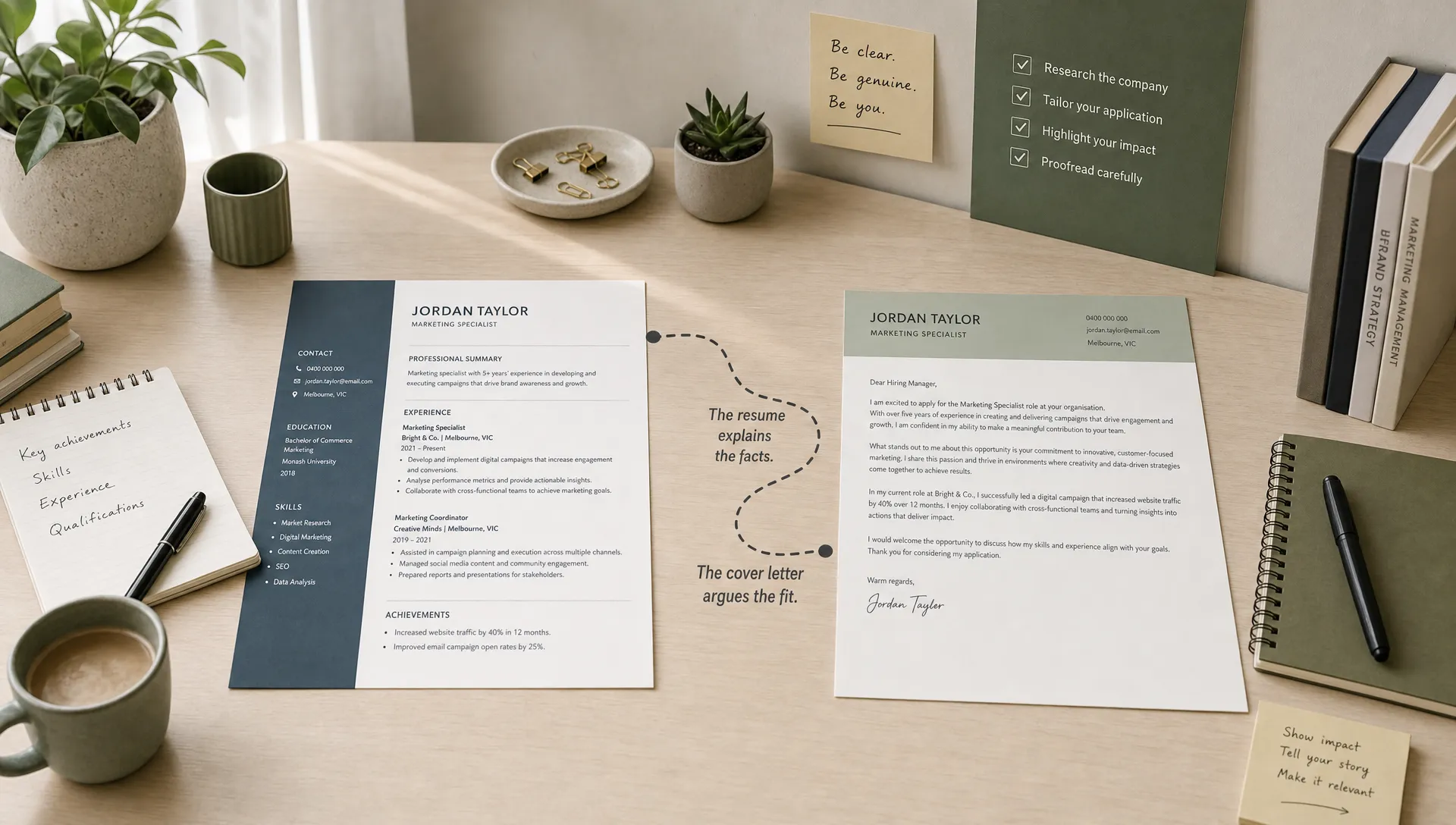
Your resume and cover letter should work together, but they do different jobs. Your resume gives the evidence: roles, achievements, skills, qualifications, and experience. Your cover letter connects that evidence to the opportunity in front of you.
If you are unsure where the boundary sits, this guide on what a cover letter and resume each really do is a useful starting point.
Think of the cover letter as your explanation of fit. It answers the employer’s quiet questions:
- Why this role?
- Why this organisation or industry?
- What relevant strengths do you bring?
- What proof supports those strengths?
- Why would you be a good person to interview?
When you write with those questions in mind, your letter becomes more focused and less likely to drift into filler.
Before you write, translate the job ad
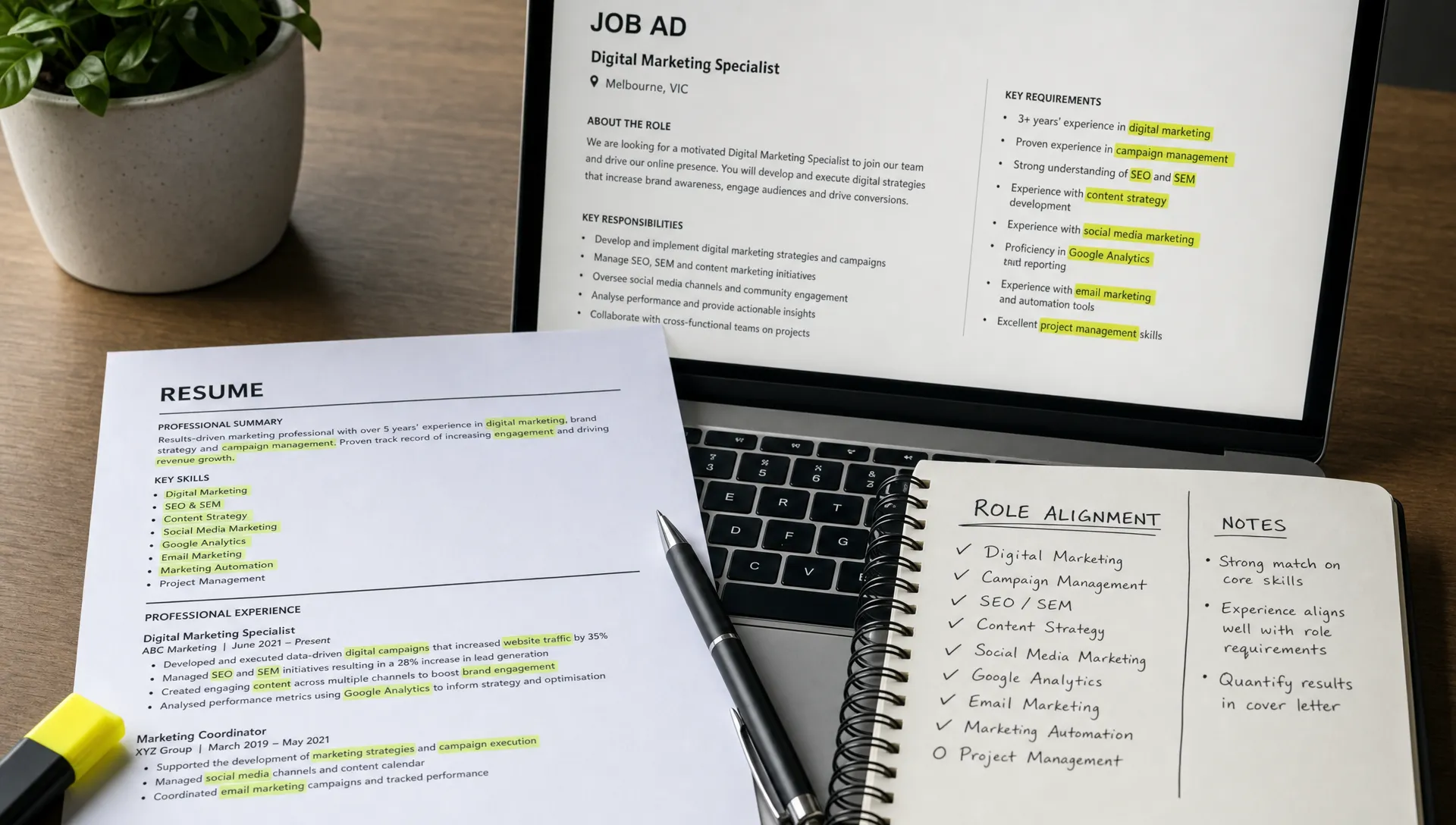
A cover letter that sounds like you still needs to sound relevant to the employer. The easiest way to do that is to translate the job ad into plain English before drafting.
Look for clues in the posting. What problems is the employer hiring someone to solve? What qualities do they repeat? What skills appear as essential rather than nice-to-have?
For example, if the job ad says they want someone who can “manage competing priorities in a fast-paced environment”, they are probably looking for evidence that you can stay organised, communicate clearly, and make good decisions under pressure.
Your cover letter should not simply repeat that phrase. Instead, it should respond to it with your own evidence:
“I developed strong prioritisation habits while balancing part-time hospitality work with full-time study, particularly during exam periods and peak service times. That experience taught me how to stay calm, communicate early, and keep tasks moving when demands change quickly.”
That sounds more human than “I thrive in fast-paced environments” because it gives context. It also sounds more like a real person, because it uses specific experience rather than a slogan.
Find your professional voice
Your professional voice is not a fake personality. It is your normal communication style, sharpened for the situation.
A good test is this: could you read the sentence aloud in an interview without cringing? If the answer is no, rewrite it.
Here are some common phrases that can be made more natural:
- Instead of “I am writing to express my interest”, try “I’m excited to apply for the Marketing Assistant role because it combines customer insight, content creation, and campaign support.”
- Instead of “I possess excellent communication skills”, try “My retail experience has made me confident explaining information clearly to different customers, especially when they need quick answers.”
- Instead of “I would be an asset to your organisation”, try “I’d bring a practical, organised approach and a strong willingness to learn from experienced team members.”
- Instead of “Please find attached my resume for your consideration”, try “I’ve attached my resume, which includes more detail on my customer service, administration, and project experience.”
Natural does not mean sloppy. You can use contractions like “I’m” or “I’d” if they fit your tone and the industry, but avoid being too casual. The goal is warm, direct, and credible.
Use proof without overselling yourself
Many students, graduates, and career changers worry that they do not have enough experience. That pressure often leads to overclaiming.
You do not need to make your experience sound bigger than it is. You need to make its relevance clearer.
If you worked in retail, hospitality, tutoring, childcare, trades, volunteering, sport, university societies, or family business support, you probably have more usable evidence than you think. The key is to connect it to the role.
For example:
- “Handled customer complaints” can become “built confidence resolving customer issues calmly and escalating when needed.”
- “Worked on group assignments” can become “collaborated with peers to divide tasks, meet deadlines, and present findings clearly.”
- “Helped with admin” can become “maintained accurate records, followed processes, and supported day-to-day coordination.”
- “Trained new staff” can become “explained procedures to new team members and helped them become confident during busy shifts.”
If you want to make your experience sound confident without exaggerating, Versadox has a practical guide on showing skills and experience without overselling.
The best cover letters use measured confidence. Instead of claiming to be “an expert” when you are early in your career, you might say you have “developed a strong foundation”, “built practical experience”, or “become confident using”. Those phrases are honest, but still positive.
Shape the letter around the employer’s needs
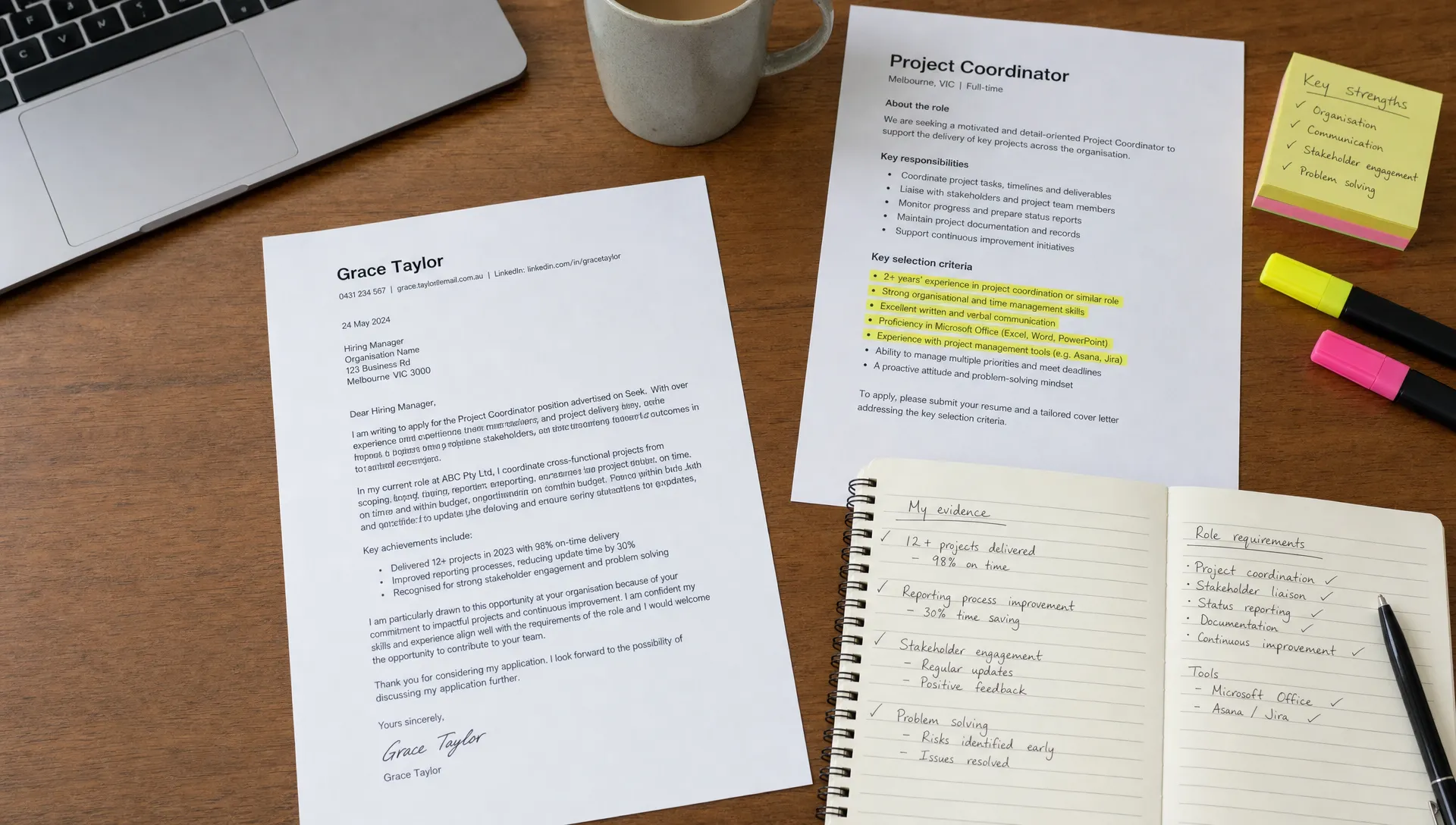
A cover letter is not your life story in chronological order. It is a short argument for why you are worth interviewing.
A simple structure works best:
- Opening: Name the role and give a specific reason you are interested.
- Fit paragraph: Connect your most relevant experience, study, or projects to the job requirements.
- Proof paragraph: Share one or two examples that show your skills in action.
- Motivation paragraph: Explain why this organisation, industry, or role direction makes sense for you.
- Closing: Thank them, mention your resume, and express interest in discussing the role.
This structure keeps you focused, but it still leaves room for your voice. You can sound enthusiastic, practical, analytical, service-focused, creative, or detail-oriented depending on who you are and what the job needs.
For example, someone applying for an events or executive support role might highlight calm coordination, discretion, and reliability. If they were researching how premium service organisations present themselves, they might notice that executive chauffeur services for business travel often emphasise trust, planning, and seamless coordination. Those themes can help a job seeker understand the kind of language that fits service-heavy roles without copying it word for word.
That is the point of tailoring. You are not pretending to be someone else. You are choosing the parts of your experience that matter most for the environment you want to join.
Make your opening specific, not dramatic
The first paragraph does not need to be clever. It needs to be relevant.
A weak opening sounds like this:
“I am writing to apply for the position advertised online. I believe I have the skills and experience required for this role.”
There is nothing wrong with it grammatically, but it could be sent to almost any employer.
A stronger opening sounds like this:
“I’m excited to apply for the Graduate Business Analyst role because it combines problem-solving, stakeholder communication, and process improvement, areas I have developed through my commerce studies and part-time operations work.”
This version names the role, identifies what attracts the applicant, and previews relevant evidence. It also sounds like a person who has thought about the job.
For a career changer, the opening might be:
“I’m applying for the Customer Success Coordinator role because it offers a natural next step from my hospitality background, where I have built strong customer communication, problem-solving, and relationship management skills.”
This does not hide the career change. It frames it.
Choose two or three strengths, not ten
One of the fastest ways to make a cover letter sound generic is to list too many skills. “Communication, teamwork, leadership, organisation, creativity, problem-solving, resilience, attention to detail” may all be positive, but together they blur.
Choose the strongest two or three for the role. Then prove them.
A good strength paragraph might look like this:
“In my current retail role, I’ve developed strong communication and prioritisation skills by supporting customers, managing stock tasks, and helping the team stay on track during peak periods. I’m comfortable switching between customer-facing work and operational tasks, which I understand is important in this role.”
That paragraph works because it does not just name skills. It shows where they came from and why they matter.
If you are deciding which skills to include, this guide to choosing skills for a cover letter that add proof can help you avoid empty claims.
Tailor without rewriting from zero every time
You do not need to create a brand new cover letter from scratch for every application. You do need to adapt it.
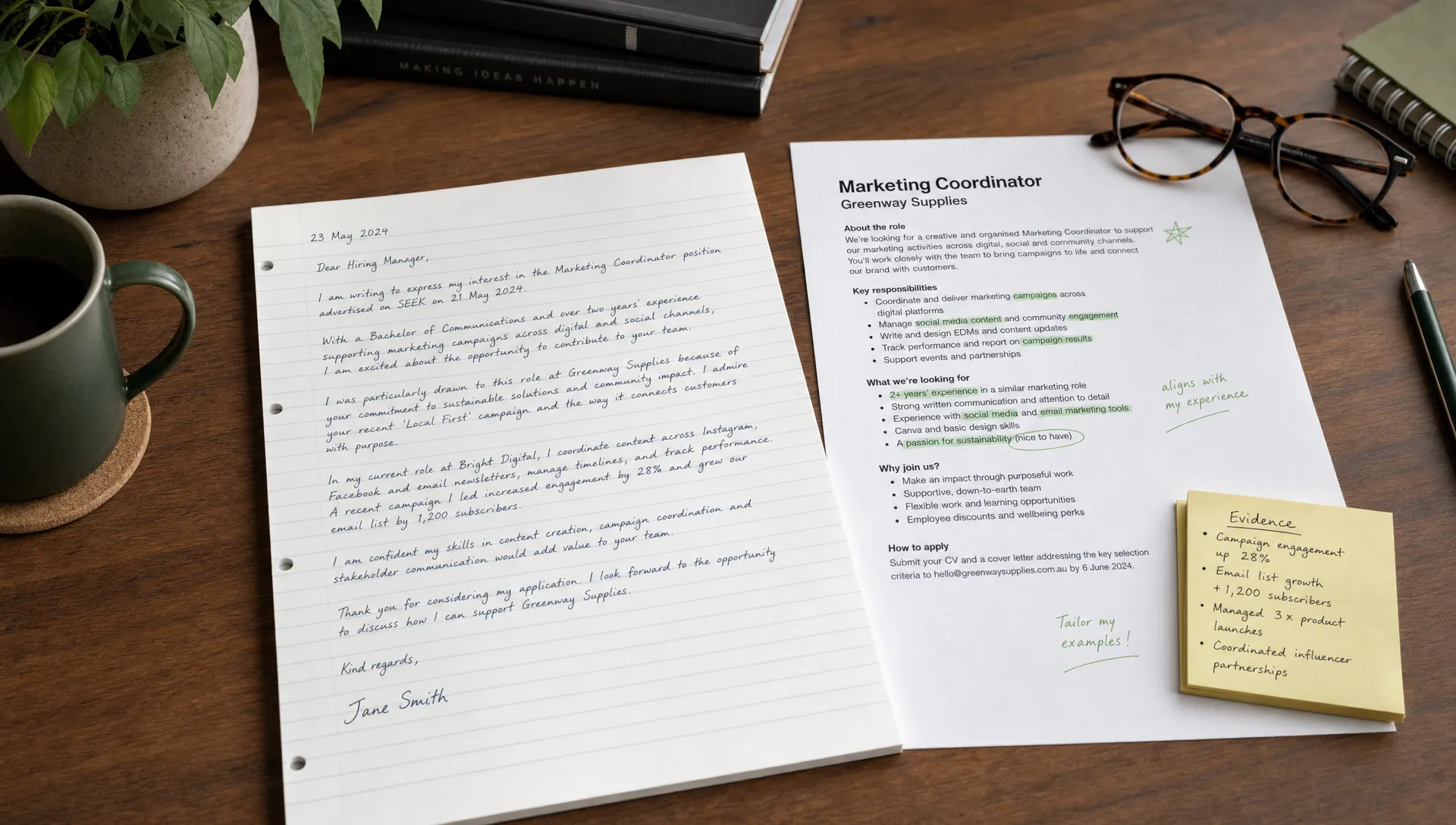
A useful approach is to keep a “base letter” that includes your core story, then update the parts that must be specific:
- The role title and organisation.
- The top two or three requirements from the job ad.
- The examples that best match those requirements.
- The reason you are interested in that employer or type of work.
- The keywords that naturally fit your experience.
This is where job seekers often benefit from slowing down before they apply. Versadox helps users compare their application against real roles, identify gaps, and make guided improvements before submitting. That kind of role alignment check can be especially helpful if you are applying for graduate roles, internships, entry-level office jobs, or a new career direction and want to know whether your materials match what the employer is asking for.
You can explore the platform at Versadox if you want a more structured way to review your resume, cover letter, and role fit before applying.
Edit for voice after you edit for content
Do not try to make the first draft perfect. First, get the content right. Then make it sound like you.
During your voice edit, look for three things.
First, remove phrases you would never say. If “I have long held a profound passion for administrative excellence” sounds strange, replace it with something clearer, such as “I enjoy organised, detail-focused work and have built those skills through office support and study projects.”
Second, shorten overloaded sentences. Cover letters often become stiff because every sentence tries to do too much. One clear idea per sentence is usually stronger.
Third, check that your enthusiasm is specific. “I am passionate about your company” is vague. “I’m interested in your focus on accessible financial education for young Australians” is more believable, if it is true.
Reading your letter aloud is one of the best editing tools. If you run out of breath, the sentence is too long. If you feel embarrassed by a phrase, it is probably not your voice. If you sound bored, the employer may feel the same.
Common mistakes that make cover letters sound fake
Even strong candidates can weaken their letters with small habits that feel impersonal.
Watch for these common issues:
- Starting with a generic opening that does not name the role or your reason for applying.
- Repeating your resume instead of explaining your fit.
- Using big claims without evidence.
- Copying the job ad word for word.
- Sounding either too formal or too casual for the industry.
- Apologising for experience gaps instead of framing transferable strengths.
- Writing more than one page when a concise letter would be stronger.
A cover letter does not need to explain everything. Its job is to create enough confidence and curiosity for the employer to read your resume seriously and consider you for an interview.
A simple cover letter example that sounds natural
Here is a short example for a graduate or early-career applicant:
“Dear Hiring Manager,
I’m excited to apply for the Junior Project Coordinator role because it combines organisation, communication, and practical problem-solving, all areas I’ve developed through my university projects and part-time customer service work.
In my retail role, I’ve learned how to manage competing priorities, communicate clearly with different people, and stay calm during busy periods. I’ve also taken responsibility for training new team members on store processes, which has helped me become more confident explaining information in a clear and supportive way.
Through my business degree, I’ve worked on group projects involving research, timelines, presentations, and stakeholder-style communication. These experiences have given me a strong foundation in planning tasks, tracking details, and contributing to shared outcomes.
I’m particularly interested in this role because it would allow me to keep building practical coordination skills in a professional team environment. I’ve attached my resume and would welcome the opportunity to discuss how my experience and willingness to learn could support your team.
Kind regards,
[Your Name]”
This letter is not flashy. It is clear, relevant, and believable. Most importantly, it sounds like a real person.
Frequently Asked Questions
How do you write a cover letter if you have little experience? Focus on transferable evidence from study, part-time work, volunteering, projects, sport, or community involvement. Explain how those experiences have helped you build skills that match the role, such as communication, organisation, problem-solving, reliability, or teamwork.
How long should a cover letter be? In most cases, aim for about three to five short paragraphs and keep it to one page. A concise, tailored letter is usually stronger than a long letter that repeats your resume.
Should a cover letter sound formal? It should sound professional, but not robotic. Use clear, respectful language and avoid slang, but write in a way you could comfortably read aloud in an interview.
Can I use the same cover letter for every job? You can use the same base structure, but you should tailor the role title, examples, skills, and motivation for each application. Employers can usually spot a letter that has not been adapted.
What makes a cover letter sound like me? Specific examples, natural phrasing, honest confidence, and a clear reason for applying. If the letter uses words you would never say and examples that could belong to anyone, it probably needs a voice edit.
Apply with a cover letter that feels clear and confident
A cover letter that sounds like you is not less professional. It is more useful. It helps employers understand your judgement, motivation, and fit before they meet you.
Before you apply, check whether your resume and cover letter are actually aligned with the role. Versadox can help you score your application, identify gaps, and make guided improvements so you can apply with more clarity and confidence.





.svg)