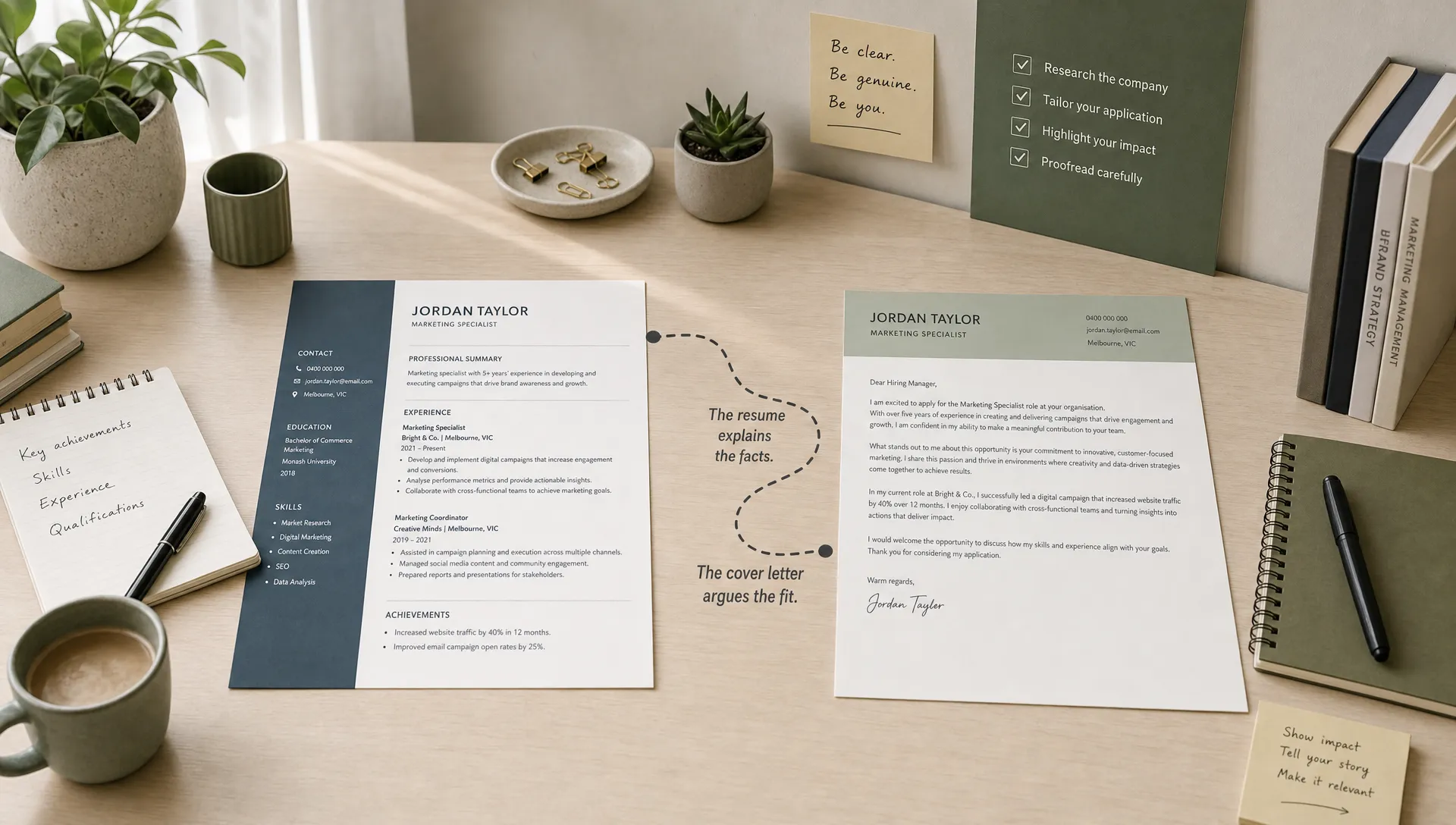
A resume profile is the short opening section at the top of your resume, usually sitting just below your name and contact details. It is small, but it carries a lot of weight. Before a recruiter studies your work history, education or skills section, your profile gives them a quick answer to one question: does this person look relevant for the role?
That is why a generic profile can weaken an otherwise strong resume. Phrases like “hardworking professional seeking an opportunity to grow” may sound safe, but they do not tell an employer what you can actually do. A strong resume profile is specific, role-aware and backed by evidence.
In this guide, you will learn how to write a resume profile that gets noticed, what to include, what to avoid and how to adapt it whether you are a student, graduate, career changer or experienced applicant.
What is a resume profile?
A resume profile is a brief professional introduction that summarises your most relevant experience, skills, strengths and career direction. It is sometimes called a professional profile, career profile, resume summary or job summary.
A good resume profile is usually 3 to 5 lines long. It should not try to tell your whole story. Its job is to create enough interest for the reader to keep going.
Think of it as the positioning statement for your application. It tells the employer:
- What kind of candidate you are
- Which role or field you are targeting
- What strengths or experience make you relevant
- What evidence supports your claims
- Why your background fits this specific opportunity
A resume profile is different from an old-style career objective. An objective often focuses on what you want, such as “seeking a role where I can develop my skills.” A profile focuses on what you bring, such as “customer service graduate with retail experience, strong complaint-handling skills and confidence using CRM systems.”
If you are still deciding whether your opening should be called a profile, summary or job summary, this guide on how to write a strong job summary for your resume explains the differences in more detail.
Why your resume profile matters
Recruiters and hiring managers often review large numbers of applications. Your resume profile helps them quickly understand your relevance before they invest more time in the rest of your resume.
For applicant tracking systems, your profile can also help reinforce role-relevant language. That does not mean you should stuff keywords into it. It means you should use the same natural terms the employer uses when they genuinely match your background, such as “accounts payable,” “customer support,” “data analysis,” “stakeholder communication” or “front-end development.”
For students, graduates and career changers, the profile is especially useful because your experience may not be perfectly linear. It lets you connect the dots before the employer has to do the work. You can show how university projects, internships, casual work, volunteering, certifications or transferable skills make sense for the role you are applying for.
A strong resume profile does not need to be complicated. Use this simple structure:
- Role identity: Name the type of candidate you are, such as “recent accounting graduate,” “customer service professional” or “junior software developer.”
- Relevant strengths: Mention 2 or 3 strengths that match the role, not every skill you have.
- Evidence: Add proof through experience, projects, achievements, tools, industries, study or measurable outcomes.
- Target fit: Make it clear why your background suits the job you are applying for.
Here is a flexible template you can adapt:
[Candidate type] with experience in [relevant area] and strengths in [skill 1], [skill 2] and [skill 3]. Experienced in [proof, tool, project or setting], with a focus on [value you bring to the target role].
For example:
Recent business graduate with experience in retail operations, customer service and data-based university projects. Confident using Excel to organise information, identify patterns and support practical decisions, with a strong interest in entry-level analyst and operations roles.
Notice that this does not use exaggerated language. It is clear, specific and relevant. That is what makes it more credible.
Start with the job before you write the profile
One of the biggest mistakes job seekers make is writing a resume profile once and using it for every application. A profile that is too broad often feels forgettable because it is not aimed at a specific employer need.
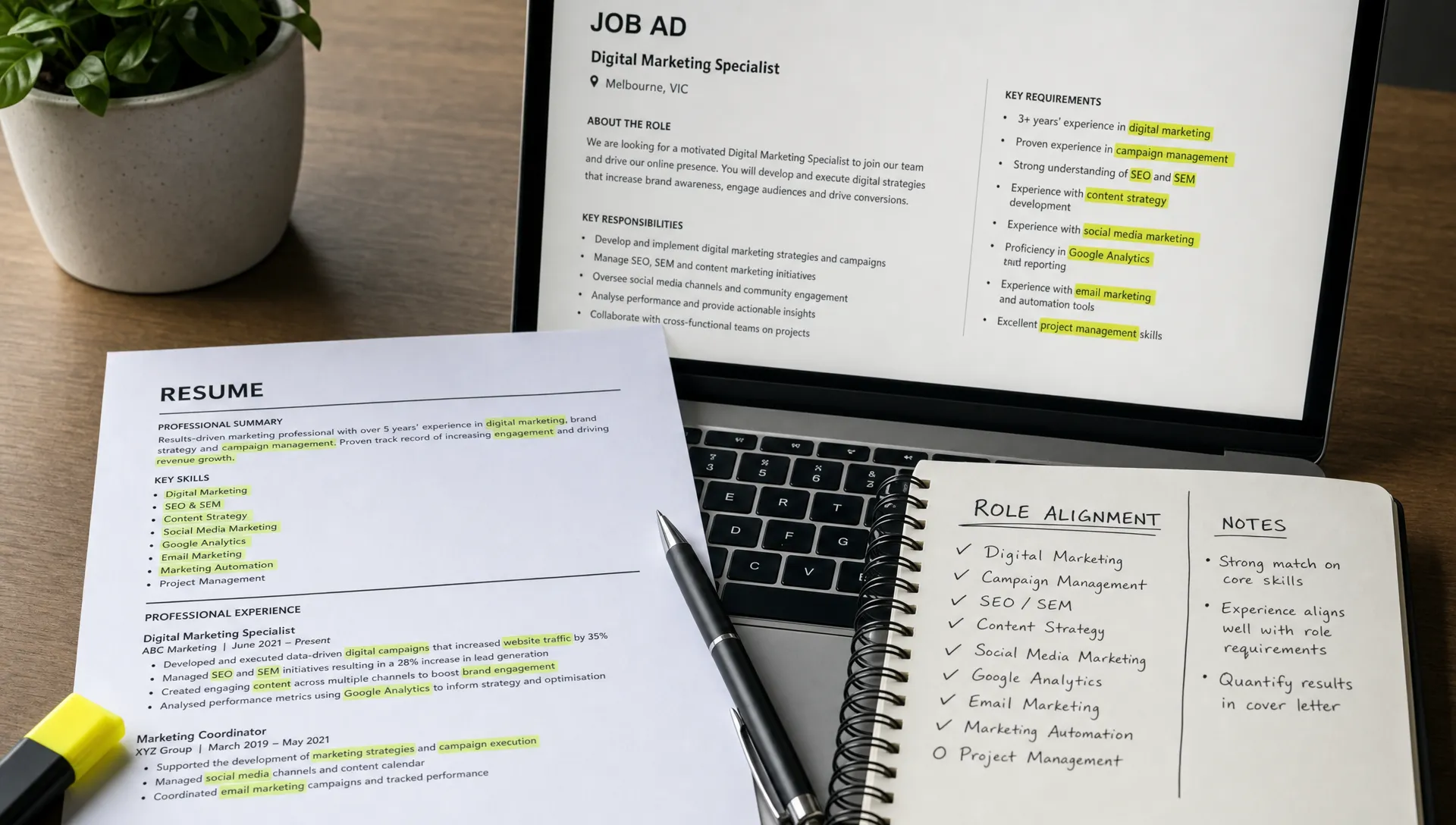
Before you write, read the job advertisement closely. Look for repeated themes. Employers usually signal their priorities through the responsibilities, required skills and selection criteria.
Ask yourself:
- What problem is this role meant to solve?
- Which skills appear more than once?
- What experience is essential, and what is only preferred?
- Which tools, systems or qualifications are named?
- What kind of person would succeed in this environment?
Then shape your resume profile around the overlap between the role and your real experience. If the job emphasises stakeholder communication, do not lead with unrelated technical coursework. If it highlights reporting and data accuracy, do not open with vague claims about being enthusiastic.
For a deeper process, use this guide on how to match your resume to the job you want before you finalise your profile.
What to include in a resume profile
Your resume profile should be concise, but it still needs enough substance to be useful. The best profiles usually include a mix of role direction, relevant capability and proof.
Strong details to include are:
- Your current professional identity or target role family
- Your most relevant experience, study, training or projects
- Skills that directly match the job advertisement
- Tools, systems or technical knowledge the employer values
- A short outcome, achievement or example of impact
- A clear link between your background and the role
Weak details to avoid are:
- Empty traits with no proof, such as “hardworking,” “reliable” or “motivated”
- Broad claims like “excellent communication skills” without context
- Personal life details that are not relevant to the role
- A long list of unrelated skills
- Salary expectations or availability
- Overstated claims that your experience cannot support
The goal is not to sound impressive at all costs. The goal is to sound relevant, credible and easy to understand.
Resume profile examples that get noticed
Below are practical examples for different career stages. They are not scripts to copy word for word. Use them to understand the level of detail and relevance your own profile should aim for.
Student resume profile
Weak: University student looking for a part-time job where I can learn new skills and gain experience.
Stronger: Second-year Bachelor of Commerce student with customer service experience in a busy retail environment. Skilled in handling enquiries, processing transactions accurately and working calmly during peak periods, with an interest in part-time administration and client service roles.
This version is stronger because it names the degree, includes work context and connects casual experience to the target role.
Graduate resume profile
Weak: Recent graduate with strong communication skills and a passion for marketing.
Stronger: Recent marketing graduate with experience creating campaign plans, social content calendars and audience research reports through university projects and internship work. Confident using Canva, Google Analytics and Meta Business Suite, with a focus on supporting data-informed digital marketing campaigns.
This profile works because it proves the marketing interest with tools, projects and relevant tasks.
Career changer resume profile
Weak: Experienced professional seeking a new challenge in IT.
Stronger: Customer service professional transitioning into IT support, with 4 years of experience troubleshooting customer issues, documenting requests and explaining technical information clearly. Currently building skills in networking fundamentals, ticketing workflows and endpoint support for entry-level help desk roles.
This profile does not pretend the candidate has years of IT experience. It connects their existing strengths to the new direction.
Experienced applicant resume profile
Weak: Results-driven operations professional with a proven track record of success.
Stronger: Operations coordinator with 5 years of experience supporting rostering, inventory control and supplier communication across fast-paced retail environments. Known for improving workflow consistency, reducing manual errors and supporting store teams with clear reporting and practical process updates.
This version is more believable because it explains the kind of operations work and the value delivered.
How to make your profile work for ATS and humans
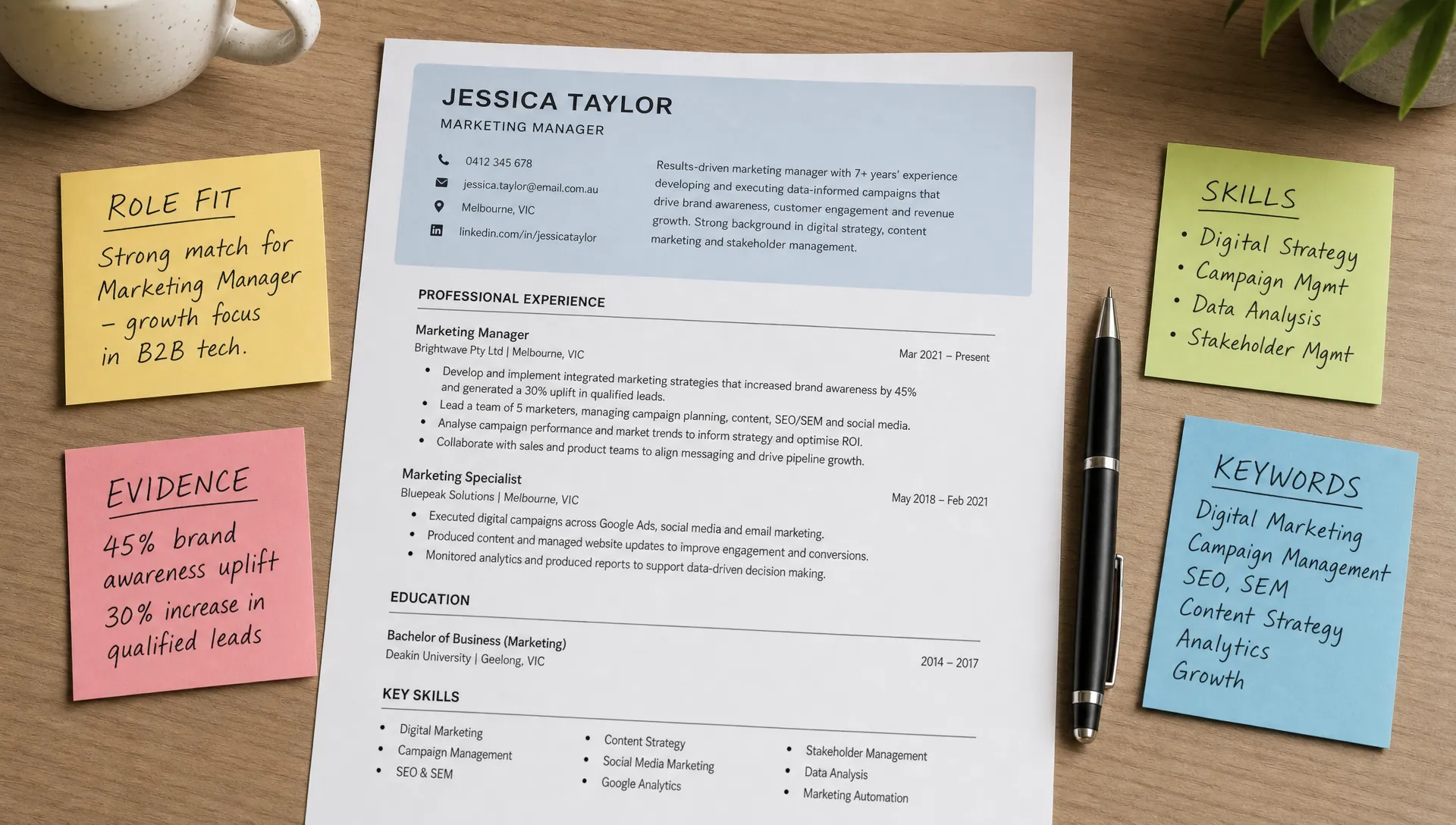
A resume profile should be written for both applicant tracking systems and real people. The ATS may help filter, parse or organise resumes, but a human still needs to understand your value quickly.
To make your profile ATS-aware without sounding robotic, use the employer’s language where it fits naturally. If the job title is “Customer Service Officer” and that matches your target, include that phrase. If the advertisement mentions “case management,” “Excel reporting” or “stakeholder engagement,” include those terms only if you can support them elsewhere in your resume.
Do not force keywords into a profile that does not read well. A keyword-heavy profile can feel unnatural and may raise doubts if the rest of your resume does not provide evidence.
A human-friendly profile should also be easy to scan. Avoid long sentences with too many ideas. Use plain English. Keep the profile focused on the role. If you are unsure which abilities deserve space, this article on skills for your resume that employers actually notice can help you prioritise relevance over volume.
How to adapt your resume profile to your career stage
Your career stage affects what kind of evidence you should lead with. The profile of a student will not look the same as the profile of an experienced project manager, and that is fine. The key is to make the best evidence you do have easy to recognise.
If you are a student or recent graduate
Lead with your study area, practical projects, placements, internships, volunteering, casual work or technical tools. Employers hiring early-career candidates do not expect a long work history, but they do want signs of readiness.
Useful evidence may include university projects, group assignments, part-time work, leadership in clubs, customer-facing experience, research tasks or software you used during study.
If you are changing careers
Use the profile to explain your transition clearly. Start with the experience you already have, then connect it to the new role. Transferable skills are stronger when they are grounded in real situations.
For example, a teacher moving into learning design might mention curriculum planning, stakeholder communication and digital learning tools. A retail supervisor moving into recruitment might mention interviewing, staff training and rostering.
If your target path requires certifications, only claim what is accurate. You can mention active study or completed credentials when relevant. For example, if you are moving into IT, cloud or project management, structured certification exam prep and practice tests can help you build credible evidence before you claim certification readiness in your profile.
If you already have experience
Lead with scope and outcomes. Mention the types of teams, customers, systems, industries or responsibilities you have handled. Then add evidence of impact, such as improving processes, supporting revenue, reducing errors, increasing customer satisfaction or managing complex workloads.
Experienced applicants often weaken their profile by sounding too general. A phrase like “experienced professional with leadership skills” could apply to thousands of people. “Store manager with 7 years of experience leading teams of up to 18 across high-volume retail sites” is much more useful.
Common resume profile mistakes to avoid
Even strong candidates can lose impact with a weak opening. Before you submit your resume, check for these common issues:
- Writing only about what you want: Employers care about your goals, but your profile should first show how you can help them.
- Using cliches: Phrases like “go-getter,” “team player” and “proven track record” need evidence or should be replaced.
- Trying to cover everything: A profile is not a full biography. Keep it focused on the target role.
- Copying your cover letter: Your profile should be sharper and shorter than a cover letter introduction.
- Making claims your resume does not prove: If you call yourself an advanced Excel user, your experience section should show how you used Excel.
- Forgetting to update it: If you tailor the rest of your resume but leave the profile generic, the application can feel inconsistent.
A useful test is to remove your name from the resume and read the profile by itself. Could it belong to almost anyone? If yes, it needs more detail.
A quick editing checklist
Once you have drafted your resume profile, review it with a recruiter’s perspective. You do not need fancy language. You need clarity.
Check that your profile:
- Names the role type or career direction clearly
- Includes 2 or 3 strengths that matter for the job
- Uses evidence instead of vague personality claims
- Reflects the job advertisement without copying it awkwardly
- Matches the experience, education and skills listed below it
- Stays concise enough to scan quickly
- Sounds honest, confident and professional
If you can answer “yes” to each point, your profile is likely doing its job.
Frequently Asked Questions
How long should a resume profile be? A resume profile is usually 3 to 5 lines, or roughly 50 to 90 words. It should be long enough to show relevance, but short enough to scan quickly.
Should every resume have a profile? Most resumes benefit from a profile, especially if you want to guide the employer’s first impression. It is particularly helpful for students, graduates, career changers and applicants targeting competitive roles.
Is a resume profile the same as a career objective? No. A career objective focuses mainly on what you want from the role. A resume profile focuses on what you bring to the employer and why your background fits the role.
Can I use the same resume profile for every job? You can use a base version, but you should adjust it for each role. Tailor the skills, examples and wording to match the job advertisement and employer priorities.
Should I include keywords in my resume profile? Yes, but only when they are accurate and natural. Use role-relevant terms from the job advertisement, then make sure the rest of your resume supports those keywords with evidence.
Build a resume profile with more confidence
Your resume profile should make your application easier to understand, not harder. When it is specific, evidence-based and aligned with the role, it helps employers see your fit faster.
If you want help improving your opening section before you apply, Versadox can score your resume, compare it against real roles, identify gaps and guide improvements across your resume and cover letter. Use it to check whether your profile, skills and experience are working together clearly, then apply with more confidence.





.svg)