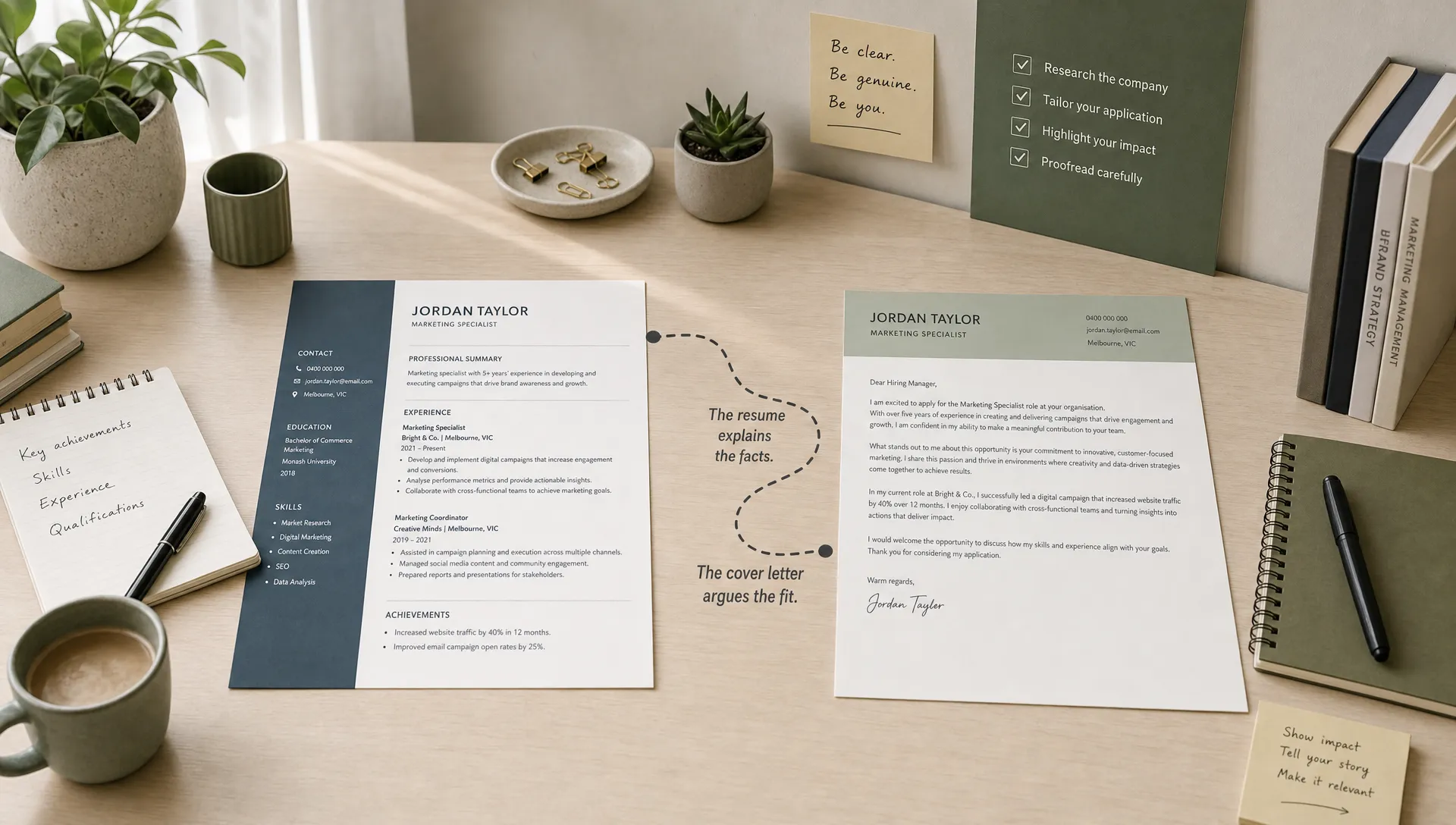
If you are asking what is a cover letter, the simple answer is this: a cover letter is a short, tailored document that introduces you to an employer and explains why you are a strong fit for a specific job.
Your resume shows what you have done. Your cover letter explains why it matters for this role, this employer, and this point in your career.
In 2026, cover letters are not always mandatory, but they still matter when they help you add context, show motivation, or stand out in a competitive process. For students, graduates, and career changers, a good cover letter can be the difference between looking underqualified on paper and helping an employer understand your potential.
What is a cover letter?
A cover letter is usually a one-page document sent with your resume as part of a job application. It is written directly to the employer, recruiter, or hiring manager and should be customised for the role you are applying for.
A strong cover letter usually answers three questions:
- Why are you interested in this role?
- What relevant skills, experience, or strengths do you bring?
- Why would you be a good fit for this organisation or team?
It should not repeat your entire resume. Instead, it should highlight the most relevant parts of your background and connect them to the job ad. If your resume is the evidence, your cover letter is the explanation.
That distinction matters. Many job seekers treat the cover letter as a formal summary of their resume, but employers are usually looking for relevance, clarity, and intent. If you want a deeper breakdown of how the two documents work together, Versadox has a helpful guide on cover letter vs resume differences.
What is a cover letter supposed to do?
A cover letter has one main job: to make the employer want to read your resume more closely and consider you for an interview.
That sounds simple, but it requires focus. A cover letter should not try to prove every achievement you have ever had. It should help the employer quickly understand why your background matches the opportunity in front of them.
A good cover letter can:
- Explain why you are applying for this specific role, not just any job
- Connect your experience, study, projects, volunteering, or transferable skills to the role requirements
- Show that you understand the employer, industry, or problem the role exists to solve
- Add context that your resume cannot easily show, such as a career change or relocation
- Demonstrate written communication, professionalism, and attention to detail
Think of it as positioning. You are helping the employer see the most relevant version of you.
This is especially useful when your background is not a perfect match on paper. A graduate may not have years of paid experience, but they may have relevant coursework, internships, leadership roles, or part-time work. A career changer may not have the exact job title, but they may have problem-solving, client service, operations, project coordination, or analytical skills that transfer well.
When do you need a cover letter?
You need a cover letter whenever the employer specifically asks for one. If the job ad says to include a cover letter, not sending one can suggest you did not read the instructions carefully. That can hurt your chances before your resume is even assessed.
You should also strongly consider writing one in the following situations.
When the role is competitive
If many applicants are likely to have similar qualifications, a cover letter gives you another way to differentiate yourself. This is common in graduate programs, internships, entry-level corporate roles, marketing roles, administration jobs, public sector roles, and positions at well-known organisations.
In a competitive field, your resume may show that you meet the basic requirements. Your cover letter can show that you understand the work, care about the organisation, and have thought carefully about how you can contribute.
When you are a student or graduate
If you are early in your career, your resume may feel thin. That does not mean you have nothing to offer. It means you need to translate your experience properly.
A cover letter can help you connect university projects, casual work, volunteering, club involvement, placements, or personal projects to workplace skills. For example, retail work might show customer communication, resilience, time management, and problem-solving. A group assignment might show research, collaboration, and deadline management.
The key is to avoid saying, “I do not have much experience.” Instead, explain the relevant experience you do have and why it prepares you for the role.
When you are changing careers
Career changers often need a cover letter because the resume alone may not make the transition obvious. If your previous job titles sit in another industry, an employer may not immediately see why you are applying.
Your cover letter can bridge that gap. It can explain your reason for changing direction, identify transferable skills, and show that you understand what the new role requires.
For example, someone moving from hospitality into customer success could highlight client communication, conflict resolution, multitasking, and the ability to stay calm under pressure. Someone moving from teaching into learning design could highlight curriculum planning, stakeholder communication, facilitation, and content development.
When the job requires strong communication
For roles involving writing, client contact, stakeholder management, sales, marketing, administration, consulting, education, or leadership, the cover letter itself becomes a work sample. It shows whether you can communicate clearly, structure ideas, and tailor your message to an audience.
That does not mean you need to sound overly formal. In fact, plain, clear writing is usually stronger than heavy corporate language. Employers want to see that you can get to the point and support your claims.
When you need to explain something important
A cover letter is useful when there is context your resume does not fully explain. This might include a career break, relocation, industry change, recent study, return to work, or a shift from part-time to full-time employment.
You do not need to over-explain personal details. Keep it professional and future-focused. A simple sentence can be enough, such as: “After completing my certificate in data analytics, I am now looking to apply my customer service background and analytical training in an entry-level operations role.”
When is a cover letter optional?
A cover letter is optional when the job ad says it is optional or when the application platform does not clearly require one. But optional does not always mean unnecessary.
If you can write a tailored, relevant cover letter, it may still strengthen your application. This is especially true when you genuinely want the role, your resume needs context, or you have a strong reason for applying to that organisation.
However, sending a generic cover letter is rarely useful. A vague letter that could be sent to any employer can make your application feel less considered. If the choice is between a rushed generic letter and no letter, it may be better to spend your time improving your resume and tailoring your application answers.
For broader guidance on application quality, it is worth reviewing what makes a professional job application in 2026, because employers increasingly expect targeted, evidence-based applications rather than one-size-fits-all documents.
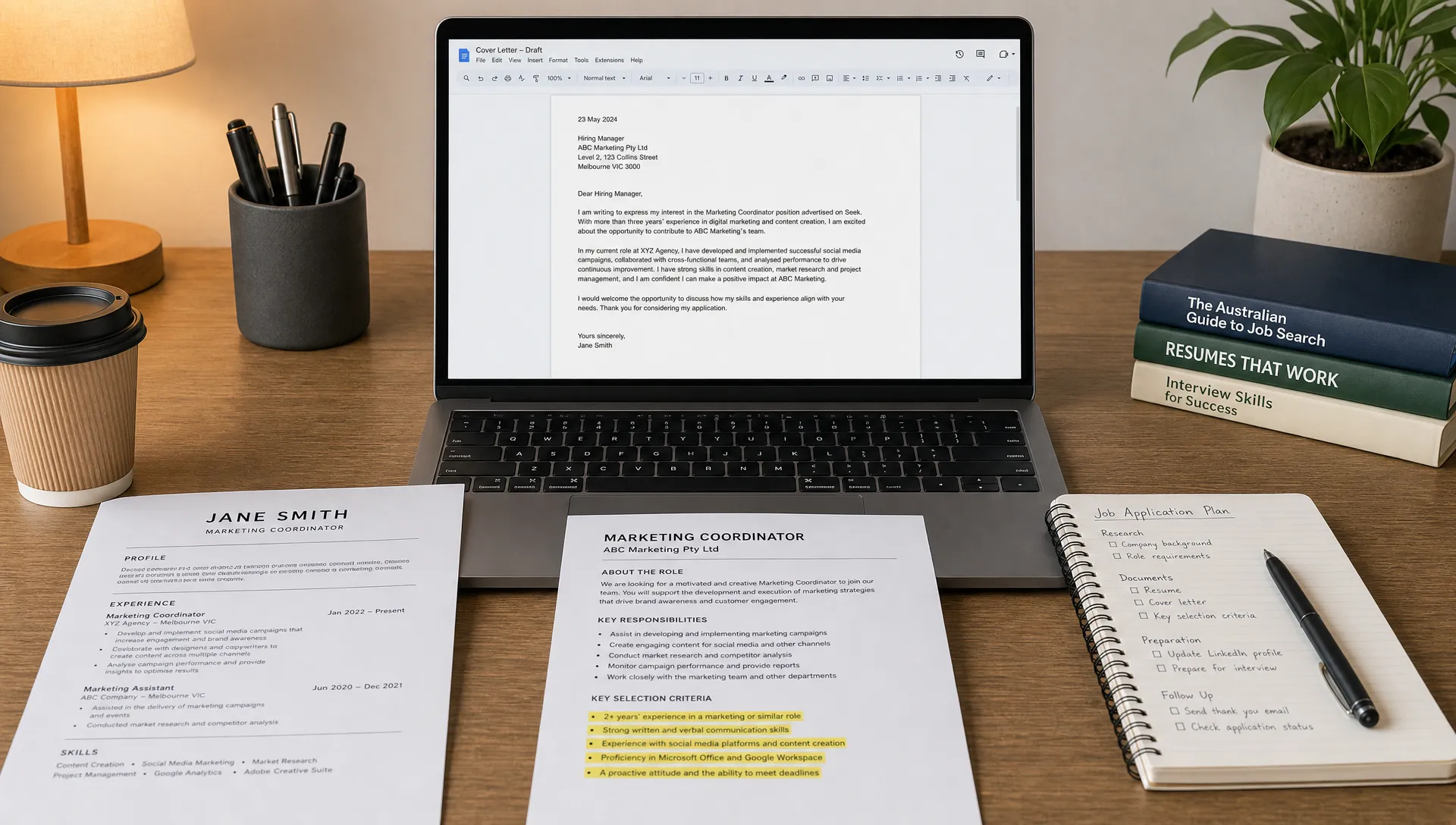
When do you not need a cover letter?
You probably do not need a cover letter when the application system gives you no place to upload one, when the employer specifically says not to include one, or when the process is built around short screening questions instead.
Some high-volume online applications may focus mainly on your resume, eligibility questions, availability, or work rights. Some LinkedIn or job board applications also simplify the process to reduce friction.
Even then, the thinking behind a cover letter still matters. You still need to understand the role, identify the most relevant skills, and tailor your resume or application responses. The document may not be required, but the strategy is.
What should a cover letter include?
A strong cover letter is usually built around a simple structure. It does not need to be clever, long, or overly designed. It needs to be clear and specific.
Include these core elements:
- A direct opening: State the role you are applying for and give a brief reason you are interested.
- A relevant fit paragraph: Connect your experience, study, projects, or skills to the most important parts of the job ad.
- Evidence: Use one or two examples that prove your strengths rather than listing unsupported claims.
- Organisation fit: Show that you understand something meaningful about the employer, team, product, service, or industry.
- A confident close: Thank the reader and express interest in discussing the role further.
For example, instead of writing, “I am a hardworking team player with strong communication skills,” you might write, “In my part-time retail role, I handled customer enquiries during peak periods, resolved complaints calmly, and supported new team members during onboarding.”
That sentence gives the employer proof. It also shows behaviour, not just personality.
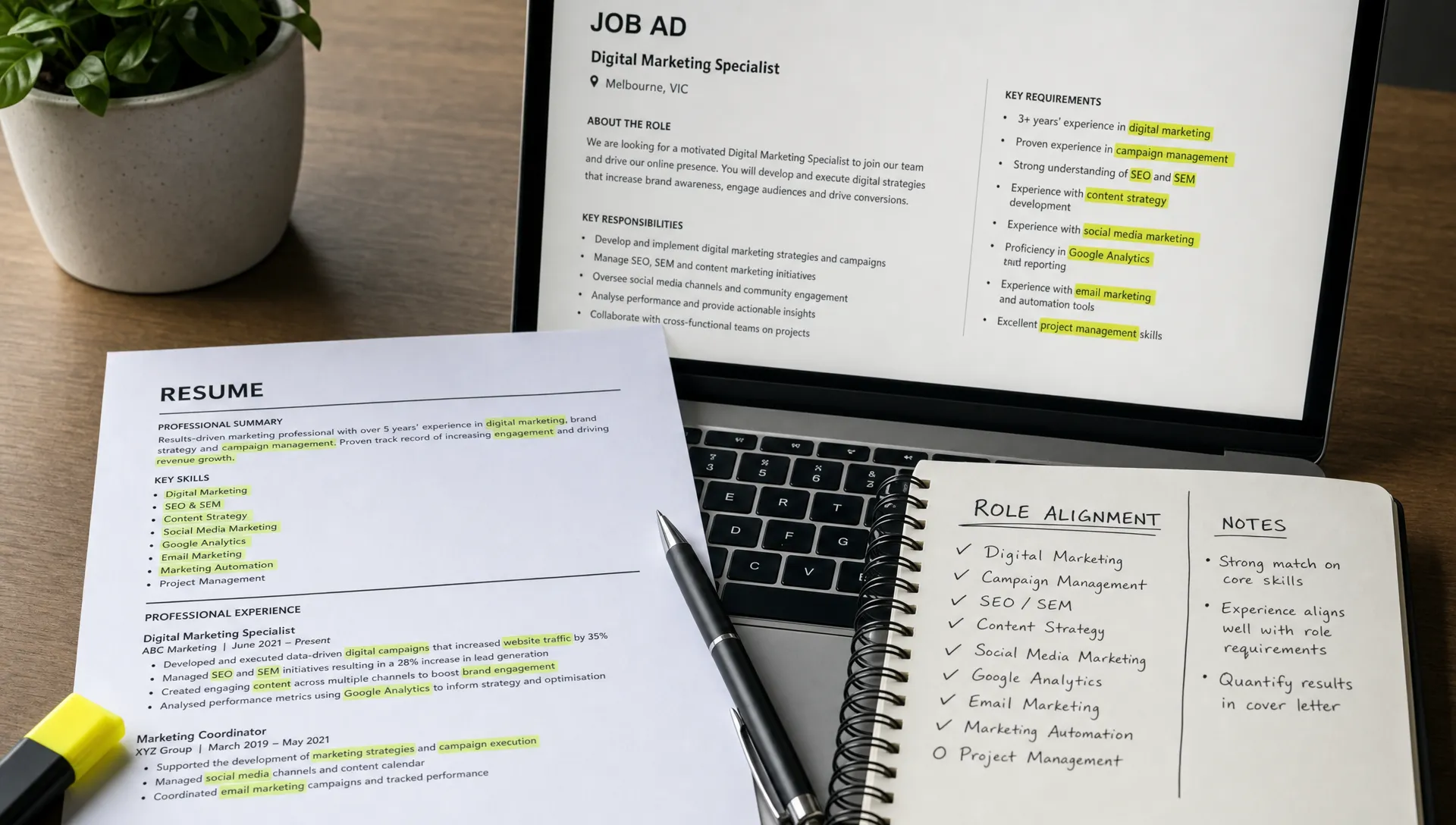
If you are unsure which strengths to include, start with the job ad. Look for repeated requirements, key responsibilities, and language that signals what matters most. Then choose examples that match. Versadox also has a practical guide to choosing the best skills for a cover letter without making unsupported claims.
How long should a cover letter be?
Most cover letters should be around 250 to 400 words and fit on one page. For many roles, three to five short paragraphs is enough.
Longer is not better. Hiring managers and recruiters often review applications quickly, so your cover letter needs to make its point without forcing the reader to search for relevance.
A good rule is to include only what helps answer this question: “Why should this employer consider me for this role?”
If a sentence does not support that answer, cut it or make it more specific.
How to tailor a cover letter to a job ad
Tailoring does not mean rewriting your entire life story for every job. It means selecting the most relevant details and framing them for the role.
Start by reading the job ad carefully. Identify the top three to five requirements. These might be technical skills, communication skills, industry knowledge, customer experience, analytical ability, teamwork, or attention to detail.
Then compare those requirements with your own background. Your evidence might come from paid work, study, placements, internships, volunteering, leadership roles, side projects, or personal experience that is professionally relevant.
If you are applying for a growth, marketing, product, or innovation role, research how organisations talk about customers, value, and outcomes. Looking at how a growth marketing and innovation agency such as User Story positions its services can help you notice the kind of commercial language employers in that space may value.
The aim is not to copy wording. It is to understand the employer’s world so your letter speaks to the work they actually do.
Example cover letter angles by situation
You do not need a completely different personality for each application. You need the right angle.
For a student or graduate, the angle might be learning ability, relevant study, initiative, and early evidence of workplace habits. You could focus on a university project, internship, part-time role, or leadership experience.
For a career changer, the angle might be transferable skills and motivation. You could explain what prompted the shift and show how your previous experience gives you a useful perspective.
For someone returning to work, the angle might be readiness, recent upskilling, and relevant past experience. Keep the focus on what you can contribute now.
For someone applying above their current level, the angle might be responsibility already taken on, measurable outcomes, and readiness for the next step.
The best cover letters make your application easier to understand. They reduce doubt. They do not ask the employer to guess why you are a fit.
Common cover letter mistakes to avoid
Many cover letters fail because they are too broad. They sound professional, but they do not say anything specific enough to influence the hiring decision.
Watch out for these mistakes:
- Repeating your resume line by line
- Using the same letter for every application
- Opening with a generic statement that could apply to any job
- Listing soft skills without proof
- Focusing only on what you want, not what the employer needs
- Writing too much about personal passion without showing capability
- Ignoring the job ad’s key requirements
- Sending a letter with spelling, grammar, or formatting issues
One of the biggest mistakes is trying to sound impressive instead of useful. Employers are not looking for perfect language. They are looking for evidence that you understand the role and can do the work, or learn it quickly.
Do employers still read cover letters in 2026?
Some do. Some do not. That is the honest answer.
Recruiters may skim cover letters quickly, especially when they receive many applications. Hiring managers may read them more closely for shortlisted candidates, career changers, graduates, or roles where communication matters.
The practical takeaway is this: write a cover letter when it can add value, but do not rely on it to fix a weak or untargeted resume. Your documents should work together. A strong resume helps you pass the first screen. A strong cover letter helps explain your fit and motivation.
For students, graduates, and career changers, that extra explanation can be valuable. It helps you move from “maybe” to “worth interviewing.”
Frequently Asked Questions
What is a cover letter in simple terms? A cover letter is a short document that introduces you to an employer and explains why you are a good fit for a specific job. It is usually sent with your resume.
Is a cover letter the same as a resume? No. A resume lists your experience, education, skills, and achievements. A cover letter explains how those details connect to the role you are applying for.
Do I need a cover letter for every job application? Not always. You need one when the employer asks for it. You should also consider one when the role is competitive, your background needs context, or you can write a genuinely tailored letter.
How long should a cover letter be in Australia? Most Australian cover letters should be one page, usually around 250 to 400 words. Keep it focused, relevant, and easy to read.
Can I use AI to write a cover letter? Yes, but use it carefully. AI can help you structure and refine your letter, but you should still add accurate examples, check the tone, and make sure the final version sounds like you.
Apply with more clarity and confidence
A cover letter is not just an old-fashioned formality. Used well, it helps employers understand your fit, your motivation, and the value behind your resume.
If you are unsure whether your application is strong enough, Versadox can help you compare your resume and cover letter against real roles, identify gaps, and improve your application before you apply. That way, you are not guessing where you stand. You are applying with clearer evidence, stronger positioning, and more confidence.






.svg)