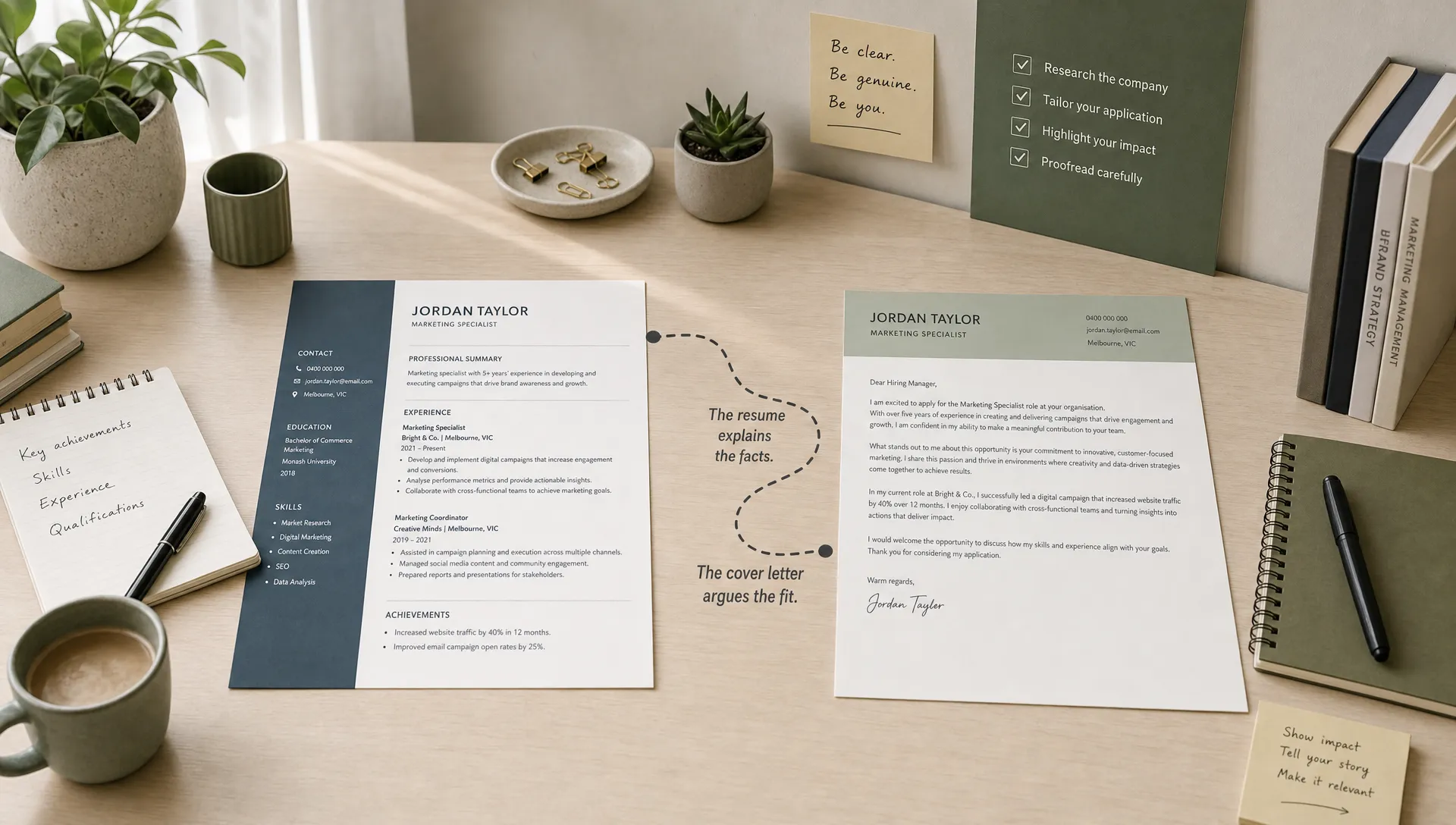
A cover letter is often explained as a formal note that goes with your resume. That is technically true, but it misses the real point.
A strong cover letter is not just a polite introduction. It is your chance to connect the dots between the job, your experience, and the reason an employer should take your application seriously. It gives context that a resume often cannot, especially when you are a student, graduate, career changer, return-to-work applicant, or someone applying for a role that is slightly different from your previous experience.
So, what is a cover letter for a job, really? It is a tailored argument for your fit. Not a life story. Not a repeat of your resume. Not a generic page of enthusiasm. It should help the reader understand why this role makes sense for you, why you make sense for them, and what evidence supports that match.
The simple definition of a cover letter
A cover letter is a short, tailored document sent with a job application to explain your interest in a specific role and highlight the most relevant parts of your experience.
Most cover letters are around three to five short paragraphs. They usually introduce you, explain why you are interested in the role or organisation, connect your skills to the job requirements, and close with a professional call to continue the conversation.
That sounds straightforward, but the best cover letters do something more strategic. They make your application easier to interpret.
A recruiter may be reviewing dozens or hundreds of applications. Your resume shows what you have done, but it may not immediately explain why your background is relevant to this particular role. A cover letter gives you space to say, in plain language, “Here is why my experience fits what you are looking for.”
If you are still clarifying the difference between the two documents, Versadox has a deeper guide on how a cover letter and resume each support your application.
What a cover letter is actually for
The purpose of a cover letter is not to decorate your resume. It should improve the employer’s understanding of your application.
A good cover letter can help you:
- Explain why you are interested in this specific role, not just any job
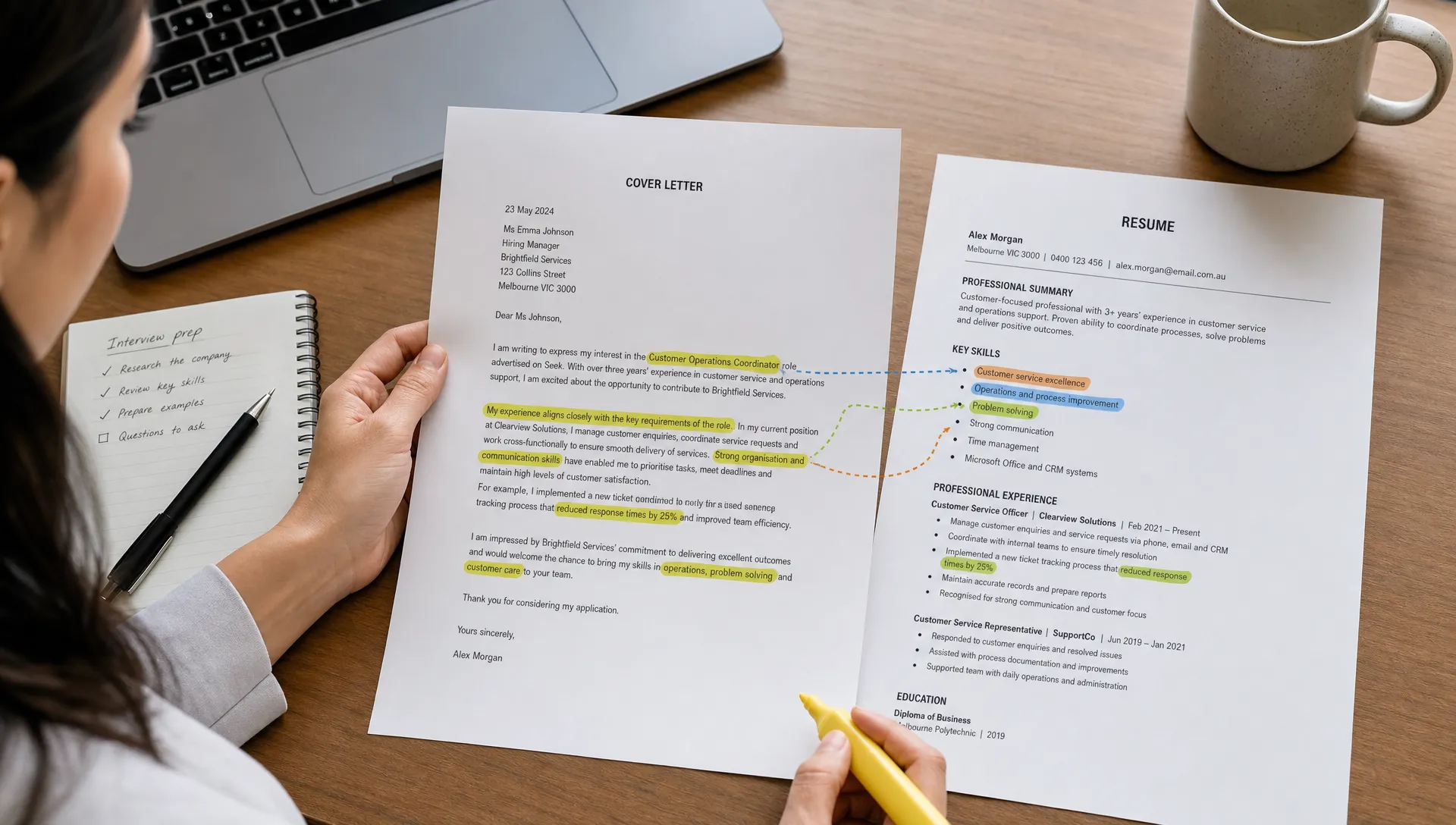
- Highlight the most relevant evidence from your resume
- Show how your skills connect to the employer’s needs
- Add context for a career change, study background, employment gap, relocation, or unusual career path
- Demonstrate written communication and professional judgement
- Show motivation without sounding vague or exaggerated
In other words, your cover letter should reduce doubt. If the employer is wondering whether your experience is relevant, your letter should help answer that. If they are wondering why you are applying from a different industry, your letter should explain the connection. If your resume includes several strong experiences, your letter should point them to the ones that matter most.
What a cover letter is not
A cover letter becomes weak when it tries to do the wrong job.
It is not a copy of your resume in paragraph form. If your resume says you worked as a retail assistant and your cover letter simply says you worked as a retail assistant, you have not added much value. Instead, explain what that experience proves, such as customer communication, conflict resolution, sales targets, time management, or working under pressure.
It is also not a generic message you can send to every employer. Recruiters can usually spot this quickly. Phrases like “I am a hardworking and passionate individual seeking an opportunity to grow” may sound professional, but they could apply to almost anyone.
A cover letter is not the place to overshare personal details either. You do not need to explain every life event, every challenge, or every reason you want a job. Keep the focus on the role, the employer’s needs, and the evidence that makes you a credible candidate.
Do employers still read cover letters?
Some do. Some do not. That is the honest answer.
In many hiring processes, the resume is reviewed first. In some roles, especially high-volume roles, cover letters may receive a quick scan or only be opened for shortlisted candidates. In other cases, particularly graduate programs, internships, public sector roles, education, administration, communications, community services, and professional roles, the cover letter can carry real weight.
The practical takeaway is simple: if a cover letter is requested, treat it seriously. If it is optional and you can write a relevant one, it can still help. If you only have time to submit a generic letter, it may not add much.
A tailored cover letter is most useful when it answers a question your resume might leave open. For example, if you are changing industries, applying for your first professional role, returning after a break, or targeting a job where your transferable skills matter, the letter can make the connection clearer.
What should a cover letter include?
A cover letter does not need to be complicated. It needs to be relevant.
Most strong cover letters include these elements:
- A clear opening that names the role and sets up your fit
- A reason for interest that is specific to the position, organisation, industry, or type of work
- Two or three pieces of evidence that match the job requirements
- A short explanation of fit that connects your background to what the employer needs
- A professional closing that thanks the reader and expresses interest in the next step
The evidence matters most. Employers are not only asking, “Does this person want the job?” They are asking, “Can this person do the job, learn the job, or bring something useful to the team?”
For example, instead of writing, “I have strong communication skills,” you might write, “In my customer service role, I handled daily enquiries, resolved complaints, and explained product options clearly to customers during busy trading periods.”
That one sentence gives the employer proof. It also makes the skill easier to trust. If you want to strengthen that part of your letter, this guide to choosing cover letter skills that add proof explains how to avoid empty claims.
A useful way to think about your cover letter
Think of your cover letter as the answer to three questions:
- Why this role?
- Why you?
- Why now?
“Why this role?” shows that you understand what you are applying for. It does not mean you need to flatter the company. It means you should show a genuine connection between the job and your goals, interests, skills, or experience.
“Why you?” is where you provide evidence. You might refer to work experience, study projects, volunteer roles, placements, leadership responsibilities, customer-facing work, technical skills, or measurable achievements.
“Why now?” is especially helpful for career changers, graduates, and people shifting direction. It explains why this move makes sense at this stage. For example, a hospitality worker applying for an entry-level HR role might explain how roster coordination, onboarding casual staff, and handling team communication sparked an interest in people operations.
This structure keeps your letter focused. It also prevents you from writing a broad personal essay that sounds sincere but does not help the employer make a decision.
What makes a cover letter good?
A good cover letter is specific, evidence-based, and easy to read.
Specific means it refers to the actual role. You do not need to mention every line of the job ad, but you should show that you understand the main priorities. If the role asks for stakeholder communication, scheduling, and attention to detail, your letter should not spend most of its space talking about unrelated interests.
Evidence-based means your claims are supported. “I am organised” is a claim. “I balanced part-time work with full-time study while coordinating weekly volunteer events” is evidence. “I am a problem solver” is a claim. “I redesigned our stocktake checklist to reduce missed items during closing shifts” is evidence.
Easy to read means the letter is structured and concise. Hiring teams are busy. Long paragraphs, vague wording, and overcomplicated sentences make your message harder to absorb. Short paragraphs usually work best.
When a cover letter matters most
A cover letter can be useful in any job application, but it matters more in some situations than others.
It is especially valuable when:
- You are applying for a role that asks for one
- You are changing careers or industries
- You are a student or graduate with limited paid experience
- You have transferable skills that may not be obvious from your job titles
- You are applying to a mission-driven organisation where motivation matters
- You need to explain a location change, employment gap, or career shift briefly
- The role requires strong written communication
For Australian job seekers, this is particularly relevant in competitive entry-level and graduate markets. Many applicants may have similar qualifications. A thoughtful letter can help separate someone who simply meets the criteria from someone who understands the role and can explain their value clearly.
The same principle applies beyond job documents. Sustainable job hunting depends on clarity, routine, and energy. Looking after your wellbeing can support consistency during a long search, and resources such as trusted fitness and wellness guides can be useful when you are trying to maintain healthy habits alongside applications and interviews.
How long should a cover letter be?
For most jobs, aim for one page. In practice, that usually means 250 to 400 words.
Shorter can work if the application is simple and your resume is strong. Longer may be acceptable for roles that ask you to respond to selection criteria, but that is a different style of document.
A standard cover letter should not try to include everything. Its job is to highlight the most relevant evidence and encourage the reader to look at your resume with that context in mind.
If you are struggling to keep it short, you may be trying to cover too many points. Choose the strongest two or three reasons you match the role, then make those points clearly.
A simple cover letter structure
You can use this structure for most applications:
Opening paragraph: State the role you are applying for and give a concise reason you are a strong fit. Mention the job title clearly so the reader immediately knows the purpose of the letter.
Middle paragraph: Connect your most relevant experience to the job requirements. Use evidence, not just adjectives. This is where you might mention work experience, study, projects, placements, volunteering, or achievements.
Second middle paragraph: Add another relevant strength or explain why the role, organisation, or industry interests you. If you are changing direction, use this space to explain the link between your background and the new role.
Closing paragraph: Thank the employer, express interest in discussing the role, and keep the tone confident but professional.
This structure is flexible. The goal is not to follow a formula rigidly. The goal is to make your fit easy to understand.
What to avoid in a cover letter
Many cover letters fail because they sound polished but say very little.
Avoid these common mistakes:
- Starting with a generic line that could apply to any company
- Repeating your resume without adding context
- Listing soft skills without evidence
- Writing more about what you want than what you can contribute
- Using overly formal or unnatural language
- Apologising for lack of experience instead of showing transferable strengths
- Sending the same letter for every role
- Making claims that are not backed up anywhere in your resume
One of the biggest mistakes is writing from your own perspective only. It is fine to explain why you want the role, but the employer is also thinking about their needs. Your letter should meet both sides: your motivation and their requirements.
How to tailor a cover letter without rewriting everything
Tailoring does not mean starting from scratch every time. It means adjusting the letter so it reflects the specific role.
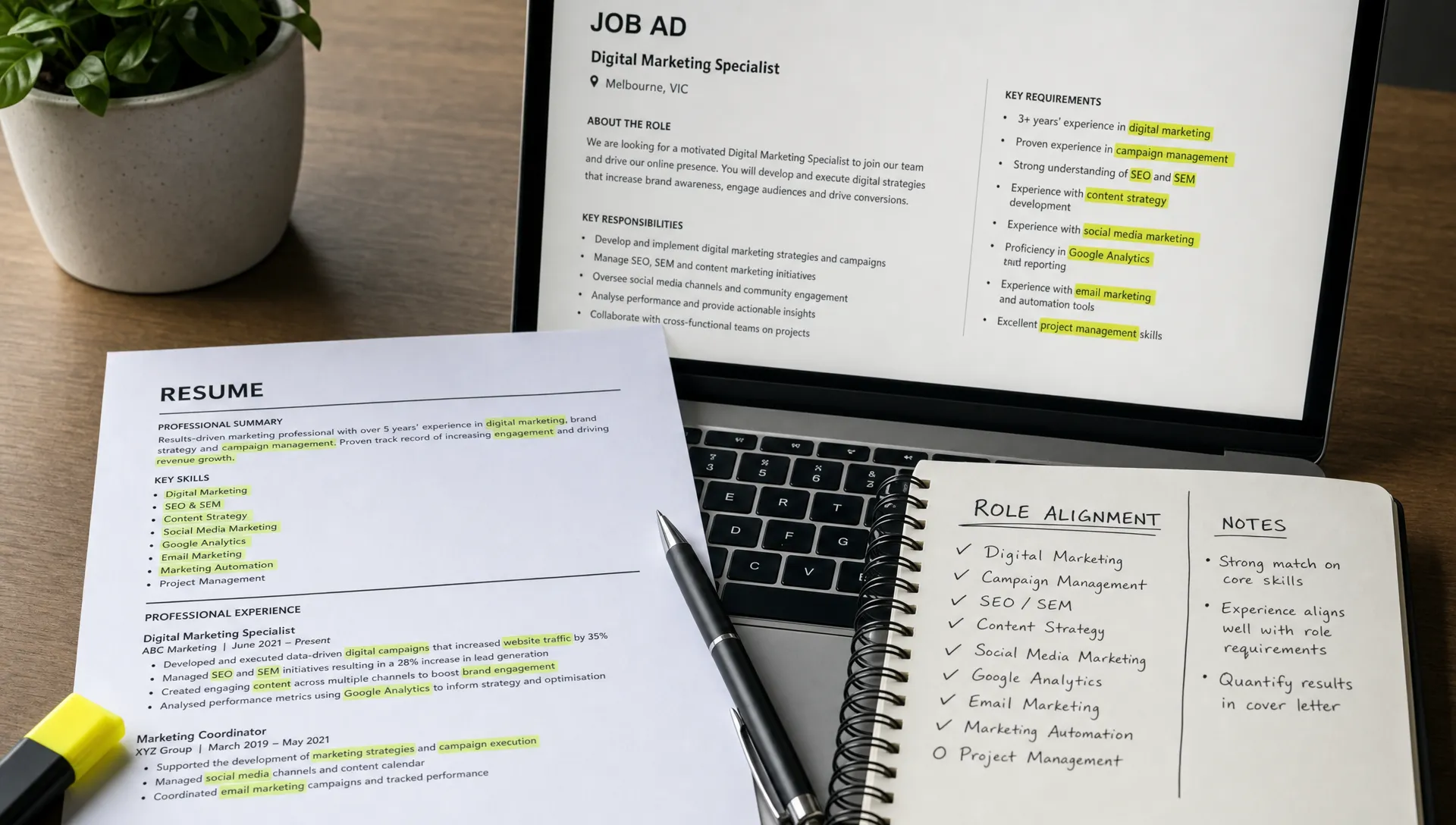
Start by reading the job ad and identifying the main requirements. Look for repeated themes. If the ad mentions customer support, scheduling, CRM use, and problem solving, those are likely more important than a minor requirement mentioned once.
Then choose examples from your background that match those themes. You might keep the same basic structure across applications, but your evidence should change depending on the role.
A practical approach is to keep an evidence bank. This is a simple list of examples from work, study, volunteering, projects, sport, leadership, or community involvement. When you apply for a role, choose the examples that best match the job ad.
This is also where application quality matters more than volume. Sending fewer, better matched applications is often more effective than sending dozens of generic ones. Versadox explains this broader approach in its guide to job hunting strategies for better application results.
What if you do not have much experience?
A cover letter can be especially helpful when you are early in your career.
If you do not have much paid experience, use evidence from other areas. Employers understand that students and graduates may not have years of professional work behind them. What they want to see is potential, reliability, communication, learning ability, and relevant effort.
You can draw from:
- University or TAFE projects
- Internships, placements, or practicums
- Casual or part-time work
- Volunteer roles
- Club, society, or sports leadership
- Personal projects or portfolios
- Group assignments that involved research, presentation, analysis, or coordination
The key is to translate the experience. A retail job is not “just retail” if it proves customer communication, prioritisation, cash handling, complaint resolution, or teamwork. A group assignment is not “just study” if it proves research, collaboration, deadlines, and presentation skills.
What if you are changing careers?
Career changers often need a cover letter because the resume alone may not make the transition obvious.
Your goal is to explain the bridge. Do not spend the whole letter apologising for not having the exact background. Instead, show how your previous experience has prepared you for the new direction.
For example, someone moving from teaching into learning design might highlight curriculum planning, learner engagement, assessment design, and stakeholder communication. Someone moving from hospitality into administration might highlight scheduling, customer service, systems use, cash reconciliation, and fast-paced problem solving.
A career change cover letter should answer the employer’s quiet concern: “Why is this person applying, and can they realistically do this role?” If you answer that clearly, your application becomes easier to consider.
Should you use AI to write a cover letter?
AI can help, but it should not replace your judgement.
The risk of using AI carelessly is that your letter may sound smooth but generic. Employers do not need another polished paragraph about passion, dedication, and growth. They need relevant evidence.
A better way to use AI is to help organise your thoughts, compare your experience with the job ad, identify gaps, and improve clarity. You still need to check that the final letter sounds like you and accurately reflects your background.
This is where career intelligence tools can be useful. Versadox helps job seekers build stronger resumes and cover letters, compare applications against real roles, identify gaps, and make guided improvements before applying. Instead of guessing whether your letter supports the role, you can work from clearer alignment insights and a stronger sense of readiness.
Frequently Asked Questions
What is a cover letter for a job? A cover letter is a short document sent with your resume that explains why you are interested in a specific role and how your skills, experience, or potential match what the employer needs.
Is a cover letter the same as a resume? No. A resume summarises your qualifications, experience, skills, and achievements. A cover letter explains the relevance of that information for a particular job and adds context that may not be obvious from the resume alone.
Do I need a cover letter for every job application? If the employer asks for one, yes. If it is optional, a tailored cover letter can still help when it adds useful context, especially for career changes, graduate roles, or applications where motivation and communication matter.
How long should a cover letter be in Australia? For most Australian job applications, keep it to one page, usually around 250 to 400 words. Focus on the most relevant evidence rather than trying to include every detail.
What should I write if I have no experience? Use examples from study, casual work, volunteering, placements, projects, sport, or community involvement. Focus on transferable skills such as communication, reliability, teamwork, organisation, and problem solving, backed by real examples.
Apply with a clearer story
A cover letter is not just a formality. It is a chance to shape how an employer understands your application.
The strongest letters are not the longest or the most dramatic. They are the clearest. They show why the role fits, why your background is relevant, and what evidence supports your application.
If you want to stop guessing whether your resume and cover letter match the roles you are applying for, Versadox can help you assess alignment, identify gaps, and improve your application before you send it. That way, your cover letter does what it is meant to do: make your fit easier to see.






.svg)